Estimated Reading Time: 14 minutes
Dry skin in winter isn’t your routine failing. It’s the air changing faster than your moisturizer can keep up, and one seasonal switch handles most of it.
The radiator kicks on for the season, and a few days later your cheeks feel tight by mid-morning, the skin along your jaw turns rough, and a flaky patch shows up where nothing was wrong a week ago. Nothing in your routine moved. Same cleanser, same serum, same cream. So, it’s tempting to decide your skin has become difficult, the products stopped working, or you need to go shopping.
None of those are necessarily true. Winter changes the air you live in, indoors and out, and that air now draws moisture out of your skin faster than your skin can replace it. Once you understand that, the fix stops being a cabinet of new products and becomes one decision: a richer moisturizer, used a certain way, for the months that need it.
This post walks through what the cold season does to your skin barrier, why it matters more after 40 and on darker skin, how to tell whether that flaking is buildup or a barrier asking for help, and how to pick and use a winter moisturizer without overbuying. If you’ve been scrubbing dull winter skin or adding steps that haven’t helped, this reframe can save you the cycle. Dry skin in winter is a water problem, and water problems have a simple answer.
In This Post:
- Why does my skin get so dry in winter?
- Is winter flaking buildup or a barrier problem?
- How do I know a moisturizer is rich enough for winter?
- Two creams that meet the winter bar
- What does dry winter skin look like on darker skin?
- Does dry skin in winter get worse after 40?
- What should I change in my routine for winter, and when do I change it back?
- Do I need a humidifier for dry winter skin?
- Should I keep using retinol and exfoliants in winter?
- Go Deeper in the Video
- Dry skin in winter: your questions, answered
- The Bottom Line
- What To Do Next
- Shop With Me
- Sources
Why does my skin get so dry in winter?
Your skin is always releasing a little water into the air around it. The clinical name is transepidermal water loss, and it’s a normal, constant process, not a malfunction. What changes with the season is how fast it happens.
Warm summer air holds more moisture, which slows that loss and lets your skin keep what it has. Cold air holds far less. Then, you step inside, where forced heat has made the air drier still. Low humidity, indoors and out, is associated with higher water loss through the skin and a barrier that struggles to keep up, a pattern described in a 2016 dermatology review of how climate affects the skin barrier (Engebretsen and colleagues, JEADV) and in more recent lab work on dry-air exposure (International Journal of Cosmetic Science, 2025).
That’s the whole mechanism. Tightness, flaking, and rough patches aren’t your skin asking for more water poured on top. They’re your skin losing the water it already had, too quickly, to air that won’t give any back. It helps to keep the dry versus dehydrated distinction in mind here: winter can push even oily or combination skin into a dehydrated state because the air doesn’t care what your skin type is.
Three cities, one set of skin
I learned this from geography before I learned it from a study. Detroit, with more cold months than warm ones, left my skin at its worst every year, no matter how carefully I cleansed and moisturized. A few years in Atlanta, with its warmer and wetter air, and the same skin calmed down on the same routine. Then New York, in an older building where the landlord controlled the thermostat and the radiators ran hot and dry all season. My skin went right back to tight and flaky until a humidifier became part of how I lived. Different cities, different results, identical skin. The air was the variable.
Dana’s Tip: Before you change a single product this month, change one habit. Note how your skin feels one hour after you moisturize, on two or three mornings. If your skin is tight within the hour, it means the formula isn’t holding water in winter air, and that tells you more than any label will.
Is winter flaking buildup or a barrier problem?
This is the question that sends most of us in the wrong direction, so it gets its own answer. When skin goes dull and flaky in the cold, it looks like something sitting on the surface that needs to come off. The instinct is to exfoliate it smooth. For years, that was my instinct too, every single Detroit and New York winter. But that’s not necessarily the case.
Winter flaking is most often a dry, stressed barrier shedding, not a layer of dead cells you failed to remove. Scrubbing a barrier that’s already losing water strips it further, and on darker skin, that irritation is exactly what leaves a mark behind. Exfoliation is still important in the cold months, just less often. If anything, the season is a reason to ease off, not add more. My exfoliation guide for dark spots covers how to dose it when you do.
Here’s how the two read side by side, so you can tell them apart in the mirror rather than guessing.
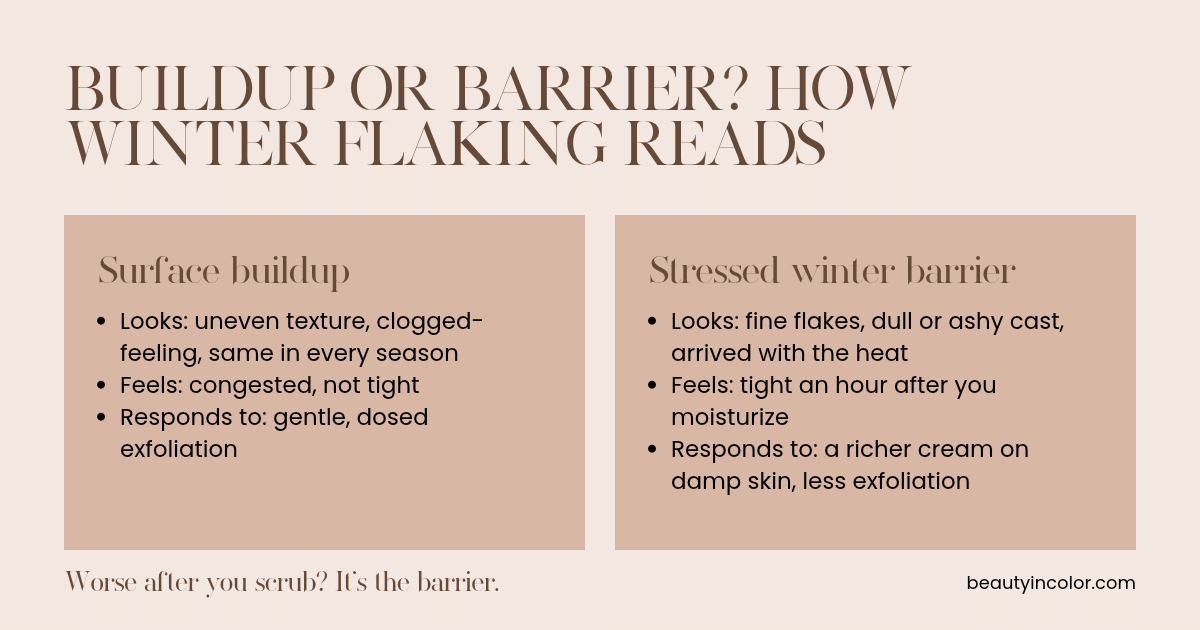
The short version: if the flaking arrived with the heat, comes with tightness, and gets worse after you scrub, you’re looking at a barrier to repair, not buildup. Treat it by sealing in more water, not by rubbing it off.
How do I know a moisturizer is rich enough for winter?
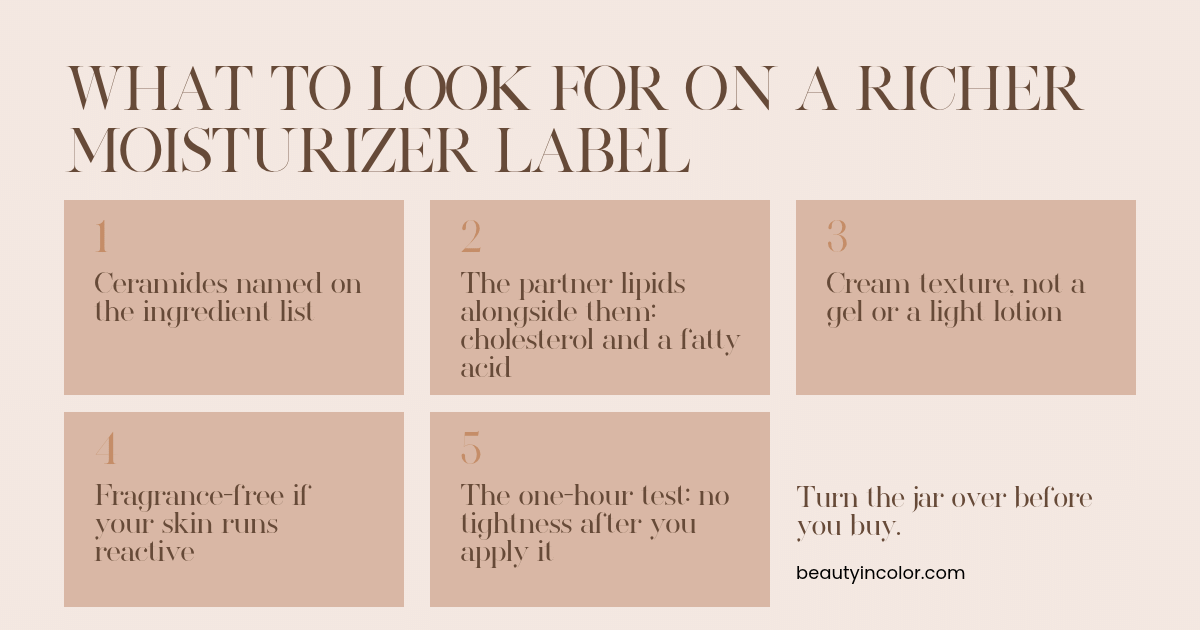
“Richer” sounds vague, so let’s make it concrete. A winter moisturizer has one job the summer one didn’t need to do: hold water in the skin while the air outside works against it. Texture is a clue (a cream rather than a gel or a light lotion), but the label tells you more than the feel.
Ceramides are the first thing I look for. They’re a family of lipids your barrier is partly made of. So, a cream built around them is replacing what the season strips out rather than just sitting on top. Look for them named on the ingredient list, ideally alongside the other barrier lipids, cholesterol and fatty acids. If you want the deeper explanation of what ceramides do, my ceramides guide covers it. If your skin is on the reactive side, as mine is, a fragrance-free formula counts for as much as the ingredient list. Winter is not the season to introduce a scented formula to a barrier that’s already under strain. For the full method on reading a moisturizer label, start with my moisturizer-selection guide for dry, reactive skin.
Use this as a checklist when you turn a jar over in the store or on your own shelf.
Two creams that meet the winter bar
Once you know what you’re looking for, the specific jar matters less than people think. Two meet my own bar, and they’re the two I rotate through the cold months. The Skinfix Triple Lipid-Peptide Cream is formulated around the same three barrier lipids your skin’s own seal is made of. The Dieux Instant Angel is a lipid-rich, fragrance-free cream that hydrates while it reinforces. Both were gifted to me originally; I’ve since paid for each of them myself, and they’re the two I alternate through the cold months. Neither is the only right answer. If you’d rather compare options, my Hydrate, Then Seal collection is the seal-step edit, the richer creams and the serums that go under them, so you can pick the one that suits your skin and your wallet.
Dana’s Tip: Check your own cabinet before you check out. The cream that seemed too much for a July morning is often the exact texture your skin wants in January. Swap it onto the shelf for the season, and you may not need to buy anything at all.
What does dry winter skin look like on darker skin?
Most winter skin advice stops at “dry and tight.” For Black women, the season shows up in two ways that advice often skips.
The first is ashiness. That grey, flat cast that shows up on parched, flaking skin isn’t dirt, and it isn’t a cleansing problem. It’s the skin’s surface gone dry enough to scatter light differently, and it goes away when water returns, not when you scrub harder.
The second is the mark. A barrier that stays dry and stressed gets irritated more easily, and irritation on darker skin tends to respond with pigment rather than redness. Post-inflammatory hyperpigmentation is more frequent and often more persistent in skin of color, and barrier compromise is one path to it, because inflammation drives the pigment response (Davis and Callender, 2010). So, a winter of cracked, irritated skin can hand you new marks to deal with in the spring. That’s why, for us, winter dryness is more than a comfort issue. If you’re already working on marks, my post on hyperpigmentation on Black skin explains why they linger and what helps.
Does dry skin in winter get worse after 40?
Yes, and it isn’t your imagination. Two things shift. In your 40s and beyond, your skin produces less of its own oil, and that oil helps hold the barrier shut and keep water in. Add to that a skin barrier that’s slower to repair: once the barrier takes a hit, it tends to recover more slowly than it did in our 20s and 30s. Both patterns are described in research on aging skin (Kremer and Burkemper), with the caveat that most of those measurements come from much older cohorts, so the direction is well supported, but the exact numbers for the 40s are not.
The practical translation: nothing is broken in your 40s. Your skin just has less cushion and recovers more slowly. The winter that didn’t faze you ten years ago now shows on your face, and it needs a little more help holding on to water. That’s a reason to adjust, not a reason to panic or overhaul everything you own.
What should I change in my routine for winter, and when do I change it back?
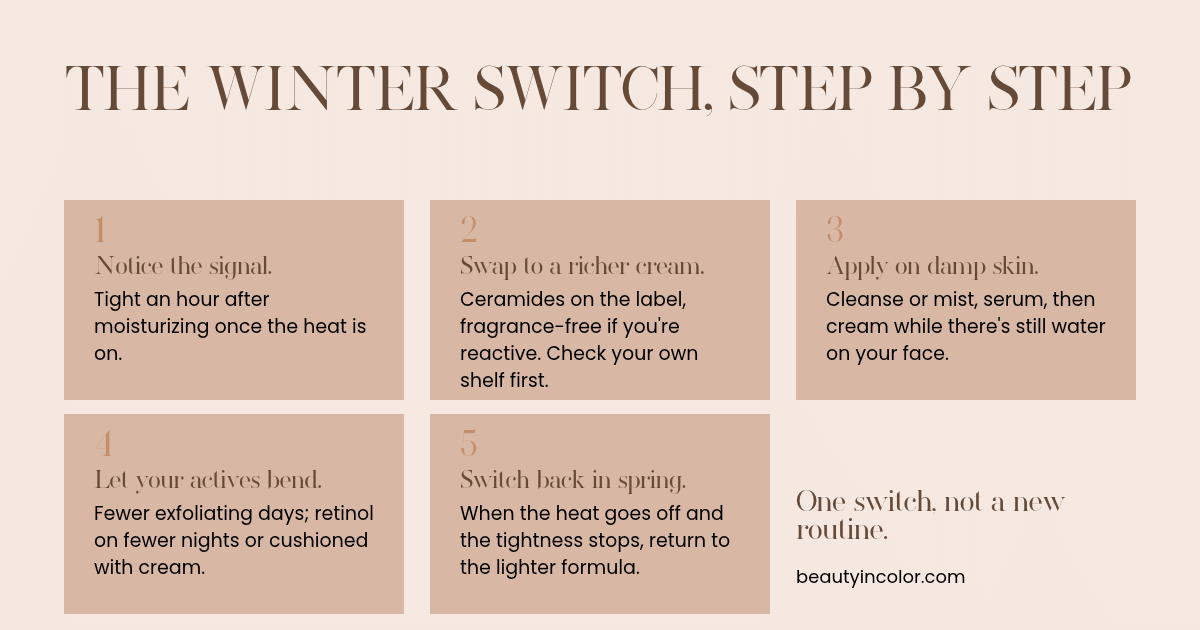
One switch. Trade the lighter formula for a richer cream that seals, and when the season turns and the air warms up, switch back. That’s the entire routine change, and it costs nothing if the richer cream is already in your cabinet. A lighter moisturizer works well in warm weather because humid air is doing part of the job for you. Winter air doesn’t provide any help with moisture, so the cream has to carry more of the load.
There’s one more piece, and it’s about timing rather than product. Apply your moisturizer while your skin still has a little water on it, not after it’s dried completely. After cleansing or misting, apply your serum, then your cream, while your face is still faintly damp. That way, the cream has water to hold on to. It’s a small change that does a surprising share of the work, which is why the video spends a full beat on it.
Here’s the sequence in order, so you can save it and stop thinking about it.
Dana’s Tip: Keep the summer cream. Don’t give it away or push it to the back of the drawer. When your skin stops feeling tight after moisturizing, usually as the heat goes off for the year, that’s your signal to switch back. The richer formula was for the season, not forever.
Do I need a humidifier for dry winter skin?
I can only answer this one from my own bathroom, so take it that way. In the New York apartment where I didn’t control the heat, a humidifier was the difference between skin that stayed cracked all winter and skin that had a chance. It didn’t replace the richer moisturizer; it made the air in the room less hostile so the moisturizer had less to fight.
If you live somewhere with forced heat you can’t adjust, or you wake up with a tight face and a dry throat, it’s worth trying, especially in the bedroom overnight. If your skin settles down with the moisturizer switch alone, you don’t need one. It’s a support, not a requirement, and I’d never tell you to buy a device before you’ve changed the one thing that costs nothing. If you do want one, mine is a Carepod. You can use my code BEAUTYINCOLOR for at least 10% off.
Should I keep using retinol and exfoliants in winter?
Keep them, but let them bend. Your actives should follow your barrier’s lead, never the other way around.
Exfoliation gets the biggest cut, for the reasons above: the flaking you want to remove is usually the barrier shedding, and more friction feeds the irritation that leaves marks. Drop the frequency for the season rather than stopping entirely, unless your skin is visibly raw.
Retinol is more forgiving, but watch it. If your skin turns tight or flaky on retinol nights after the heat comes on, scale back to fewer nights while it’s cold, or buffer it with your moisturizer. If you’re new to it, winter is a reasonable time to go slowly; my guide on how to start retinol covers the gentler approach. The goal is to come out of March with your barrier intact and your actives still in the routine, not to prove you can tolerate everything in January.
Three questions to ask yourself before you change your moisturizer for the winter:
- Is your face tight an hour after you moisturize?
- Is the cream on your shelf the same one from summer?
- Does it go on fully dry skin?
One yes is enough to act on.
Go Deeper in the Video
This blog post gives you the method, but the YouTube video offers more practical detail. In it, I walk through the three cities that taught me how much the air matters, show the two creams I alternate through winter and how I decide between them on a given night, and demonstrate the damp-skin timing on camera, which is easier to see than read. If you’re a watcher more than a reader, start there: Dry Skin in Winter: What Indoor Heat Does to Your Barrier, and the Switch to Make.
Dry skin in winter: your questions, answered
- Why is my skin so dry in winter even though I moisturize?
Because the moisturizer that was enough in humid air isn’t enough in dry air. Cold outdoor air and heated indoor air both draw moisture from your skin more quickly, so a lighter formula can’t hold the line. The fix is usually a richer cream, applied to damp skin, not more layers of the same one. - Is ashy skin in winter the same as dry skin?
Ashiness is what dryness looks like on darker skin. That grey, dull cast is the surface gone parched and flaky, and it responds to water and a seal, not to scrubbing. If it clears when you moisturize well, it was dryness. - Should I exfoliate flaky winter skin?
Usually less than you want to. Winter flaking is most often a stressed barrier shedding, and exfoliating it harder strips the barrier further and can leave marks on darker skin. Ease off for the season and let the richer moisturizer do the work first. - What ingredient should a winter moisturizer have?
Ceramides are the first thing to look for, ideally alongside cholesterol and fatty acids, since those are the lipids your barrier is made of. If your skin is reactive, fragrance-free matters just as much as the ingredient list. - Can I use the same moisturizer all year?
You can, but if your skin feels tight within an hour of applying it once the heat comes on, it’s telling you the formula is too light for the season. Switching to a richer cream for winter and back in spring is one of the simplest changes with the biggest payoff. - Does drinking more water fix dry skin in winter?
Hydration matters for your whole body, but winter dryness is mostly about water leaving through the skin’s surface into dry air. The lever that addresses that is what you put on the skin and when, not only what you drink.
The Bottom Line
Winter isn’t a signal that your skin needs more. It’s a signal that the air, frigid outdoors and heated indoors, is drawing water away faster than your barrier can hold it, and after 40 and on darker skin, that costs more than comfort. It can cost you a season of irritation and the marks that follow.
The answer is one seasonal switch. A richer moisturizer, built around the lipids your barrier is made of, fragrance-free if your skin is reactive, applied to damp skin, and swapped out when the air warms up. Everything else bends around that: the exfoliating, the retinol, the humidifier.
Tonight, pull the heaviest cream you already own off the shelf and put it on damp skin. Start there before you buy anything.
What To Do Next
- Watch the full lesson, including the damp-skin demonstration: Dry Skin in Winter on YouTube.
- Compare the richer creams and the serums that go under them in the Hydrate, Then Seal collection, the seal-step edit, organized so you can see what each one does before deciding whether it belongs in your routine.
- Get the personal side of each week’s lesson on Thursdays: join the newsletter.
Shop With Me
The products I keep in rotation plus my budget-friendly picks, all in one place.
Sources
- Engebretsen et al., Journal of the European Academy of Dermatology and Venereology, 2016 (review). DOI 10.1111/jdv.13301.
- International Journal of Cosmetic Science, 2025 (low humidity and transepidermal water loss, laboratory model). PubMed 39935117.
- Kremer and Burkemper. Aging Skin and Wound Healing. PMC3840548.
- Davis and Callender, Journal of Clinical and Aesthetic Dermatology, 2010 (post-inflammatory hyperpigmentation in skin of color). PMC2921758.
- Transepidermal water loss in healthy adults: a systematic review and meta-analysis update. PubMed 30022486.