Estimated reading time: 10 minutes
Exfoliation is one of the best things you can do for dark spots and one of the fastest ways to create them. If you have darker skin, the difference comes down to one thing: the dose.
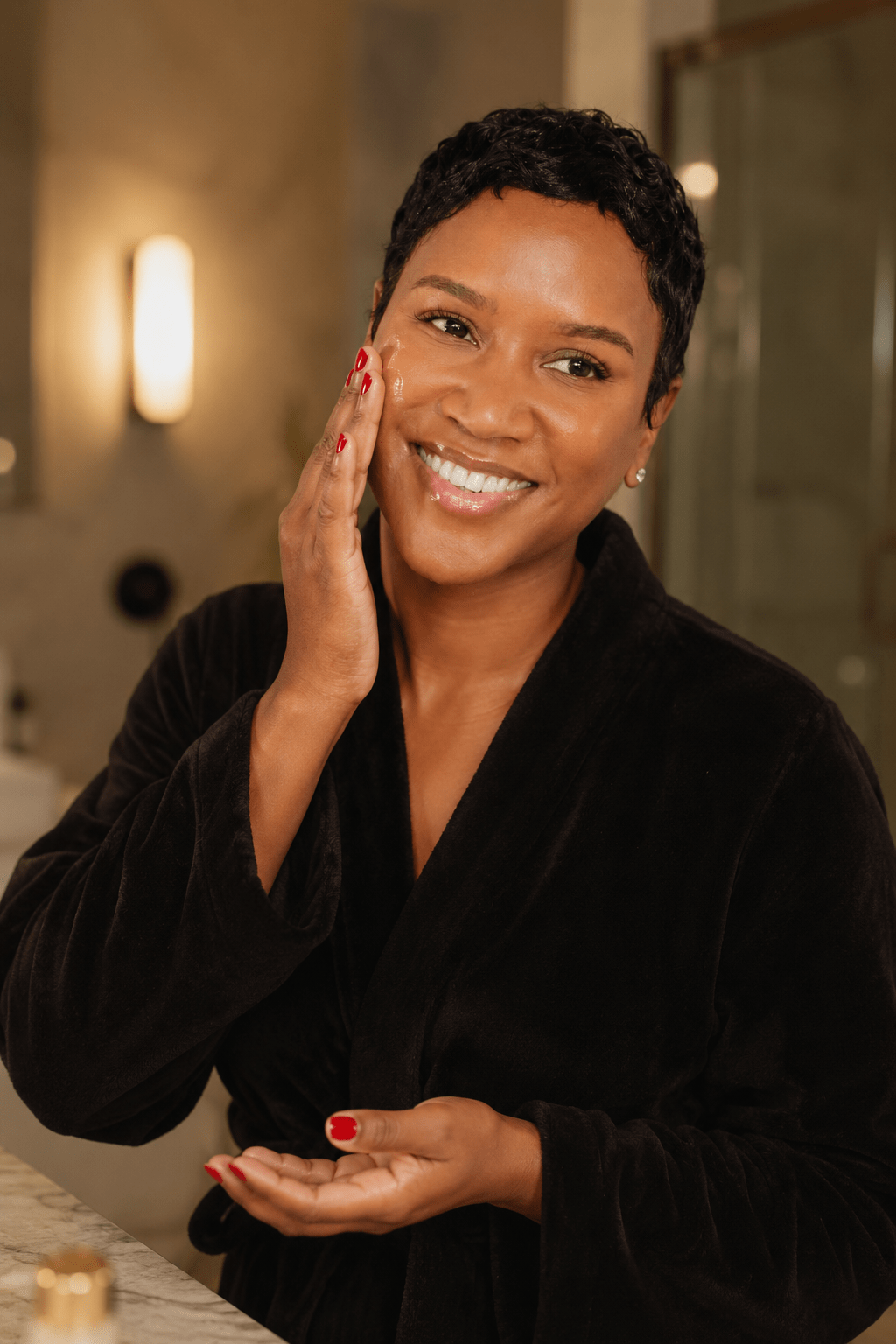
If you searched for exfoliation for dark spots, you’ve probably already felt both sides of this. The first few times you exfoliate, your skin looks smoother and clearer, and makeup sits better the next morning. Then somewhere along the way a patch shows up darker than it started, and now you’re not sure whether to keep going or stop completely. That confusion is fair, and it’s why this guide exists.
Here’s what changes everything once you see it. Exfoliation isn’t really a step you add to a routine. It’s a dose. And for melanin-rich skin, the goal is the smallest dose that still works, because when we overdo it, we don’t just pay in dryness. We pay in marks that can last for months. This article walks you through what exfoliation does, how to choose the right kind for your skin, how often to actually do it, the warning signs that you’ve crossed the line, and what to do if you already have.
In This Post:
- What Exfoliation Actually Does (and Why the Results Feel So Fast)
- Why Dark Spots Are the Real Risk for Black Skin
- How to Choose Your Exfoliant
- How Often Should You Exfoliate?
- The 5 Signs You’ve Over-Exfoliated
- What to Do If You’ve Already Gone Too Far
- Go Deeper in the Video
- Exfoliation for Dark Spots FAQ
- The Bottom Line
- What To Do Next
- Shop With Me
- Sources
What Exfoliation Actually Does (and Why the Results Feel So Fast)
Your skin is always making new cells and shedding old ones. As we move through our 40s, that shedding slows down, so dead cells sit on the surface a little longer. That buildup is what can leave skin looking dull and feeling rough, and it can hold surface discoloration in place. Exfoliation clears that layer, which is why skin can look brighter and feel smoother quickly.
That speed is exactly the trap. Most of skincare asks you to wait weeks for a payoff. Exfoliation rewards you the same night, so the instinct is to reach for it again tomorrow. That instinct is where the trouble starts. Think of an exfoliant less like a daily cleanser or moisturizer and more like a measured dose. The right amount can help. More than that doesn’t help more. It sets you back.
Dana’s Tip: If a product makes your skin look smoother the very first night, treat that as a reason to go slower, not faster. Fast results are a signal that the ingredient is active, and active is exactly what you want to dose carefully.
Why Dark Spots Are the Real Risk for Black Skin
Most of the dark spots women tell me about didn’t just come from a breakout. They came from the scrub or the acid that was supposed to smooth things out. Not because the product was bad, but because you used it past what your skin could handle.
The short version of why: when you exfoliate beyond your skin’s limit, you damage the barrier, and barrier damage shows up as inflammation. In Black skin, inflammation tells your pigment cells to respond quickly and generously, which is how post-inflammatory hyperpigmentation, or PIH, forms. PIH is simply the extra pigment left behind after that inflammation. If you want the full mechanism, I break it down in my guide to dark spots in Black skin. For today, the takeaway is that in our skin, irritation and dark spots are the same conversation.
This isn’t only my read on it. The American Academy of Dermatology advises that people with darker skin tones avoid strong chemical or physical exfoliation, because aggressive exfoliation can lead to new dark spots (American Academy of Dermatology, How to Safely Exfoliate at Home). Gentle isn’t a beginner setting we grow out of. For Black skin, gentle is the whole strategy.
How to Choose Your Exfoliant
There are two families of exfoliants, plus one hidden category most of us forget we’re using.
Chemical vs Physical: Why a Dose You Can Control Wins
Chemical exfoliants are ingredients that loosen the bonds holding dead cells so they release on their own. Physical exfoliants work by friction: scrubs, brushes, grainy polishes. For darker skin, gentle chemical exfoliation is usually the safer lane, and the reason is simple. A scrub adds a variable nobody’s measuring, which is your own hand: the pressure, the speed, that one extra pass on your cheek. An acid at a set strength is a dose you can actually control. If you love your scrub, it isn’t banned. It just stops being the default, and a light hand matters.
The Acid Ladder: Start at the Bottom
Within chemical exfoliants, it helps to picture a ladder and start at the bottom. Molecule size drives how fast an acid moves into skin, and slower penetration generally means less irritation.

In the studies that actually included deeper skin tones, gentler mandelic-based treatments held their own against stronger glycolic for evening out tone, with better tolerability (Garg, Sinha and Sarkar, 2009). So gentle isn’t the compromise here. Gentle is how you get the result without the marks. Glycolic isn’t off limits. It’s the acid you earn your way up to, not the one you start with.
The gentle acids I point people to live in EXFOLIATE THE RIGHT WAY COLLECTION, organized gentlest-first so you can compare what each one does before deciding whether you need it at all.
The Hidden One: Exfoliating Cleansers
An acid in a cleanser is the shortest possible dose because it rinses off in under a minute, making it one of the gentlest ways to begin. It also makes it easy to miss. Many products labeled for a brighter finish are exfoliants that don’t announce themselves. If you use one, count it. This connects back to something I covered in the cleanse step, where I promised to come back to exfoliating cleansers. Here they are.
How Often Should You Exfoliate?
This is the number everyone wants, so here it is. Start with one night a week, using the gentlest option on the ladder, and stay there for two full weeks before you change anything. Then let your skin decide. If it stayed calm and comfortable, you can try a second night. For many of us, twice a week is the ceiling, not the floor. A label might say daily, but the label wasn’t written for your face.
A simple starting protocol:
- Weeks 1 to 2: one gentle acid night per week. Nothing else new.
- Week 3 onward: if your skin stayed calm, consider a second night. If anything felt off, hold at one.
- Every morning after an exfoliating night: sunscreen, no exceptions.
That last point is not optional. Alpha hydroxy acids can make skin more sun-sensitive while you use them and for about a week after you stop, which is why the FDA asks brands to print a sunburn alert on these products (U.S. Food and Drug Administration, Alpha Hydroxy Acids). If you exfoliate at night, you wear sunscreen in the morning. That’s the whole contract. One more pairing to keep straight: retinol isn’t an exfoliant, and when you’re starting out, acid nights and retinol nights shouldn’t be the same night. If you’re building retinol in, my guide on how to start retinol walks through that.
The 5 Signs You’ve Over-Exfoliated
Your skin will tell you when the dose is too high. Watch for these five signs:
- Stinging when you apply products that never used to sting.
- Tightness that a moisturizer doesn’t settle.
- A shiny, tight look that isn’t the same as healthy.
- Warmth in your cheeks after you rinse.
- New darkening, or an ashy, rough patch where you’ve been exfoliating.
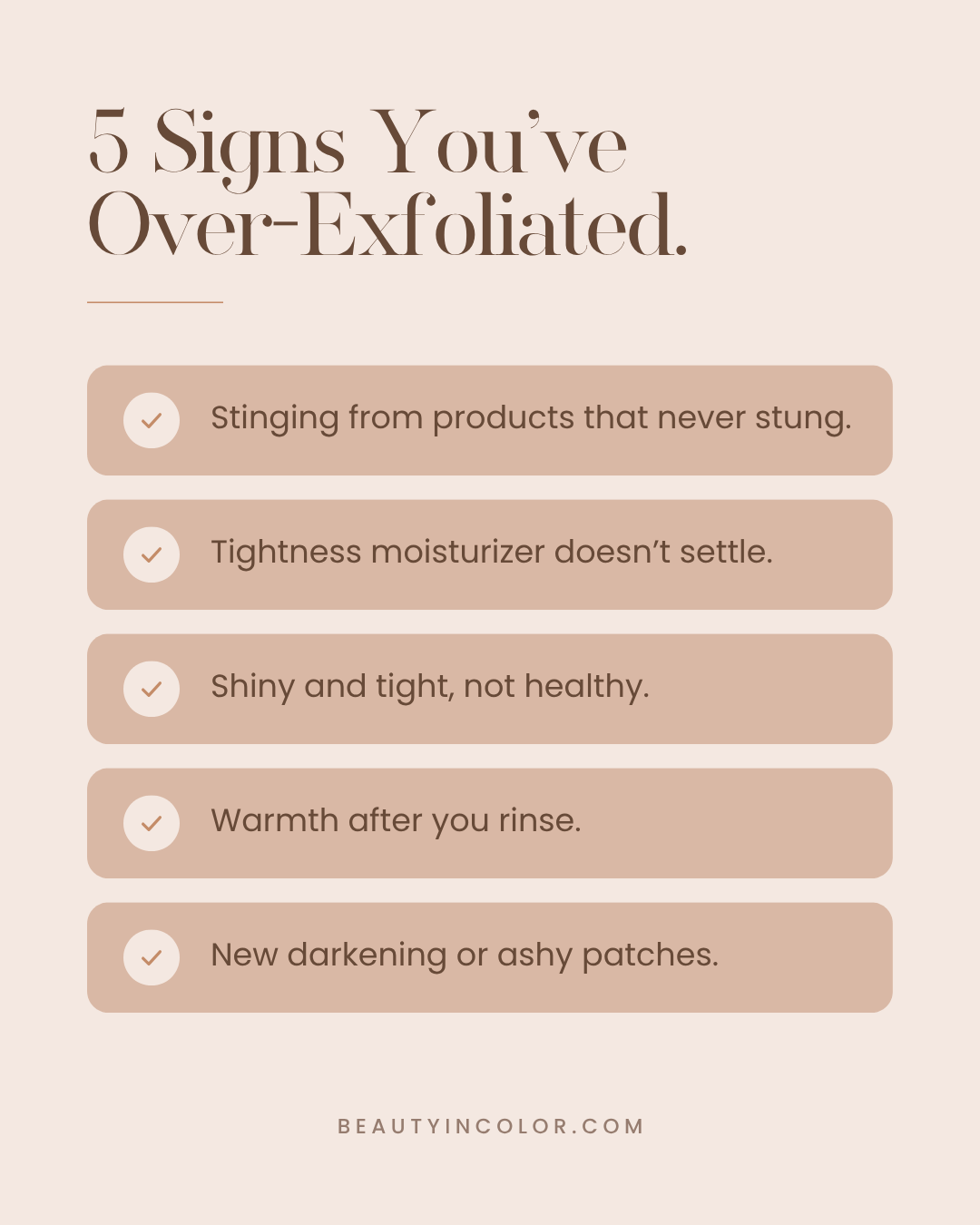
A little more smoothness is fine. Any of the signs above is your cue to cut back, not push through. The difference between a mild adjustment and pause-worthy irritation is whether the feeling settles on its own within a day or keeps building.
Dana’s Tip: Before you add anything to calm irritated skin, remove what’s causing it. More often than not, the fix is fewer doses for two weeks, not a new soothing product on top of the problem.
What to Do If You’ve Already Gone Too Far
If you’re reading this thinking that red, tight, slightly burning stage is me right now, here’s the plan. Stop all of it, every acid and every scrub, starting today. Skin in that state needs barrier repair before it can handle another dose of anything, and I have a full walk-through in my guide to repairing your skin barrier.
Two more mistakes worth naming, because they’re common and they backfire. The first is exfoliating harder right on a dark spot to fade it faster. The extra irritation can deepen the exact spot you’re working on. Fading existing dark spots is its own routine, not more exfoliation. The second is stacking doses without realizing it. Which brings us to the most useful thing you can do tonight.
The hidden-dose audit. Turn over everything in your routine that exfoliates and count it:
- Your cleanser (is it a brightening or resurfacing formula?)
- Any acid toner or essence
- Serums with AHAs or BHAs
- Weekly masks or peels
- Scrubs and cleansing brushes
- The washcloth or disposable face towel you use every day, which counts as mild physical exfoliation
That last one surprises people. A soft towel used daily is gentle, but it still counts as a dose, especially if you press or scrub with it. If you want a truly soft, single-use option so the towel isn’t adding friction, I reach for the Clean Skin Club Clean Towels as my everyday face towel, and code BEAUTYINCOLOR takes 20% off.
If your audit list is longer than you expected, you may not need a new product. You may need fewer doses.
Go Deeper in the Video
The companion video walks through the acid ladder out loud, shows the difference between a controlled dose and a scrub, and includes my own over-exfoliation story, told the way it happened. If you learn better by seeing the routine in motion, start there.
Exfoliation for Dark Spots FAQ
- Can exfoliation actually help with dark spots?
Yes, gentle and consistent exfoliation can help clear the surface buildup that holds discoloration and can support a more even-looking tone over time. The key word is gentle. Overdoing it can create new spots faster than it fades old ones. - How often should you exfoliate melanin-rich skin?
Start with one night a week and hold there for two weeks. If your skin stays calm, a second night may be fine. For many people with darker skin, twice a week is the ceiling. - What are the signs of over-exfoliation?
New stinging, tightness a moisturizer won’t settle, a tight shiny look, warmth after rinsing, and new dark or ashy patches. Any of these means cut back and let your barrier recover. - Is chemical or physical exfoliation better for dark skin?
For most people with melanin-rich skin, a gentle chemical exfoliant at a set strength is easier to control than a scrub, where your hand adds unpredictable pressure. If you love a scrub, use a light hand and count it as a dose. - Do I still need sunscreen if I exfoliate at night?
Especially then. AHAs can raise sun sensitivity during use and for about a week after you stop. Daily sunscreen is what keeps an exfoliating routine from becoming a spot-making routine.ore.
The Bottom Line
Exfoliation works, and it’s genuinely one of the most satisfying things you can do for your skin. For melanin-rich skin, the win comes from the smallest dose that still works, held steadily, with sunscreen every morning. The right amount can help fade the look of dark spots. Anything past it is how new ones start.
Start with one gentle night a week, hold it for two weeks, and let your skin, not the label, set the pace from there.
What To Do Next
- Watch the companion video for the full walk-through.
- Already working on spots you have? Start with my dark spot fade routine.
- Want the gentle exfoliants and barrier support in one place? Browse EXFOLIATE THE RIGHT WAY COLLECTION, organized gentlest-first.
- Get the weekly email that goes beyond each video: join Beauty In Your Inbox.
Shop With Me
The products I keep in rotation plus my budget-friendly picks, all in one place.
Sources
- American Academy of Dermatology. How to Safely Exfoliate at Home. aad.org
- U.S. Food and Drug Administration. Alpha Hydroxy Acids. fda.gov
- Garg VK, Sinha S, Sarkar R. Glycolic acid peels versus salicylic-mandelic acid peels in active acne vulgaris and post-acne scarring and hyperpigmentation: a comparative study. Dermatologic Surgery. 2009;35(1):59 to 65. PMID 19018817.