EST READING TIME: 11 minutes
By the time you finish reading, you will know what double cleansing actually is, why the cleanse step matters more than it gets credit for, whether your skin needs a double cleanse or not, and how to pick a cleanser that leaves your face comfortable. You will not need to add a single new product to start.

Double cleansing has been sold as a nightly rule for a while now, but the honest version is smaller than the marketing. Most skin needs it on some nights and not others. And if your face feels tight and squeaky after you wash, that is worth noticing, because it usually means the cleanser took more than it should have.
This is a plain-language guide to the whole question: what double cleansing is, why cleansing is worth getting right in the first place, when a second cleanse earns its place and when it does not, and how to keep any cleanse gentle enough that it helps your skin instead of wearing it down.
In This Post:
- What Is Double Cleansing?
- Why Cleansing Is Worth Getting Right
- Do You Actually Need to Double Cleanse?
- How Often Should You Double Cleanse?
- Can a Cleanse Be Too Much?
- How to Choose a Cleanser That Does Not Strip Your Skin
- Double Cleansing and Melanin-Rich Skin
- Double Cleansing FAQ
- The Bottom Line
- What To Do Next
- Shop With Me
- Sources
What Is Double Cleansing?
Double cleansing is what it sounds like: two cleanses back-to-back, done in a set order. The first pass is oil-based and the second is water-based, and the order is the whole point.
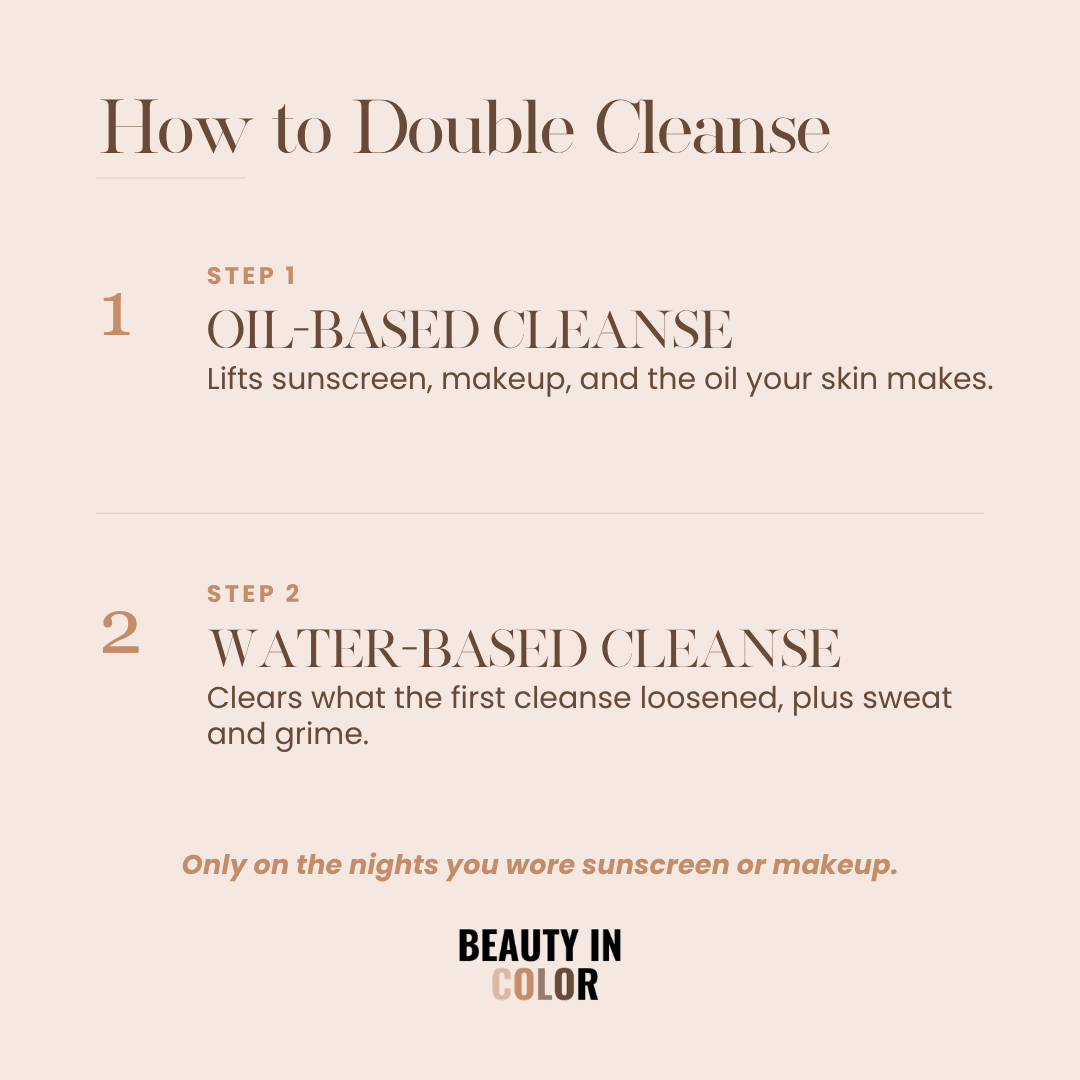
The first cleanse handles the oil-based things sitting on your skin: sunscreen, makeup, and the oil your skin makes through the day. An oil cleanser loosens those far more effectively than water can. One study of cleansing methods found that water on its own left more than half of a sunscreen behind, a regular cleanser removed more, and only an oil-based cleanser reliably took off waterproof sunscreen.1
The second, water-based cleanse then clears what the first one loosened, along with sweat and everyday grime. If oil cleansing is new to you, I break down how to pick and use one in my guide to oil cleansers.
Why Cleansing Is Worth Getting Right
Cleansing sits first in a routine for a practical reason, not a ceremonial one. Whatever you apply next – a serum, a treatment, a moisturizer – can only do its work if it can reach the surface of your skin.
Picture your face at the end of an ordinary day. It is carrying sunscreen, any makeup you wore, the oil your skin produced over the hours, sweat, and the grime that settles out of the air. Layer an active over all of that and a good share of it never lands where you wanted it. There is a second cost, and it turns up in your pores: sunscreen and makeup that sit overnight are a frequent driver of clogged pores and breakouts, because these products were built to hold up through a day of wear, not to spend sixteen hours pressed into your skin.
So a good cleanse is not the throat-clearing before the real routine. It is what decides whether the real routine lands, and it is the cheapest way to get more out of the products you already own.
Do You Actually Need to Double Cleanse?
Sometimes, not every night. Double cleansing got marketed as a daily ritual, and for a lot of us that is more than our skin asks for.
The deciding question is small: did you wear sunscreen or makeup today? If you did, a double cleanse that night is worth it, because a single water-based wash does not fully break those down on its own. If you did not, one gentle cleanse is plenty. A bare face does not need two passes. Double cleansing answers to your day, not to a rule printed on a jar.
Dana’s Tip: On a bare-faced day, let the second cleanse go completely. One gentle wash has done the whole job. That is not cutting corners, it is matching the cleanse to what your skin actually carried.
How Often Should You Double Cleanse?
Only on the nights you actually wore sunscreen or makeup, and only at night. You do not double cleanse a bare face, you do not do it in the morning, and you do not need it twice a day.
Mornings are their own small question. It is worth washing rather than only splashing water, because your skin makes oil while you sleep and it collects on your pillowcase overnight. Here is a check you can run tomorrow: before you put anything on your skin, pass a damp cloth over your face. Whatever shows up on the cloth is what a plain rinse would have left behind. Most mornings there is something, and one gentle cleanse clears it.
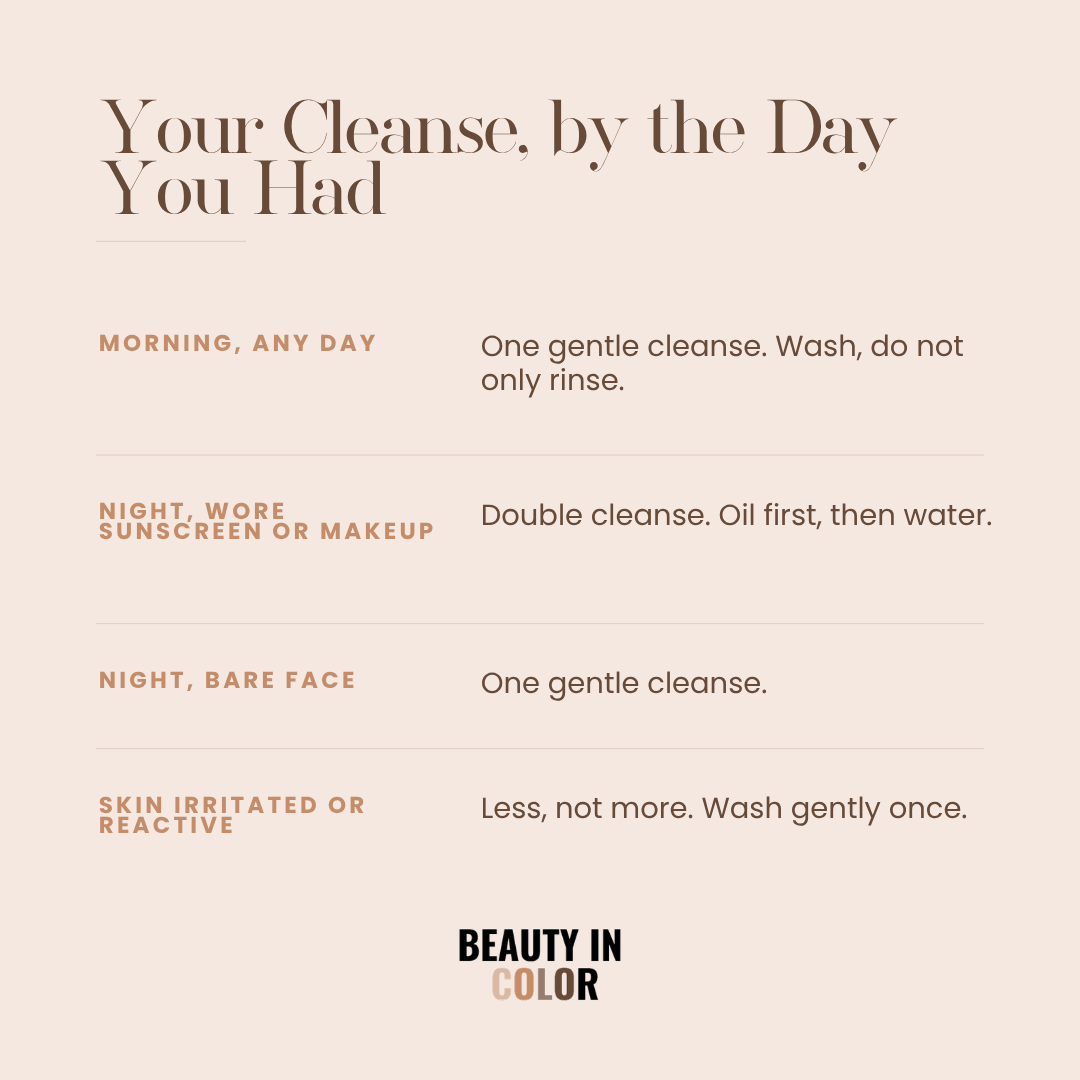
Quick reference: your cleanse by scenario:
- Morning, any day: one gentle cleanse. Wash, do not only rinse.
- Night, wore sunscreen or makeup: double cleanse. Oil-based first, water-based second.
- Night, bare face: one gentle cleanse.
- Skin already irritated or reactive: less, not more. Wash gently once and give it a rest.
Can a Cleanse Be Too Much?
Yes, and over-cleansing is the more common problem of the two. A lot of us were taught to treat tightness as proof that a wash worked. It is closer to a warning light. When your skin feels tight and squeaky, a cleanser has usually gone past the grime and taken some of the oils your skin needs to stay comfortable. Two ingredients are worth knowing by name.
Sodium Lauryl Sulfate
SLS is a strong detergent, and it is the ingredient behind a big, satisfying lather, the kind that feels like evidence the cleanser is working. It is used in laboratory research specifically to break down the skin barrier under controlled conditions, which tells you how dependably irritating it can be.2 On everyday skin, it can raise water loss and leave you drier and quicker to react. Keep it in proportion, though. Nearly all of that testing is patch-based, with the ingredient left on the skin for hours.3 A cleanser is on your face for well under a minute, so a single SLS wash will not undo your skin. But if you run dry, sensitive, or reactive, it is an easy ingredient to retire, and the difference is often one you can feel.
Fragrance
Fragrance matters less in something you rinse off than in a product you leave on all day. Still, for skin that is sensitive or eczema-prone, it is among the more common triggers, and a face wash has no real need to be perfumed.
Dana’s Tip: You do not have to bin a cleanser that lists SLS. If your skin leans dry or reactive, save it for the occasional heavy-makeup night and reach for something milder the rest of the week.
How to Choose a Cleanser That Does Not Strip Your Skin
You have five formats to work with, and you do not need one of each. The format matters less than a single standard that holds across all of them: once you rinse, your skin should feel calm and comfortable, never tight or squeaky, and never so parched it is begging for moisturizer just to feel normal.
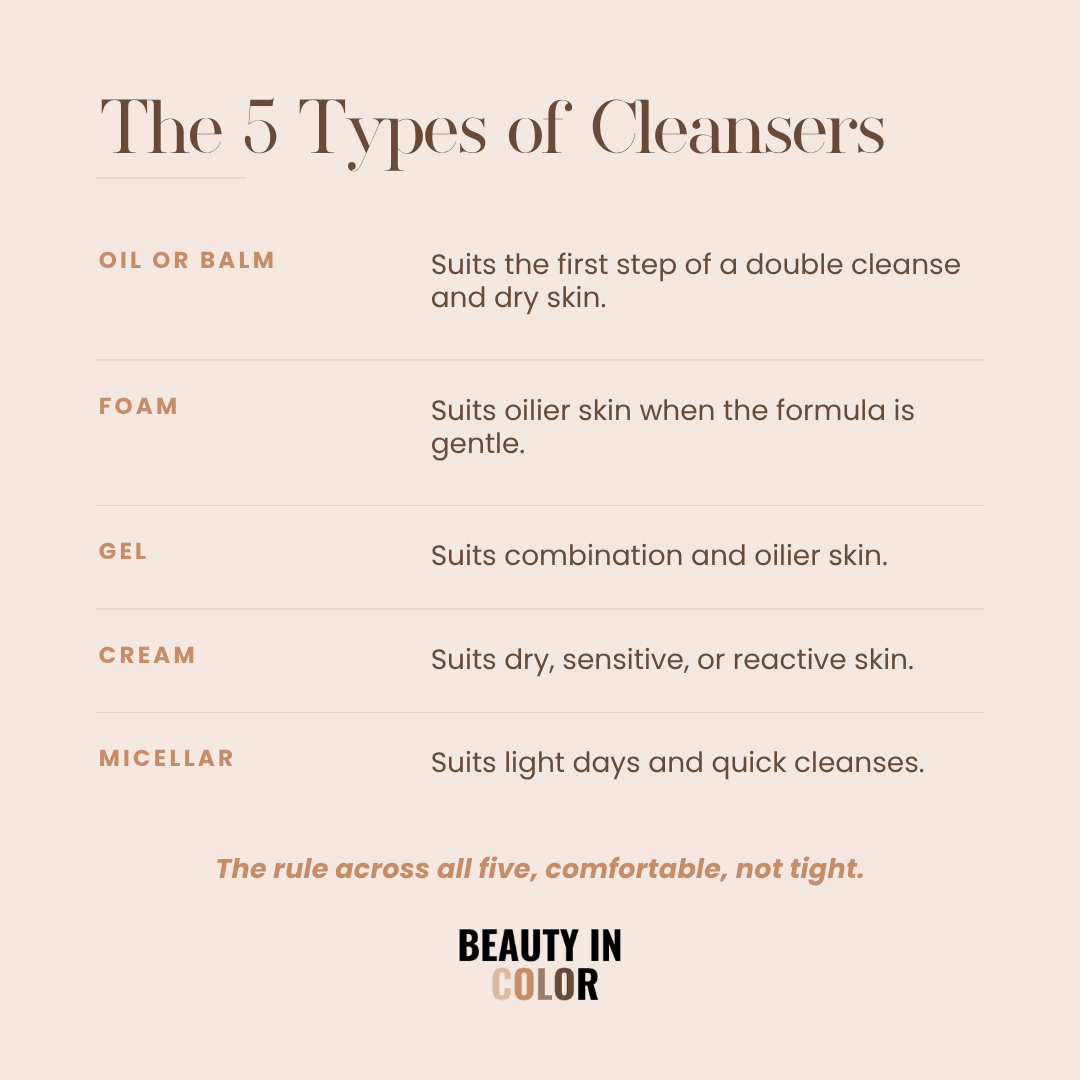
If washing leaves your skin feeling raw and depleted, that cleanser is wrong for you, no matter how it reviews. How your skin feels afterward is the review that counts. For a fuller walk-through of matching a formula to your skin, see my guide on how to choose the best face cleanser.
Dana’s Tip: When you are trying a new cleanser, check in about a minute after you rinse, before any other product goes on. If your skin already feels tight, you have your answer.
Double Cleansing and Melanin-Rich Skin
For Black skin, the stakes on all of this run higher, and it is worth naming why. Repeated stripping creates irritation, and in melanin-rich skin irritation rarely passes quietly. Inflammation is one of the more reliable triggers of post-inflammatory hyperpigmentation, or PIH, the dark marks that surface after skin has been irritated and then linger for months. For the full mechanism, see the guide on dark spots in Black skin.
Seen that way, an aggressive cleanse is not a small thing. Chasing a stripped-clean feeling night after night can set up a mark you spend the next season trying to fade, the kind of discoloration the dark-spot routine then has to work to undo. For us, gentleness at the sink is less a preference than a form of pigment protection, quiet, steady insurance that your tone stays even. If your barrier is already worn down, meaning your skin has been reactive and raw for a while, that is a repair project to handle before anything else.
But, double cleansing doesn’t mean you have to use an oil-based cleanser followed by a water-based cleanser. If you prefer to use a cream or milk-based cleanser as your first cleanse and second cleanse, that’s fine too.
If you wear a lot of makeup, regardless of your skin type, you’ll benefit from an oil-based cleanser. To remove makeup, you need to fight oil with oil. A good oil-based cleanser will get off all traces of makeup and leave your skin feeling nourished. I’d recommend:
Go Deeper in the Video
The companion video walks the whole thing through at the sink, morning and night, and shows the damp-cloth check and the two-step cleanse as they actually happen, which is easier to follow when you can watch it. It also sets the cleanse inside a full Beauty In Color routine. Watch the companion video for the walk-through.
Double Cleansing FAQ
- Do I need to double cleanse every night?
No. A double cleanse earns its place on the nights you wore sunscreen or makeup, because an oil-based first step breaks those down in a way water cannot. On a bare-faced night, one gentle wash is enough. - Is sodium lauryl sulfate bad for your skin?
SLS is a strong detergent that can irritate and dry the skin, and it is used in research to break down the barrier on purpose. In a quick rinse-off cleanser the contact is brief, so one SLS product will not ruin your skin. If you run dry, sensitive, or reactive, it can be an easy ingredient to cut. - Does the order matter, oil first or water first?
Oil first. The oil-based cleanser loosens sunscreen, makeup, and excess oil, and the water-based cleanse that follows clears what is left. - Can I just use micellar water?
Micellar water can carry a light day, but on its own it may not fully lift sunscreen or long-wear makeup. On those days, an oil-based first cleanse does the job more completely. - Should I double cleanse in the morning?
No. Mornings call for one gentle cleanse. The goal then is to clear the oil and sweat from overnight, not to scrub your skin before the day begins.
The Bottom Line
Cleansing is not the forgettable first step. It sets up whether the rest of your routine has a chance to work, and it is where the quietest damage tends to happen. Size it to your day and keep it gentle, and everything after it stands to benefit.
The whole method fits in a breath. Wash in the morning instead of only rinsing. At night, reach for the second cleanse only when you actually wore sunscreen or makeup. Stay gentle, since a tight, squeaky finish is a signal you overshot, not a target to hit. And choose a cleanser that leaves your face comfortable.
If you keep one line from all of this, keep this one: judge every cleanse by how your skin feels once it is done. Comfortable means clean. Tight means you took too much.
What To Do Next
- Watch the companion video on cleansing without stripping your skin HERE.
- Browse the cleanser edit in my collection.
- Join the newsletter for the weekly lesson that goes deeper than the video: Beauty In Your Inbox.
Shop With Me
The products I keep in rotation plus my budget-friendly picks, all in one place.
- Discount codes: beautyincolor.com/beauty-discount-codes
- My ShopMy edit: shopmy.us/shop/beautyincolor
- Amazon budget picks: amazon.com/shop/beautyincolor_official
Sources
- Chen W, et al. The optimal cleansing method for the removal of sunscreen: water, cleanser or cleansing oil? Journal of Cosmetic Dermatology, 2019. pubmed.ncbi.nlm.nih.gov/31157512
- Törmä H, Lindberg M, Berne B. Skin barrier disruption by sodium lauryl sulfate. Journal of Investigative Dermatology, 2008. pubmed.ncbi.nlm.nih.gov/18007579
- Effect of sodium lauryl sulfate applied as a patch on human skin physiology. Cosmetics (MDPI), 2021. mdpi.com/2079-9284/8/1/6
- American Academy of Dermatology. Face washing 101. aad.org