Estimated Reading Time: 8 minutes
Sunscreen in winter feels optional the moment it’s dark by five and cold outside. For melanin-rich skin over 40, it’s the season the most important ray never takes off.
The clocks changed, the light is shorter, and somewhere on your shelf a bottle of sunscreen has quietly drifted to the back. If you’ve wondered whether you still need sunscreen in winter, you’re asking the right question at the right time. The short answer is yes. Winter is actually the season I push back on hardest, because what changes in winter isn’t the part most people assume, and for darker skin over 40 that difference matters more than almost anyone tells you.
Here’s what this post covers: what actually changes when the weather turns, why it lands differently for melanin-rich skin, how to read the one number everybody checks on their phone, and the single change worth making. You can read it on its own. The companion video walks through the routine if you want to see it.
In This Post:
- Does winter sun really reach your skin?
- The two rays: which one takes winter off
- Why winter sun matters more for melanin-rich skin
- What your UV index really tells you
- Do you need a different sunscreen in winter?
- What to keep doing, and the one change to make
- How to keep winter SPF a habit
- Go Deeper in the Video
- Winter sunscreen questions, answered
- The Bottom Line
- What To Do Next
- Shop With Me
- Sources
Does winter sun really reach your skin?
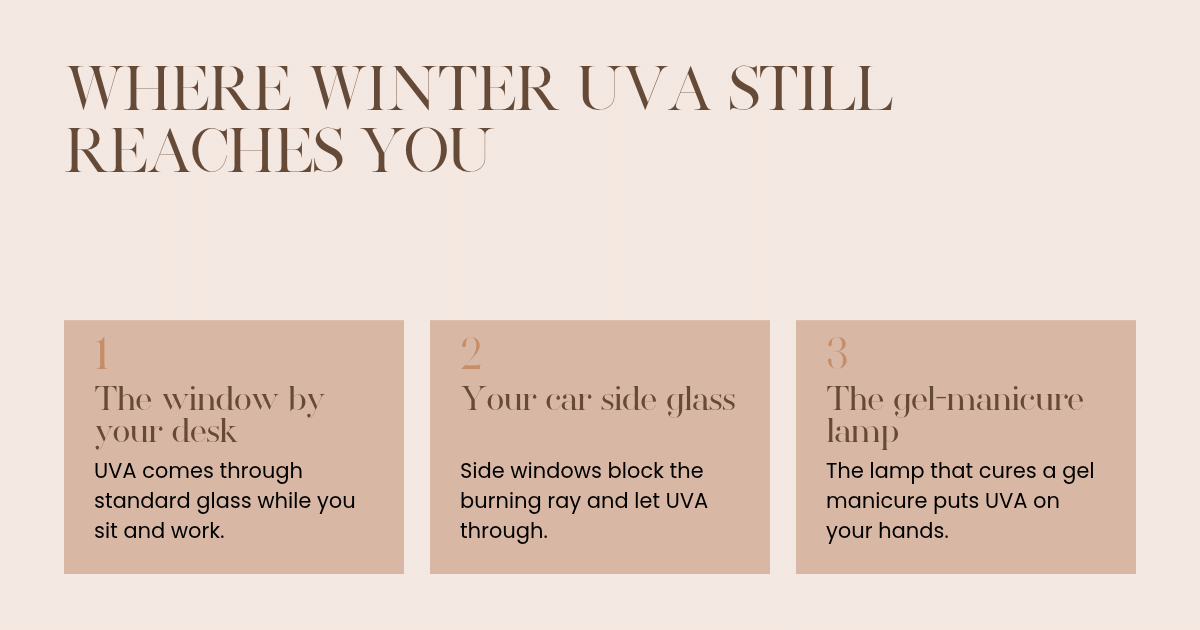
It’s grey, it’s freezing, and it feels like the sun has packed up until spring. It hasn’t. Ultraviolet light reaches your skin all year, and it comes through in more places than you’d expect.
It comes through the window next to your desk. It comes through your car windows on the drive, especially the side glass. Standard glass blocks most of the ray that burns and lets the ray that ages your skin right through. Even the small lamp that cures a gel manicure puts ultraviolet light onto the backs of your hands. I walk through how I protect my hands in my neck, chest, and hands post, and the research on gel-manicure lamps is worth a look if you get them done.
None of this is about a sunburn. It’s about the exposure you never feel, the kind the Skin Cancer Foundation points to when it reminds people that winter sun still counts.
The two rays: which one takes winter off
There are two kinds of ultraviolet light reaching your skin, and they behave completely differently.
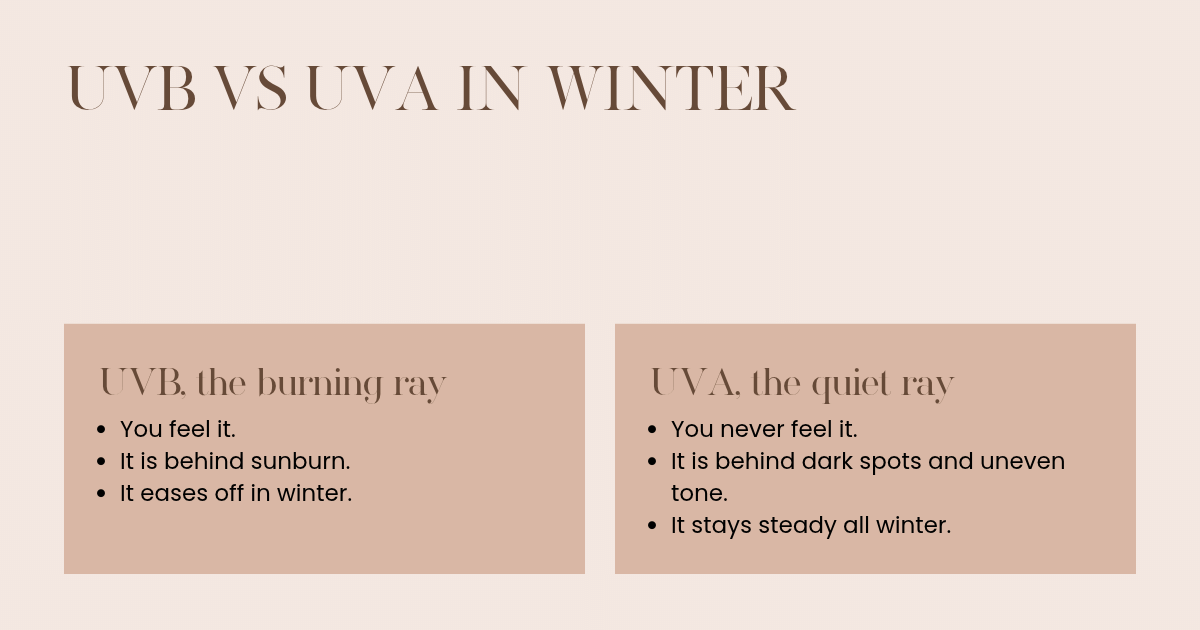
UVB is the one you feel. It’s the burning ray, the one behind a sunburn, and it genuinely drops off in winter, especially the further north you live. So the part of you that says you won’t burn today isn’t wrong.
UVA is the ray you don’t feel at all. It doesn’t burn you, so nothing warns you it’s there, and it stays much steadier through the winter than UVB does. It doesn’t take the season off. And this is the part that matters for your skin, because UVA is the ray behind dark spots, uneven tone, and the slow changes that show up years later.
If you take one thing from this whole post, take this: in winter, the burning ray clocks out, and the ray that spots and ages your skin does not.
Dana’s Tip: If a product only talks about SPF, it’s telling you about burn protection. Look for broad spectrum on the label, which is the part that speaks to UVA.
Why winter sun matters more for melanin-rich skin
This is where it lands differently for us. If you have darker skin, the thing you manage day to day usually isn’t sunburn. It’s tone. It’s the dark mark that shows up after a breakout and takes months to fade. It’s the unevenness that creeps in around your cheeks and forehead as the years go by. Every bit of that sits in UVA’s lane, the exact ray that stays active all winter.
After 40 there’s another layer. Your skin renews more slowly than it used to, so a mark that might have faded on its own in your twenties now lingers, and ongoing sun keeps it lingering longer. The winter version of not burning today is completely true, and it’s beside the point. We’re not protecting against a burn. We’re protecting the even, clearer tone we’re actually working toward. If sunscreen for deeper skin is new to you, start with why most sunscreen advice doesn’t work for Black women.
What your UV index really tells you
So you check the weather app, see a low number next to the UV index, and feel reassured. Here’s what that number is actually saying. The UV index is a sunburn forecast. It’s built around the ray that burns you, which is UVB, and that’s exactly the ray that drops in winter.
So the number looks low, and your burn risk really is low. It barely reflects UVA at all. A low UV index means your burn risk is low. It doesn’t mean the ray behind dark spots went anywhere. That’s why winter can feel like the safe season and still be the one that undoes months of work on your tone.
Do you need a different sunscreen in winter?
Usually not. The best winter sunscreen is the one you’ll actually wear every morning. The only reason to change the formula is your skin, not the calendar. In winter my skin runs drier, so some mornings I reach for a thicker, richer sunscreen on top of my moisturizer. If your skin isn’t dry, you have more options. Choosing the one you’ll wear is a whole topic on its own, so I made a separate guide on how to choose a sunscreen that disappears on deeper skin, and a companion on how to pick a moisturizer for the layer underneath.
Dana’s Tip: Don’t go shopping for a winter sunscreen before you’ve used up the one you own. A sunscreen you finish beats a better one you skip.
What to keep doing, and the one change to make
The good news is that the habit barely changes. Moisturizer, then sunscreen, every single morning, all year. That order doesn’t change in January. If you only protect one step through the winter, protect the morning sunscreen.
The other piece is reapplying. On a day I’m not wearing makeup, I keep a sunscreen stick in my bag and swipe it over my face, my ears, my neck, and the backs of my hands in the afternoon. A stick goes on clear and takes about ten seconds, which is the whole reason it actually happens.
How to keep winter SPF a habit
Most winter skipping isn’t a decision. It slides, a little at a time, because the sun feels far away and skipping it for a few months feels like it costs nothing. The fix is to remove the friction.
Go get your sunscreen, wherever it drifted to, and put it right next to your moisturizer. When it’s sitting there in your eyeline in the morning, you reach for it. That one move, taking the decision out of it, is what keeps the habit alive through the cold months.
Dana’s Tip: Keep a second sunscreen where your afternoon actually happens, a bag, a desk drawer, the car. The one you can reach is the one you reapply.
Go Deeper in the Video
The video shows the part that’s easier to watch than to read: how I layer moisturizer and sunscreen in the morning, the ten-second stick reapplication, and a quick look at the UV index on my own phone so you can read yours the same way. Watch it here.
Winter sunscreen questions, answered
- Do I really need sunscreen in winter if I stay inside most of the day?
If you sit near a window or drive, UVA still reaches you through the glass, so indoor days aren’t zero days. If you’re away from windows all day, your exposure is genuinely low, and a morning application still covers the commute and the errands. - Does a low UV index mean I can skip sunscreen?
A low UV index means a low chance of burning. It doesn’t measure UVA well, and UVA is the ray behind dark spots and uneven tone. For melanin-rich skin, that’s the exposure you most want to limit, so the low number isn’t your cue to skip. - Should I switch to a richer sunscreen for winter?
Only if your skin feels drier. Put your moisturizer on first, and if you still want more comfort, a thicker sunscreen on top is a reasonable winter swap. If your skin is comfortable, keep the sunscreen you already wear. - Do I need to reapply sunscreen in winter?
On a long day outside or near windows, a midday swipe helps, and a stick makes it realistic. On a short day indoors, your morning application is doing most of the work.
The Bottom Line
Winter changes the temperature and how your skin feels. It doesn’t change the fact that UVA never got the memo that it’s winter. The burning ray clocks out, and the ray that spots and ages your skin does not. For melanin-rich skin over 40, that’s the whole reason to keep sunscreen in the routine when it feels least necessary.
Your one move is small, and it’s the whole thing. Put your sunscreen back next to your moisturizer, and wear it tomorrow morning.
What To Do Next
- Watch the companion video for the morning routine and the reapplication.
- Browse the winter sunscreen collection to compare fragrance-free options you’ll actually wear.
- Want one idea a week in your inbox? Join the newsletter.
Shop With Me
The products I keep in rotation plus my budget-friendly picks, all in one place.
This week’s winter sunscreen collection