Estimated reading time: 0 minutes
Search “do Black people need sunscreen” and you will find a confusing mix of answers, many written by people who have never had to think about a grey cast on deeper skin. So let us settle it clearly, with the actual numbers and the actual reasons, in one place you can come back to.
Here is the short version. Melanin gives you some real sun protection. It does not give you enough. And most of the sunscreen advice you have heard was built around lighter skin, which is why so much of it has not worked for you.
This guide covers how much protection melanin actually provides, why the sun is the real driver behind the dark spots and uneven tone many of us fight, why sunscreens leave that grey cast, and how that is finally solvable, and the mistakes that keep us unprotected.
The reframe underneath all of it: the advice failed you, your skin did not.
If you are new here, the short version is this. Sun protection is not the boring last step in your routine. For melanin-rich skin, it may be the most important one.
In This Post:
- The Melanin Myth, and What Your Skin Actually Has
- Burning Was Never Really Our Problem. Pigment Is.
- Why the Advice Fails Us: What the Sun Is Really Doing
- Why the Advice Fails Us: The Grey Cast
- What This Actually Means for Your Routine
- Why We Were Never Taught This
- The Three Mistakes I See Most
- Watch the Companion Lesson
- Sunscreen for Black Women FAQ
- The Bottom Line
- What To Do Next
- Shop With Me
The Melanin Myth, and What Your Skin Actually Has
Let us start with the belief that almost all of us have absorbed in some form. That because we have melanin, we are already protected, so sunscreen is optional.
Here is the part that is true. Melanin does give deeper skin some natural sun protection. Research and the American Academy of Dermatology put that built-in protection at roughly an SPF of 13 for deeper skin, compared to about 3 or 4 for very fair skin. Your skin did come with a real head start.
But think about what that number means next to the standard. Dermatologists recommend wearing at least an SPF 30 every single day. Your melanin is giving you less than half of that floor.
Melanin is real protection, and it is not enough on its own.
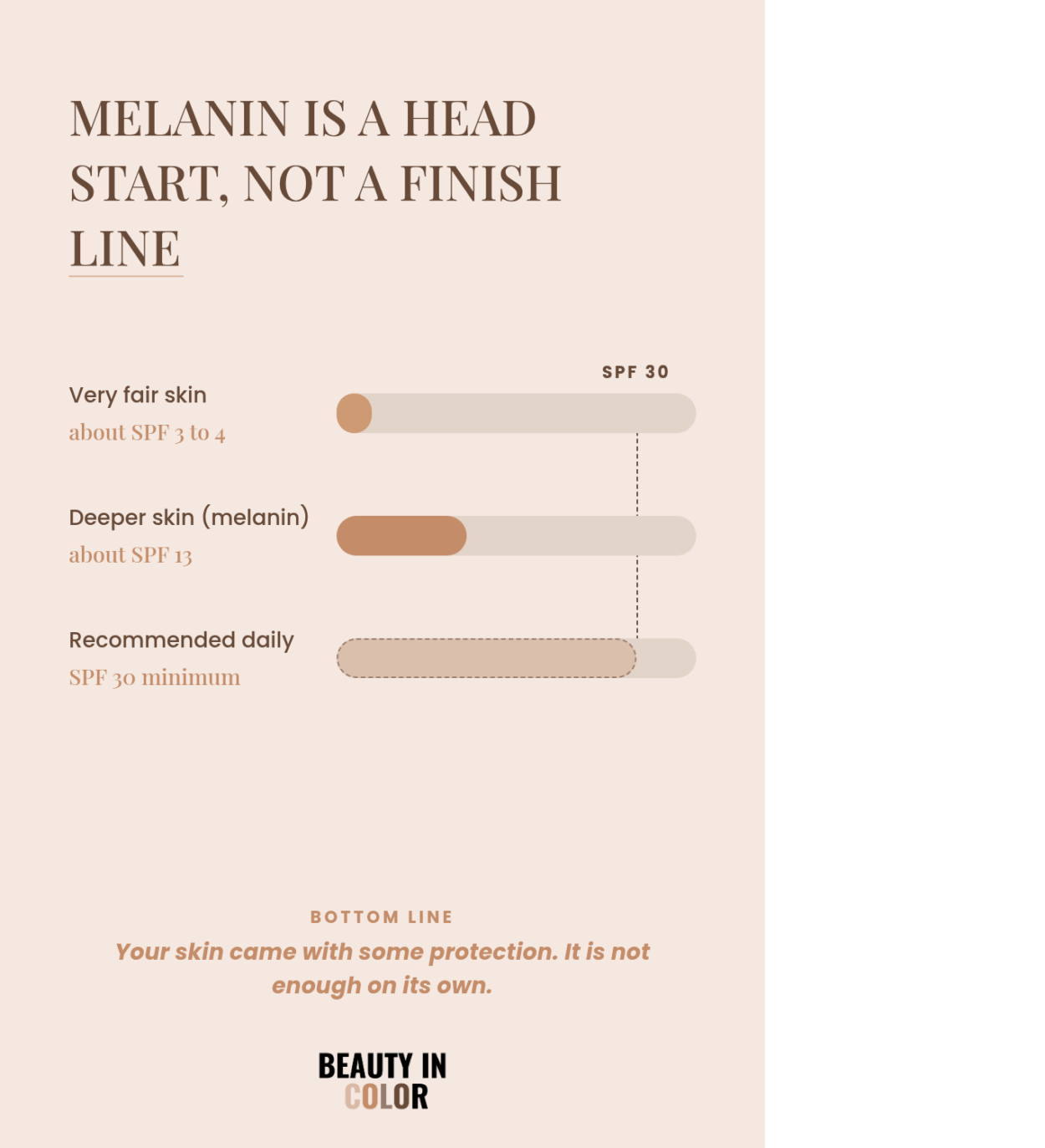
Takeaway: you have some built-in defense, but it sits well below the daily minimum, which is why sunscreen still matters for you.
Burning Was Never Really Our Problem. Pigment Is.
The whole myth was built around sunburn. You do not burn easily, so you do not worry. But sunburn was never the main event for us.
Our issue is pigment. It is the dark spots, the uneven tone, the patches that take time to fade. If you have ever watched a mark from a breakout or a bug bite linger for weeks or months, you already know your skin holds onto pigment differently.
That is the lens that changes everything. When you stop thinking about sunscreen as burn protection and start thinking about it as pigment protection, it stops being optional.
For melanin-rich skin, sunscreen is pigment insurance.
Takeaway: you may never get a sunburn and still be accumulating the exact discoloration you are spending money to fade.
Why the Advice Fails Us: What the Sun Is Really Doing
There are two reasons standard sunscreen advice falls short for us. The first is about what the sun actually does to deeper skin.
In an earlier lesson on why your skin gets more sensitive as you age, I talked about how irritation and inflammation in melanin-rich skin tend to leave a mark behind. That is post-inflammatory hyperpigmentation, the discoloration left after a breakout, a scratch, or a reaction. The sun does the same thing, just more quietly. Every day of unprotected exposure feeds the uneven tone and dark marks so many of us are working to fade.
And it is not only pigment. The sun is also the leading cause of premature aging, the fine lines, the loss of firmness, the change in texture. According to the American Academy of Dermatology, daily broad-spectrum SPF 30 or higher is recommended for every skin tone, and deeper skin carries a higher risk of hyperpigmentation from that same UV exposure.
So sunscreen is not competing with your anti-aging routine. It is the foundation the rest of your routine sits on. Your skin barrier, the outermost layer that keeps moisture in and irritants out, takes daily damage from UV, and a weaker barrier shows up as more sensitivity and more pigment.
Most of what we call aging is actually sun damage.
Dana’s Tip: If you are spending good money on serums, treatments, and dark-spot products but skipping sunscreen, you are working against your own money. The sun is undoing the very thing you are paying to fix. Sunscreen is the step that makes everything else in your routine worth it.
Takeaway: protecting your skin from the sun protects your tone, your texture, and the results of every other product you use.
Why the Advice Fails Us: The Grey Cast
The second reason is the one that actually made many of us quit. The grey cast.
Some sunscreens work by sitting on top of the skin and reflecting light away from it. The ingredients that do that can be white or chalky. On fair skin, you barely notice. On deeper skin, that same layer reads grey, ashy, that washed-out look we all recognize.
For years, the sunscreens sitting on the shelf were formulated around lighter skin, and the burden landed on us to make them work. That was backwards. A formula that turns deeper skin grey is a formula that was not built for deeper skin.
The cast was never a flaw in your skin or your technique. It was a gap in the products.
The good news is that the formulas have finally caught up. There are now sunscreens made with deeper skin in mind, including no-cast and tinted options that disappear or even out your tone instead of greying you. I keep the ones I reach for in my sunscreen collection, and if you want my specific product picks, I break down my favorites in the best sunscreens for Black skin.
Takeaway: if a sunscreen made you grey, that was one bad formula, not proof that the whole category is not for you.
What This Actually Means for Your Routine

I am saving the full how-to-choose breakdown for the companion lesson on choosing a sunscreen that disappears on deeper skin. But here is what I want you to walk away knowing today.
- First, you need it daily, all year. Not just in summer, not just at the beach, not just when it is bright out. The rays that age your skin and drive pigment come through windows and clouds every day.
- Second, the grey cast problem is solvable now. You do not have to choose between protected and ashy anymore. That tradeoff is over.
- Third, the best sunscreen is the one you will actually wear. If it stings, pills, greys you, or takes too long to rub in, you will skip it, and a perfect sunscreen sitting in a drawer protects nothing.
The right sunscreen is the one that fits your life, not the one with the best marketing.
Dana’s Tip: When you find a sunscreen that genuinely disappears on your skin and feels good to wear, buy a backup before it runs out. Consistency is what protects your skin, and you protect consistency by never letting yourself run empty.
Takeaway: daily use, a formula that works on deeper skin, and one you enjoy enough to keep using. That is the whole assignment for now.
Why We Were Never Taught This
There is a part of this that goes deeper than sunscreen, and I want to name it.
For a lot of us, sun protection was simply never part of the conversation at home or in the products marketed to us. If no one in your family wore it, and the brands on the shelf neither made formulas for your skin nor spoke to you, then this was never information you turned down.
And that gap did not start with us. It started higher up. Research has shown that dermatology as a field has historically underserved deeper skin: in one survey, nearly half of dermatologists and residents said they felt their training did not adequately cover conditions in Black skin, and studies have found Black patients are prescribed sunscreen far less often and screened less suspiciously for sun-related concerns than white patients. So the silence around sunscreen for us was built into the system that was supposed to inform us.
This was not information you ignored. It was information that never reached you in the first place.
That gap has a real cost, and it is worth naming plainly. While skin cancer is less common in deeper skin, it is far more often caught late, when it is harder to treat. That is its own conversation, and I will give it the full attention it deserves in a future lesson. For now, hold onto this: protecting your skin now is not vanity, and it is not catching up on a mistake. It is deciding how you age, on your own terms.
Takeaway: starting sunscreen at any age is not a correction. It is acting on something no one told you sooner.
The Three Mistakes I See Most
Once you understand the why, these are the patterns to skip right past.
- Skipping sunscreen because you do not burn. Burning was never the point for us. Pigment is, and pigment does not need a sunburn to show up.
- Only wearing it when it is sunny. The rays that age your skin and leave marks come through clouds and windows every single day, bright out or not.
- Giving up on sunscreen because one formula turned you grey. That was one formula, not the whole category. The right one for your skin exists.
Takeaway: most sunscreen failures come from one of these three beliefs, and all three have the same fix, which is better information.
Watch the Companion Lesson
This post is your written reference guide. The companion YouTube lesson walks through the same topic in a more personal, visual way, including a real look at what the grey cast actually looks like and why it happens. Each Beauty In Color YouTube topic is meant to pair with a searchable, reference-friendly blog post like this one.
Watch the full lesson here:
Sunscreen for Black Women FAQ
- Do Black people really need sunscreen?
Yes. Melanin gives deeper skin a natural protection of around SPF 13, which is real but well below the SPF 30 daily minimum dermatologists recommend. You still need daily sunscreen to protect against hyperpigmentation and premature aging. - Why does sunscreen leave a grey or ashy cast on dark skin?
Some sunscreens sit on the surface of the skin and reflect light, and the ingredients that do that can look white or chalky. On deeper skin that reads grey. It is a formulation issue, and there are now no-cast and tinted options made specifically for darker skin tones. - Does sunscreen help with dark spots and hyperpigmentation?
Sun exposure is one of the biggest drivers of dark spots in melanin-rich skin, so daily sunscreen is essential for prevention. Fading existing dark spots is its own process that can take a couple of months at the low end, and sunscreen is what keeps new ones from forming while you work on it. - What SPF should Black women use?
At least SPF 30, broad-spectrum, every day. That is the standard the American Academy of Dermatology recommends for all skin tones, regardless of how easily you burn. - Do I need sunscreen indoors or on cloudy days?
Yes. The UVA rays that drive aging and pigment pass through windows and cloud cover, so daily use matters even when you are inside or it is overcast.
The Bottom Line
If you were told that melanin was enough, or you quit sunscreen after one ashy formula, none of that was your fault. The advice was written for someone else, and the products were built for someone else. That is changing, and you get to change with it.
Melanin gives you a head start, not full coverage. The sun is the quiet driver behind the dark spots and uneven tone so many of us fight, and it is the single biggest cause of premature aging. The grey cast that pushed you away from sunscreen was a formula problem, and that problem is now solvable.
The more you understand how the sun actually affects your skin, the better decisions you can make about how to protect it. That is the mindset behind Beauty In Color: not more products, but better information, so you can protect your skin on your own terms.
What To Do Next
- Watch the companion YouTube video
- Browse the no-cast sunscreens I reach for
- New here? Start Here
- Join the newsletter for weekly skincare education
Shop With Me
The products I keep in rotation, plus my budget-friendly picks, all in one place.
- My discount codes: beautyincolor.com/beauty-discount-codes
- My full edit on ShopMy: shopmy.us/beautyincolor
- My budget-friendly Amazon picks: amazon.com/shop/beautyincolor_official