Estimated reading time: 10 minutes
By the time you finish reading this, you will know exactly where vitamin C, azelaic acid, and niacinamide go in your morning and night routine, the order to introduce them so your skin never revolts, and how to tell your dark spots are fading before your eyes can see a difference. You will not need to buy a single new thing to start.
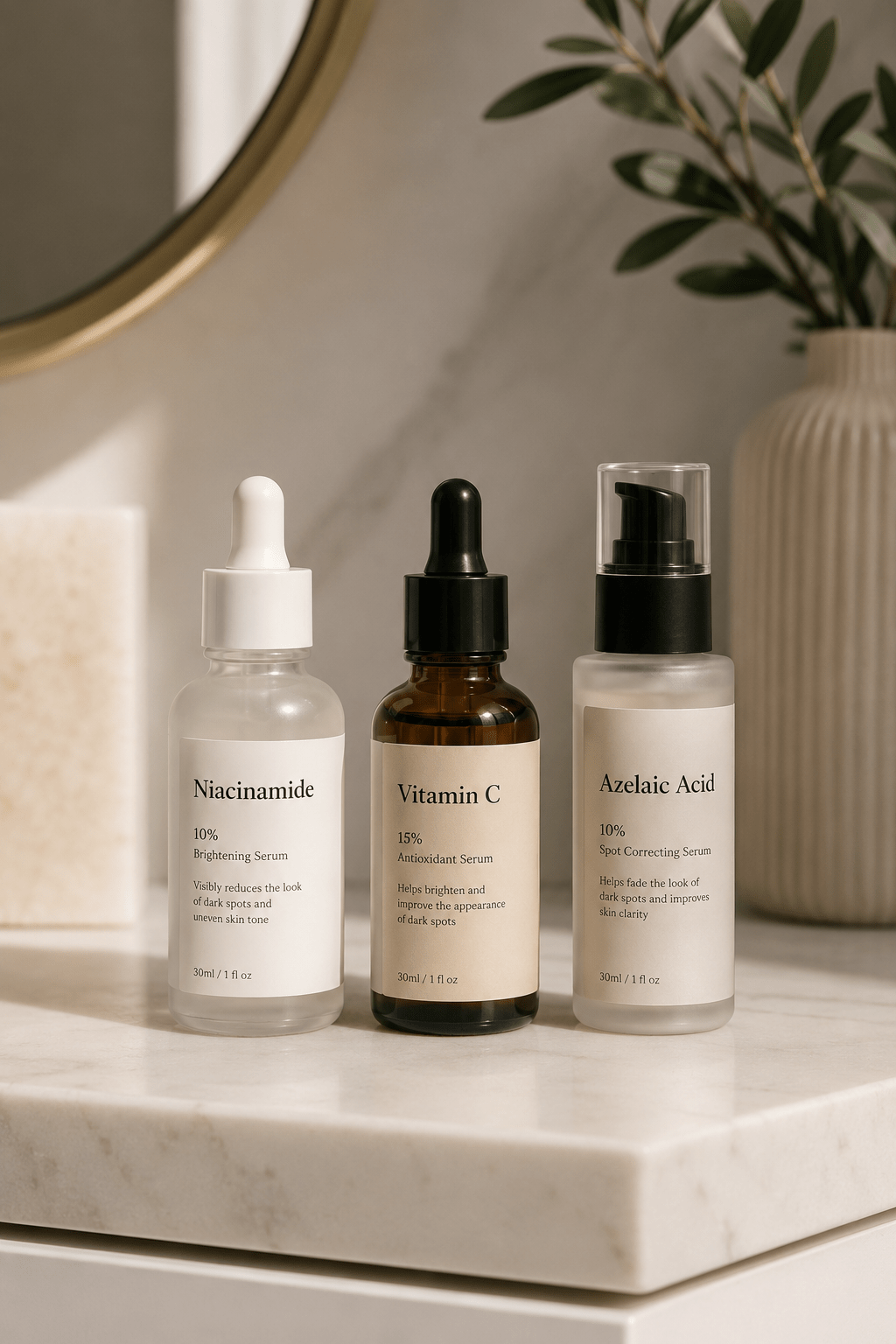
If you are looking for a skincare routine for dark spots and hyperpigmentation, there is a good chance you already own most of it. The vitamin C, the azelaic acid, the niacinamide – they may be sitting in your cabinet right now. What has been missing is not another product. It is the routine: where each one goes, in what order, and how to bring them in without setting your skin off.
This guide gives you that routine, built specifically for Black skin, where the goal is to fade the mark without triggering a new one. We will keep the science light and the steps exact, because the part you actually need is the plan.
In This Post:
- The three actives that fade dark spots, and what each one does
- Can you use vitamin C and niacinamide together?
- Your morning and night routine for dark spots
- Add one active at a time, and why gentle wins for Black skin
- Do not skip sunscreen
- How to tell your routine is working
- Go Deeper in the Video
- Dark spot routine FAQ
- The Bottom Line
- What To Do Next
- Shop With Me
The three actives that fade dark spots, and what each one does
There are several ingredients that fade dark spots, and the full lineup and how each one works at the pigment level lives in the dark spots on Black skin guide. For a routine, three actives do the most work with the least risk for skin like ours: vitamin C, azelaic acid, and niacinamide. You do not need all three to start, but it helps to know the job each one does, because the job is what decides where it goes.
Vitamin C: your morning active
Vitamin C works in the morning. It helps interrupt pigment as it forms and adds a layer of antioxidant defense against the daily light that darkens spots in the first place. For fading, formulas usually land around 10 to 15 percent, and gentler derivatives exist for skin that stings easily.
Azelaic acid: your evening workhorse
Azelaic acid works at night. It helps slow pigment production at the source, and it tends to act on overactive pigment cells while leaving the surrounding skin alone, which is part of why dermatology literature describes it as well suited to hyperpigmentation without lightening healthy skin (Azelaic Acid in Dermatology: A Review of Its Mechanism of Action). You will usually find it around 10 percent over the counter.
Niacinamide: the gentlest place to start
Niacinamide also works at night and is the gentlest of the three. It helps limit how much pigment travels up to the surface where you can see it; in a foundational study it suppressed the transfer of pigment to skin cells and reduced the look of pigmentation (Hakozaki et al., British Journal of Dermatology, 2002). It plays well with almost everything and is the easiest place to begin. About 2 to 10 percent does the job. One honest note: niacinamide’s benefit for dark spots specifically in deeper skin is extrapolated from broader pigmentation research, so treat it as a well-supported gentle option rather than a proven dark-skin-specific cure.
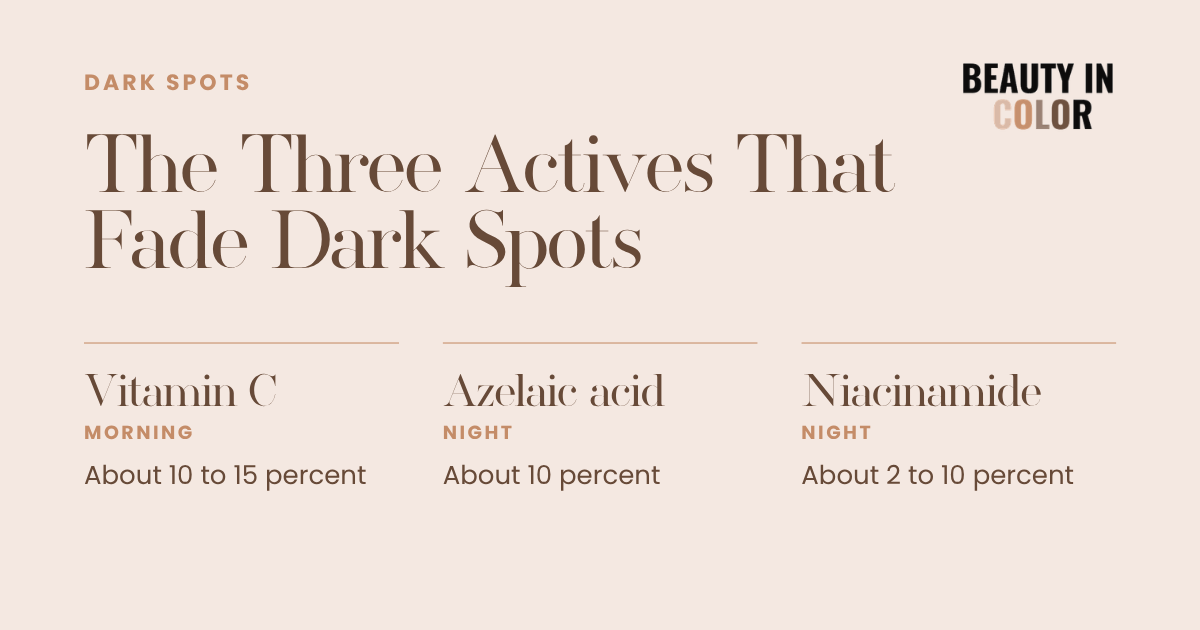
Some formulas do more than one of these jobs, so a complete routine may not need three separate products.
Dana’s Tip: Before you buy anything, turn over what you already own and read the active ingredient and its percentage. You may find you already have two of these three, and the only real gap is the order you use them in.
Can you use vitamin C and niacinamide together?
Yes. You can use vitamin C and niacinamide together, and the belief that they cancel each other out is a myth. It comes from decades-old laboratory studies where the pure, raw forms of these ingredients were combined under high heat and formed a compound that can irritate skin. That is a lab bench, not your bathroom shelf. The products you actually buy are formulated to be stable at normal temperatures on normal skin, and modern dermatology guidance treats the pairing as compatible.
They do different jobs, which means using them together gives you more, not less. So if that rumor is the reason your vitamin C and your niacinamide have been living in separate corners, you can bring them back together.
Your morning and night routine for dark spots
The routine slots into a framework you may already use: Cleanse, Treat, Moisturize, Protect. Your actives live in the Treat step. In the morning you run all four steps. At night you run three, because you are not defending against sun while you sleep.
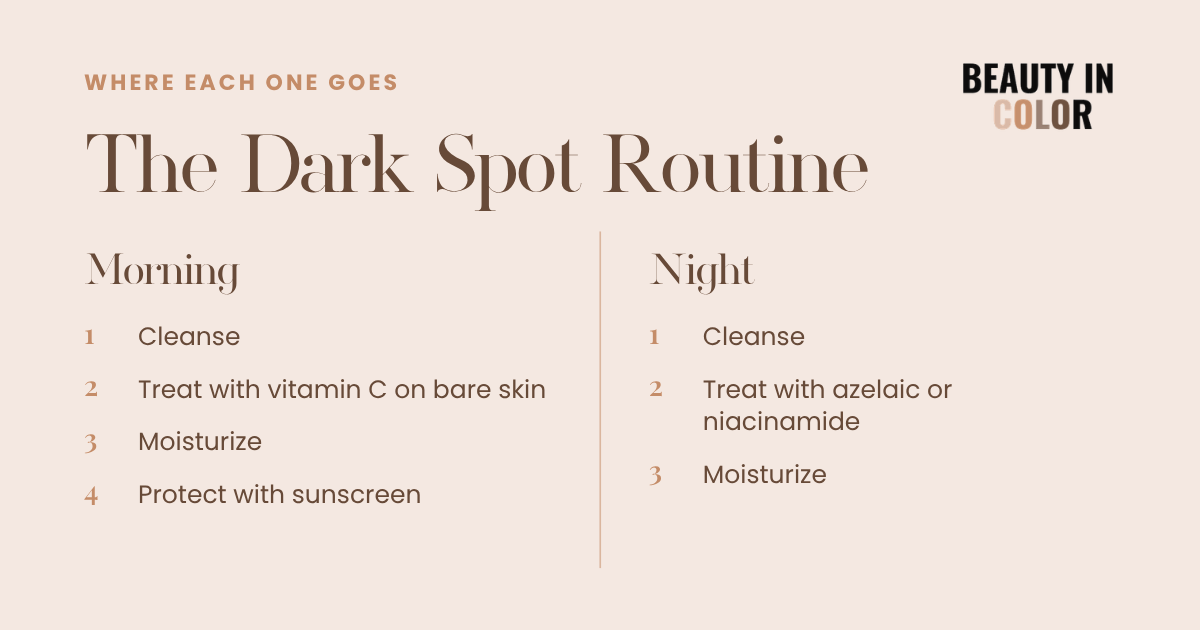
How to layer vitamin C and niacinamide
When you layer any products, the rule is thinnest to thickest: the more watery product goes first, the richer cream goes later. If vitamin C and niacinamide land in the same routine, apply the vitamin C first, give it about 30 seconds to settle, then apply the niacinamide. That is the whole technique.
Using azelaic acid and niacinamide together at night
Azelaic acid and niacinamide pair comfortably in the evening. Azelaic works at the source and niacinamide works one step later, so they support each other rather than compete. The only caution is pace, not compatibility: bring them in one at a time, which is the next section.
Dana’s Tip: If a product ever feels like too much, moisturizer first, then the active on top, softens it without canceling the benefit. A buffered active you actually keep using beats a straight one you quit.
Add one active at a time, and why gentle wins for Black skin
Here is the part that matters more than the order: do not bring all three in at once. It is tempting when you are motivated, but starting everything at the same time is the fastest way to irritate your skin and learn nothing about which product did what.
Start with one, ideally niacinamide, because it is the gentlest. Give it two to three weeks and let your skin show you it is fine. Then add azelaic. Bring vitamin C into your mornings last, once you know your skin is handling everything else. Gentlest first, strongest last.
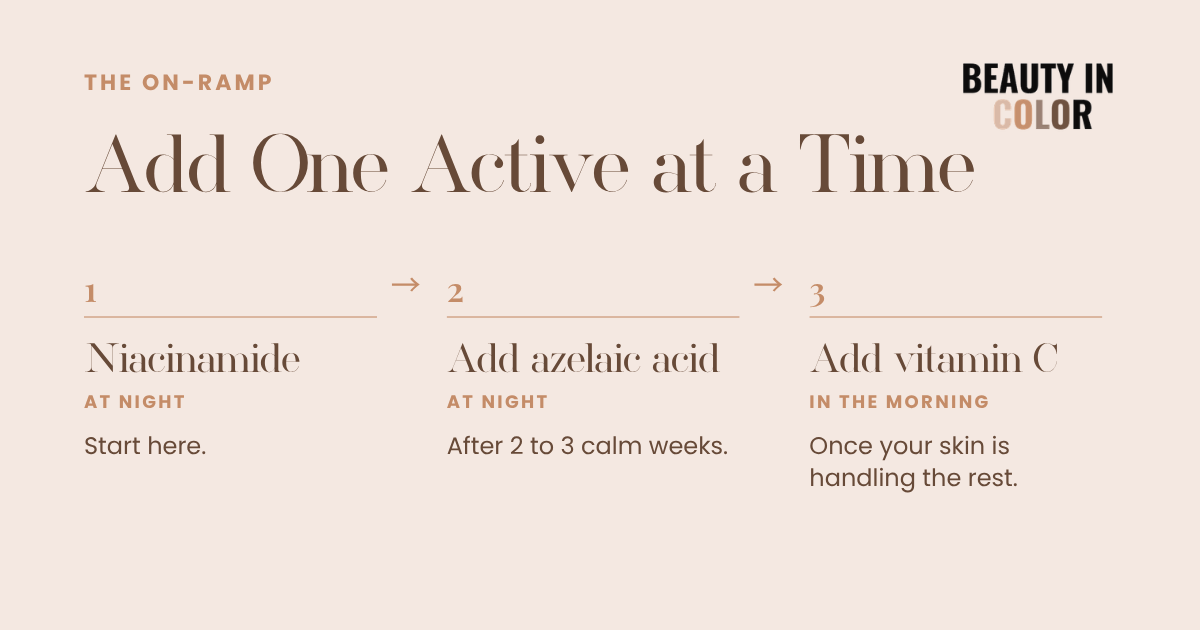
This pace is not caution for its own sake. For Black skin, inflammation is what creates the dark spot in the first place, and post-inflammatory hyperpigmentation tends to be more common and can last longer in deeper skin tones (Postinflammatory Hyperpigmentation in Skin of Color, JCAD). When you stack strong acids or push a product that stings because you think stronger means faster, you can create the exact irritation that makes new pigment. In other words, you can darken your skin while trying to fade it. That is the main trap, and it is why the gentle, consistent routine wins for most of us.
Introduce actives when your skin is calm, not while it is already irritated. A mild tingle that settles within a few minutes is usually a normal adjustment. Stinging, burning, or redness that lingers is a signal to pause and give your skin a few days, not to push through. The strongest, prescription-tier treatments have their place with a professional watching, but the routine that fades spots for most people is the one you can stay on without setting your skin back.
Do not skip sunscreen
Sunscreen is the step this whole routine collapses without. Ultraviolet light continuously re-triggers the pigment you are trying to fade, so without daily sunscreen you are treating the spot while the thing that caused it keeps working. The actives are the bucket. Sunscreen patches the hole. For the specific kind of sunscreen that best guards deeper skin against what darkens a spot, that is its own topic, and the short version is: wear it every morning, no days off.
How to tell your routine is working
Fading is slow, and the early weeks do not look like progress, so it helps to know what to actually watch for. This is about reading the signs, not counting down a fixed timeline.

Here is the honest part about how you will notice. Not in the mirror, morning to morning, where nothing seems to change. You will catch it in a photo. A few months from now you will land on a picture from today, and the spot will be quieter than it is now. Progress here is a trend, not a moment, and staying with it long enough is the whole thing.
Dana’s Tip: Take a clear, well-lit photo of the spot today, in the same light you can recreate later. It is the most reliable progress tracker you have, because your memory adjusts to your face and a photo does not.
Go Deeper in the Video
The companion video walks through the full routine out loud, in the order you would actually do it, and shows how the morning and night steps come together. If you want to hear the reasoning behind each placement and see it built step by step, that is the place to watch.
Watch the full lesson here:
Dark spot routine FAQ
- Can I use azelaic acid and niacinamide together?
Yes. They pair well at night and work at different stages of pigment formation, so they support each other. Introduce them one at a time so you can tell how your skin responds to each. - Should I use vitamin C or niacinamide for dark spots?
You do not have to choose. Vitamin C is a morning active, and niacinamide is a gentle evening one, so most routines can include both. If you are only starting one, begin with niacinamide because it is the least likely to irritate. - Can I use all three actives at the same time?
You can eventually run all three in a week, but do not start them all at once. Add one every two to three weeks, gentlest first, so you protect your skin and know which product does what. - Do I still need sunscreen if my dark spots came from acne, not the sun?
Yes. Even when a spot started as post-inflammatory pigment from a breakout, daily light keeps re-triggering that pigment, so sunscreen is what lets everything else work. - How will I know it is working if I cannot see a change yet?
Early on, calm skin that tolerates the routine is the sign. Visible fading usually starts around eight to twelve weeks with consistency, and you will notice it in a photo comparison rather than day-to-day in the mirror.
The Bottom Line
A skincare routine for dark spots and hyperpigmentation does not need to be aggressive to work. Vitamin C in the morning, azelaic and niacinamide at night, layered thinnest to thickest, introduced one at a time, with sunscreen every single morning holding it together. That is the whole method.
For Black skin especially, the gentle version run consistently beats the strong version you keep quitting, because irritation is what leaves the mark in the first place. You do not need the strongest routine. You need the right one, run long enough to matter.
What To Do Next
- Watch the companion video for the full routine, built step by step: WATCH THE LESSON
- Browse the dark spot collection, sorted by the job each product does: Dark Spots collection
- Join the newsletter for the weekly lesson, delivered a little more personally: beautyincolor.com/newsletter
Shop With Me
The products I keep in rotation plus my budget-friendly picks, all in one place.
- Discount codes: beautyincolor.com/beauty-discount-codes
- My ShopMy edit: shopmy.us/shop/beautyincolor
- Amazon budget picks: amazon.com/shop/beautyincolor_official
- Dark Spot collection: https://shopmy.us/shop/collections/4436392
Sources
- Searle T, et al. Azelaic Acid in Dermatology: A Review of Its Mechanism of Action. PubMed Central.
- Hakozaki T, et al. The effect of niacinamide on reducing cutaneous pigmentation and suppression of melanosome transfer. British Journal of Dermatology, 2002. Wiley Online Library.
- Postinflammatory Hyperpigmentation: A Review of the Epidemiology, Clinical Features, and Treatment Options in Skin of Color. The Journal of Clinical and Aesthetic Dermatology. JCAD.