If choosing a moisturizer has ever felt like a guess, you are in good company. Here is how to choose a moisturizer for dry, reactive skin by the work it actually does, so you can read almost any label yourself.
Moisturizer might be the most personal step in a routine. What feels right on one person can feel like too much on the next, and the shelves are full of jars promising the same soft, calm skin. If you have dry or reactive skin and you have ever stood in the aisle second-guessing yourself, it is not a personal failing. Most of us were never actually taught how to choose a moisturizer. We grabbed what sounded good, or what a friend swore by, and hoped.
Here is the part that makes it simpler. Underneath the packaging, a good moisturizer for dry, reactive skin only has to do three jobs. Once you can name them, you can pick up almost any jar and tell whether it is built for your skin.
This guide walks through those three jobs, the one detail that matters most when your skin reacts easily, and how to match a formula to your skin and even to the season. The goal is not to hand you one product to buy. It is to give you a method you can use on any label, in any aisle, at any price. Get this right and two things change: you stop wasting money on jars that were never going to work for you, and you stop quietly irritating skin that is already sensitive.
In This Post:
- What a good moisturizer actually does
- Is a richer moisturizer always better?
- How do you read a moisturizer label?
- Why fragrance matters more for reactive skin
- How to match your moisturizer to the season
- Do you have to spend a lot?
- Go Deeper in the Video
- How To Choose A Moisturizer FAQ
- The Bottom Line
- What To Do Next
- Shop With Me
- Sources
What a good moisturizer actually does
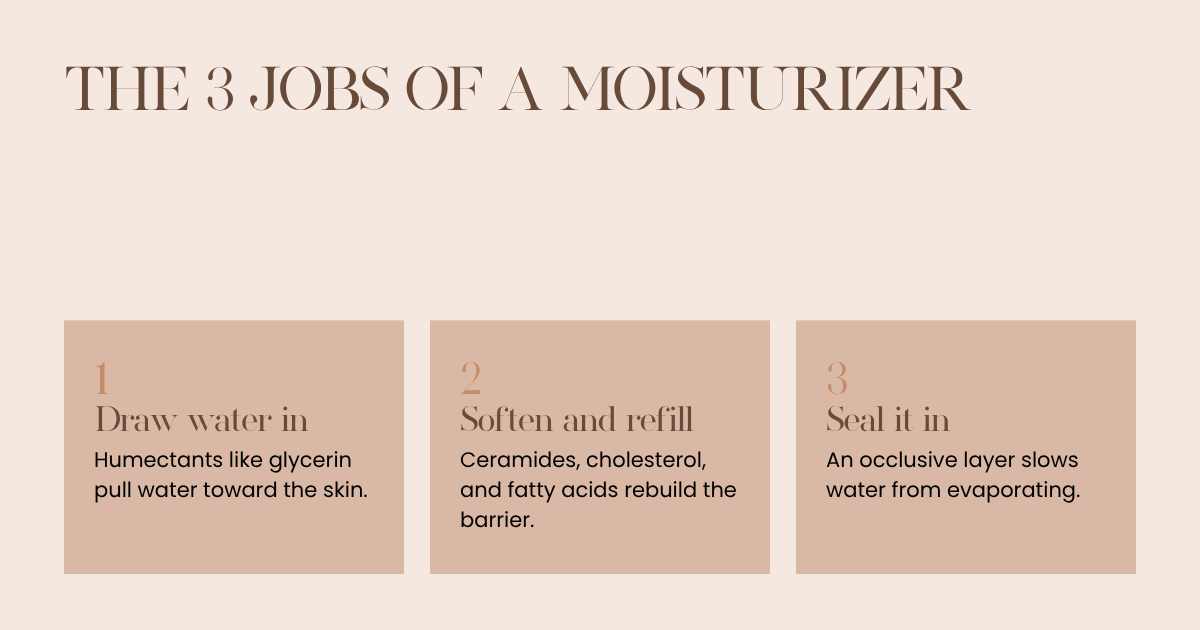
Every moisturizer is some combination of three functions. Dermatology guidance sorts moisturizing ingredients into these same three groups, and once you can name them the ingredient list stops reading like a foreign language.
Job one: draw water in (humectants)
Humectants pull water toward the skin. The one you will see most is glycerin, and it is a genuine workhorse: gentle, effective, and near the top of a lot of well-built moisturizers for good reason. You may also see hyaluronic acid listed here. The water-layer side of hydration is really its own separate conversation, so for the purpose of choosing a moisturizer, if you see glycerin near the top, your water job is covered.
Job two: soften and refill (emollients and barrier lipids)
Emollients smooth down the rough, flaky places dry skin gets. The best of them do double duty, because they carry the same fats a healthy barrier is built from. This is where you want to see ceramides, cholesterol, and fatty acids. Those are not marketing words. They are the actual building blocks the skin barrier uses, which is why they tend to be some of the calmer ingredients for dry skin. If your barrier already feels compromised, our guide to repairing your skin barrier goes deeper on those lipids.
Job three: seal it in (occlusives)
Occlusives are the lid. They do not add any moisture of their own. They slow the water that is already there from evaporating off the skin, the way a lid keeps a glass of water from drying out on the counter. That distinction matters, because a formula can feel rich and still be doing only this one job.
Here is how it ties together. Water, softness, seal. A moisturizer that only draws water in, with nothing to hold it, can actually leave dry skin drier once that water evaporates. So you are not hunting for one hero ingredient. You are looking for one formula that covers all three jobs in a reasonable balance, because that balance is what holds moisture in dry skin. Some ingredients and formulas cover more than one job at once, so a good moisturizer often does all three without needing three separate products.
Is a richer moisturizer always better?
The most common advice for dry skin is to reach for something heavier, the thickest cream on the shelf. For some skin that does help. But heavier is not the automatic win it sounds like, and for skin that reacts easily it can work against you.
A rich cream loaded with fragrance can still leave you irritated, and a thick formula that is all seal and no water underneath just sits on top of the skin without really hydrating it. The point was never to find the richest jar. It is to find the one that does the right jobs, in the right balance, with as little extra as your skin has to fight.
How do you read a moisturizer label?
You do not need to memorize chemistry to read a label well. Ingredients are listed roughly in order of how much is in the formula, most to least, at least above the trace levels near the very bottom. That gives you a quick, reliable trick.
If glycerin, a ceramide, or a barrier lipid shows up in the first several ingredients, there is a meaningful amount in there. If all the ingredients you actually want are buried at the very bottom, the formula may be doing less than the front of the jar suggests. Here is what to look for when you turn a jar over:
- Glycerin near the top, so the water job is covered.
- Ceramides, cholesterol, or fatty acids present, so the barrier is supported.
- A reasonably short list, and fragrance-free or close to it, if your skin reacts easily.
Dana’s Tip: Turn the jar over before you read the front. If glycerin or a ceramide is in the first few ingredients and fragrance sits near the bottom or is missing entirely, the formula is likely doing real work for dry, reactive skin.
Why fragrance matters more for reactive skin
If your skin is reactive, there is one more filter, and it matters more than the front of the package wants you to think. Look at how much extra is in the formula, and where fragrance falls. Fragrance and essential oils are among the most common triggers for sensitive skin, and fragrance is one of the most frequently identified contact allergens in dermatology testing. They are not in a formula to support your barrier. They are there to make the product smell nice. And a moisturizer you wear every single day is exactly the kind of product where a little daily irritation can add up.
Here is why this is not a small thing, especially for Black skin. Irritation in melanin-rich skin does not always settle quietly. It can leave a mark. We break that whole mechanism down in our guide to hyperpigmentation on Black skin, so the short version is enough here: a moisturizer that quietly irritates you day after day can be feeding the very dark spots you are working to fade. That is the real stake.
When you do try something new, give it a fair chance on its own. If you change three things at once and your skin reacts, you will never know which one did it.
Dana’s Tip: If your skin is reactive, change one thing at a time. Give a new moisturizer two to three weeks on its own before you add anything else new, so you actually know what helped or hurt.
When to see a professional. A moisturizer supports your skin. It does not treat a flare that has gotten away from you. If your skin is cracking, weeping, or getting worse instead of better, that is a moment to see a board-certified dermatologist rather than to keep swapping creams.
How to match your moisturizer to the season
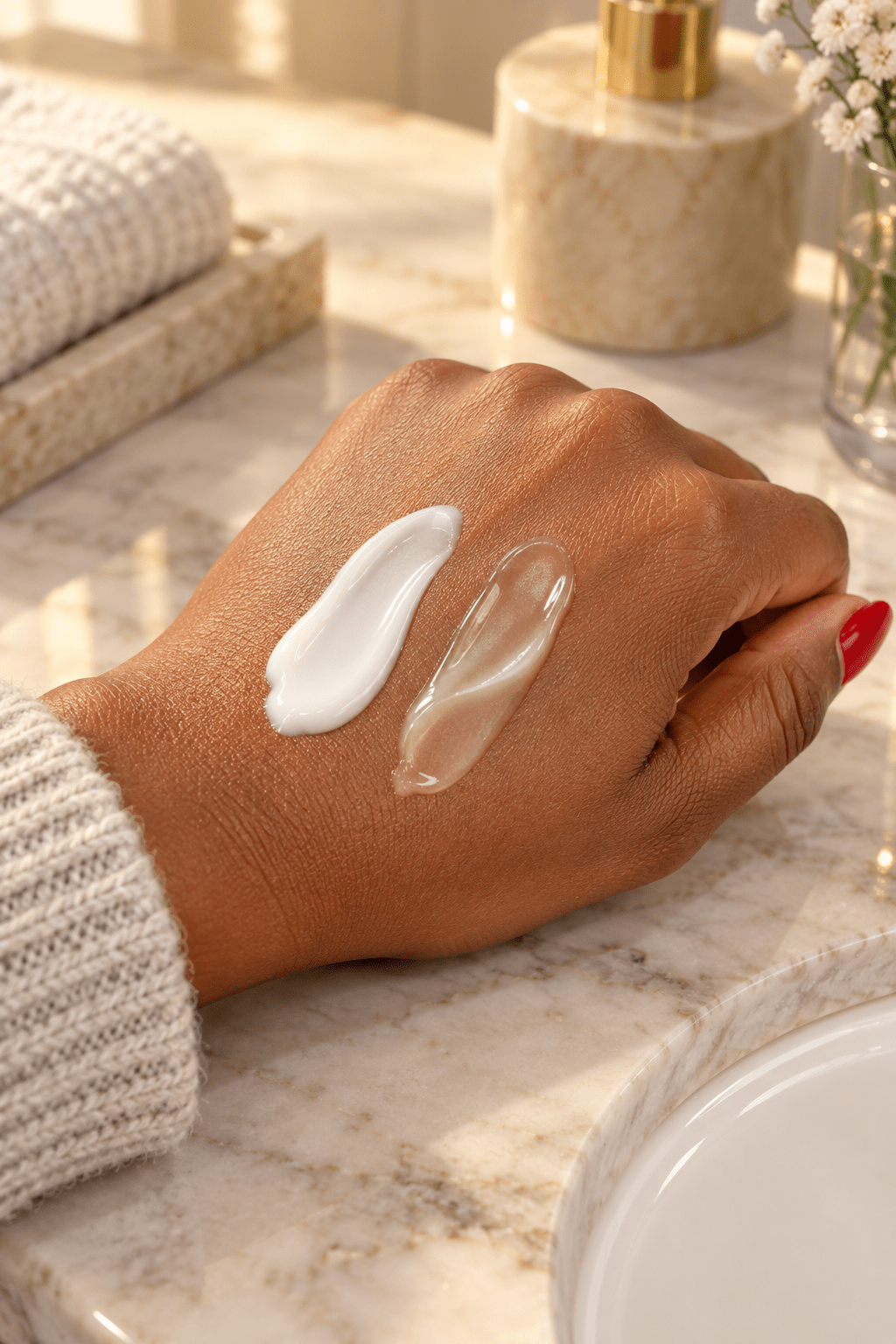
The texture you reach for does not have to be the same all year. Moisturizers run from light lotions and gel-creams to thick balms, lighter and faster-absorbing on one end, rich and cushiony on the other. In warmer, more humid months, a lighter formula is often plenty, and a heavy one can feel like too much. When the air turns cold and dry, that is usually when skin wants something richer to hold up against the weather. Owning two and switching between them is completely normal, not indulgent.
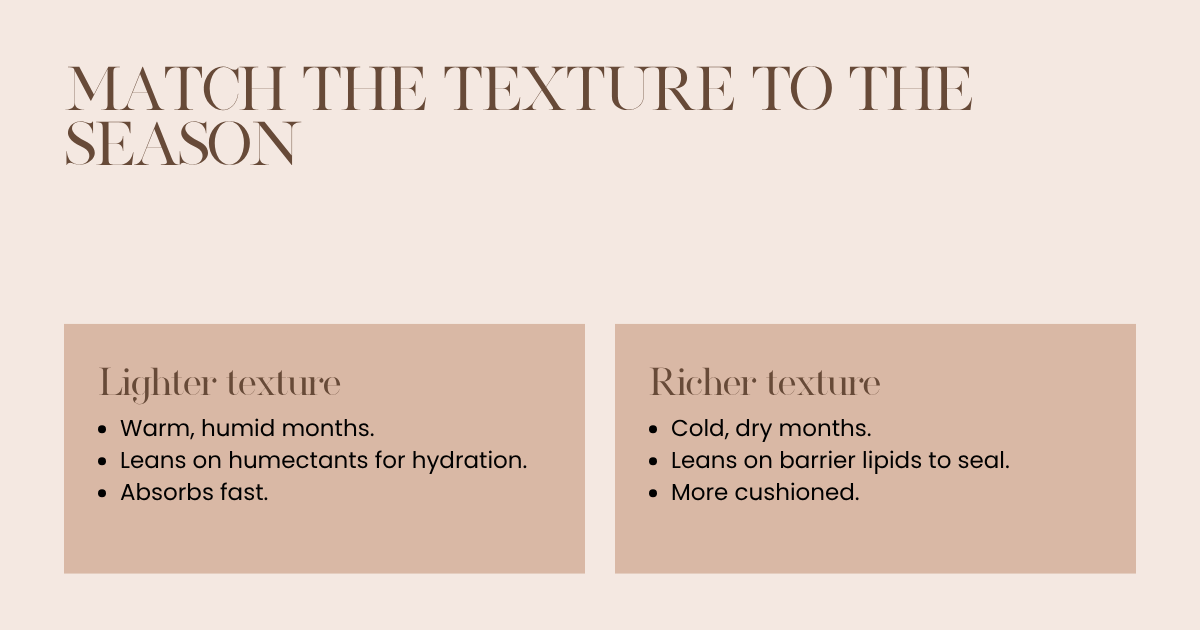
This is what I do myself. I keep a lighter cream for the warmer months and a richer one for fall and winter, same skin, two textures, matched to what the weather is doing. The two I reach for are both from Dieux, and I use them because they pass the same test this whole guide is built on. The lighter one, Air Angel Peptide Plumping Gel Cream, is humectant-forward with glycerin near the top, and the richer one, Instant Angel Lipid Rich Firming Moisturizer, is lipid-forward with ceramides and other barrier fats. Both are fragrance-free by their full ingredient lists, which is exactly what reactive skin wants in a product worn daily. You can see both, organized in one place, in my moisturizer shortlist.
Dana’s Tip: Keep two textures if your skin asks for it, a lighter one for humid months and a richer one for cold, dry ones. It is not fussy. It is matching the formula to the weather.
Do you have to spend a lot?
No. You do not need the most expensive jar to get the three jobs done. Plenty of drugstore moisturizers check every box. A higher price usually buys a nicer texture and a nicer experience, not a stronger barrier. Spend where it earns its place, and do not let a big number convince you a formula is doing more than it is. If you want a fuller framework for deciding where your skincare money is worth it, our guide to choosing skincare without wasting money covers it.
Go Deeper in the Video
The companion video walks through all of this out loud, and it shows what a label reader cannot: the two textures side by side on skin so you can see the weight difference, a slow scan down an ingredient list to where fragrance usually sits, and the reasoning behind each of the three jobs as I talk through them. If you learn better by watching someone do it, start there.
How To Choose A Moisturizer FAQ
- What are the three jobs of a good moisturizer?
Drawing water in with humectants like glycerin, softening and refilling with emollients and barrier lipids like ceramides, and sealing it in with an occlusive layer so the first two jobs last. A good formula covers all three in balance. - What ingredients should a moisturizer have for dry skin?
Look for glycerin near the top of the list, plus ceramides, cholesterol, or fatty acids for the barrier. Those support the two jobs dry skin needs most, drawing water in and refilling the fats that hold it. - Is fragrance-free better for sensitive skin?
For skin that reacts easily, usually yes. Fragrance is one of the most common contact allergens, and a product worn daily is where small irritation can compound. Fragrance-free or low-fragrance is generally the safer bet. - Should I use a different moisturizer in summer and winter?
Many people do, and it is reasonable. A lighter formula often feels like enough in humid months, while cold, dry air usually calls for something richer. Owning two textures and switching is normal, not excessive. - Do more expensive moisturizers work better?
Not necessarily. Price tends to buy a nicer texture and experience, not a stronger barrier. Plenty of affordable moisturizers do all three jobs well. Read the label, not the price tag.
The Bottom Line
Choosing a moisturizer stops being a guess the moment you stop shopping by the front of the jar. A good one for dry, reactive skin draws water in, softens, and seals, and it does all three without a lot of extra for your skin to fight against.
If your skin reacts easily, keep the fragrance low and the list reasonably short, and remember that the daily irritation you barely notice is the kind that can leave a mark on melanin-rich skin. Then let the season guide the texture, lighter when the air is humid, richer when it turns cold and dry.
Check the label for the three jobs, keep the fragrance low, and pick a texture you will actually wear every day. The moisturizer you skip does nothing.
What To Do Next
- Watch the companion video: The 3 Jobs Every Moisturizer Should Do.
- Not sure whether your skin is dry or dehydrated? That changes what you reach for. Read dry or dehydrated skin.
- See the lighter and richer moisturizers I reach for in my moisturizer shortlist.
- Get one useful, honest skincare breakdown each week in Beauty In Your Inbox.
Shop With Me
The products I keep in rotation plus my budget-friendly picks, all in one place.
- Discount codes: beautyincolor.com/beauty-discount-codes
- My full ShopMy edit: shopmy.us/shop/beautyincolor
- Amazon budget picks: amazon.com/shop/beautyincolor_official
- This week’s moisturizer shortlist: the lighter and richer creams I reach for
Sources
- American Academy of Dermatology, How to pick the right moisturizer for your skin. aad.org
- Fragrance Contact Allergy: A Review Focusing on Patch Testing (PMC). ncbi.nlm.nih.gov