Estimated Reading Time: 13 minutes
Ceramides sit on the front of almost every moisturizer now, usually with a number attached. Before you pay extra for the jar that names three of them, here is what the word really means for your skin and how to read the rest of the label.
Stand in the skincare aisle for a minute, and the labels start to blur together. One jar after another leads with ceramides, often right in the product name, and the quiet message is that more of them, or more kinds, is worth paying more for. If you are past 40 and your skin has started running drier or testier than it used to, that pitch is easy to fall for. So this piece is about what ceramides for skin genuinely do, why the word out front says less than the formula behind it, and how to turn a jar over and make sense of it.
You do not need a chemistry degree for any of it. You do need to quit shopping by the loudest word on the package and start reading the ingredient list the way you would read a nutrition panel on something you eat daily. If the barrier itself is still fuzzy to you, the skin barrier post lays the groundwork; here we go a layer deeper, into what the barrier is actually built from.
In This Post:
- What ceramides really are (and what they are not)
- Do you have fewer ceramides after 40?
- “Ceramides for Black skin”: what the research does and does not say
- How to read a ceramide moisturizer label
- Do ceramide moisturizers actually work?
- Ceramides or hyaluronic acid: which does your skin need?
- Three questions to ask before you buy a ceramide moisturizer
- Go Deeper in the Video
- Ceramide questions, answered
- The Bottom Line
- What To Do Next
- Shop With Me
- Sources
What ceramides really are (and what they are not)
Think of your skin’s outer layer as a wall of brick. The cells play the part of the bricks, and the fatty material wedged into the gaps acts as the mortar. Ceramides are the biggest single ingredient in that filler. Roughly half of it is ceramide, about a quarter is cholesterol, and something near fifteen percent is free fatty acids, with a scatter of other lipids making up the remainder. Your body produces all of it and stacks it into neat, layered sheets, and it is those sheets that hold moisture in and keep irritants from pushing their way through.
Here is the distinction that will change how you read a label. A ceramide is a building material, one of the things your barrier is made of, rather than an active that pushes your skin to do something new. It does not behave like a retinoid or an acid. So the goal with a ceramide cream is a formula that is put together well, not a jar stacked with one headline ingredient.
A cream that carries ceramides can absolutely give the barrier a hand. What it cannot do is prove anything from the label on its own. Whether the finished product feels good and holds up comes down to everything blended in alongside the ceramide, not the fact that a ceramide got named.
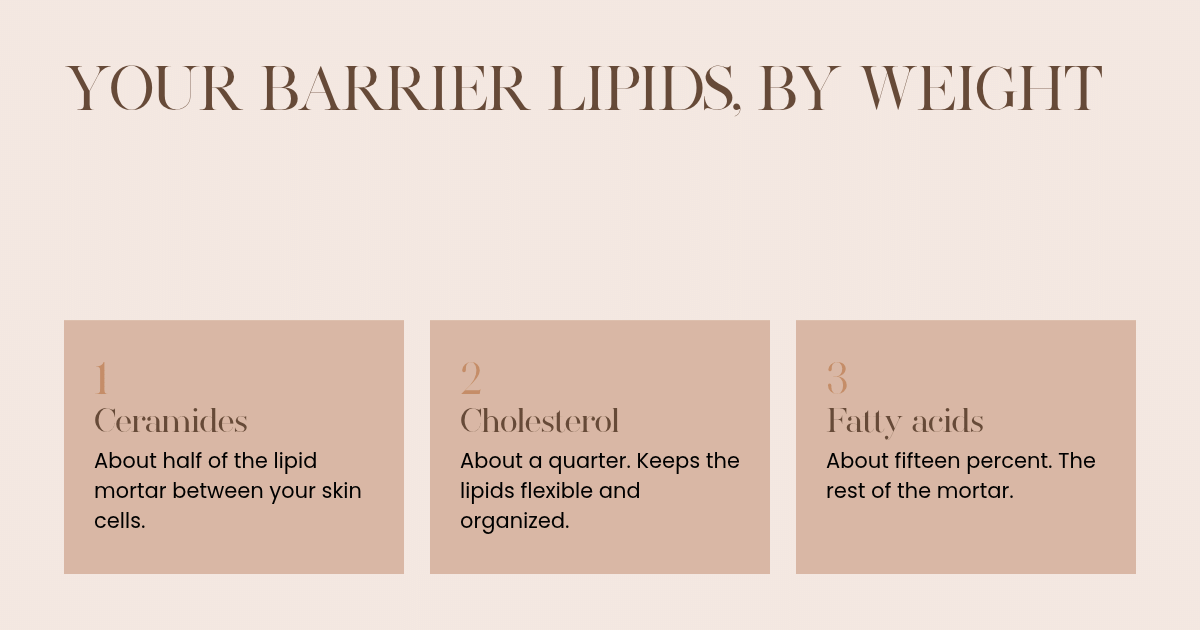
As the graphic above shows, the filler follows a loose formula: ceramide takes up about half, cholesterol roughly a quarter, and fatty acids most of what is left.
Do you have fewer ceramides after 40?
Possibly, and that is the fairest answer the research allows. Several things can lower lipid levels in your outer skin, and after 40 more than one of them is usually at play at once.
- Age. The evidence is dated and limited, but researchers who compared the surface lipids of different age groups found fewer of them in older women, especially ceramides. In another study, people past eighty rebuilt a disturbed barrier more slowly than people in their twenties did.
- Season. The same body of work saw those levels dip in the colder months, which tracks with how most of our skin feels by deep winter.
- Cleansing. Certain aggressive cleansing agents strip those lipids out, so a tight, squeaky feeling after washing can signal your cleanser is too strong.
- Eczema. Research shows notably lower ceramide in eczema-prone skin, even on patches that are calm at the moment, which is one reason that kind of skin stays dry more or less everywhere.
- Hormones. This is the thread the menopause conversation picks up. As estrogen falls, skin holds onto water less easily, and one small study saw lower, shorter ceramides in women past menopause than in those who were not, while the group on hormone therapy landed closer to the younger women. That is a single study in one group of people, so treat it gently, though it leans the same way as the rest of the list.
What this means for your skin
None of that means a birthday hands you a ceramide shortage, or that every flake is a ceramide issue. What it signals is that the barrier is worth a bit more care now than it asked for a decade ago. If what you are noticing is more about tightness and lost water than the lipids themselves, the hydration and water-layer post and the perimenopause post each dig into that side.
Dana’s Tip: If your skin only feels tight right after you wash, look at your cleanser first, not your moisturizer. A gentler cleanse often does more than a richer cream.
“Ceramides for Black skin”: what the research does and does not say
On deeper skin, dryness tends to read as ashiness rather than redness. The American Academy of Dermatology points to a ceramide moisturizer as a go-to for exactly that, which is a reasonable, practical call.
The idea to treat with more suspicion is the one that keeps getting repeated online, that Black skin simply carries fewer ceramides than white skin. There is no solid basis for stating it that broadly. The figure people cite comes from a conference abstract from 1993 that never ran as a full paper, and the handful of studies done since then do not agree. Experts who have weighed the whole body of work say it does not support a clean conclusion.
What the evidence does back is the cost of irritation. On darker skin, inflammation tends to leave a spot behind rather than a flush, and that spot can hang around for months after the trigger is long gone. A barrier running low on that lipid filler lets more irritants slip in, and on darker skin that irritation is often what leaves a mark behind. Supporting the barrier can take away one source of that irritation, though it is not a guarantee of fewer marks. It will not lift the marks you are already carrying; that is a separate job, and it lives in the hyperpigmentation post.
How to read a ceramide moisturizer label
This is the part you can use standing in the store. Reading a ceramide moisturizer is really three looks down the ingredient list, taken in order.
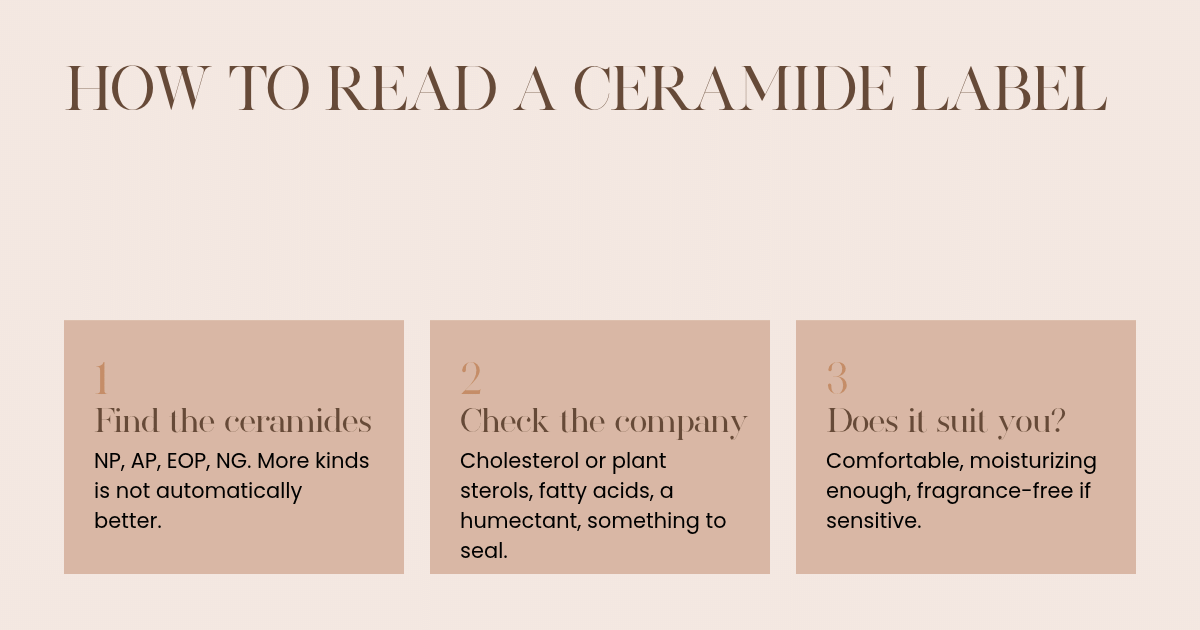
First, find the ceramides
On the list they carry letters: Ceramide NP, AP, EOP, NG, and older formulas sometimes still use a number such as Ceramide 3. These are cousins within one family, and your skin produces a whole range of them, so a product naming three covers more of that range than one naming a single type. More range, though, does not by itself make the cream better.
Second, check its company
This is where the recipe earns its keep. When lab researchers put ceramide alone on damaged skin, repair did not pick up and in some cases dragged, yet when all three lipids went on together the barrier mended the way it should. That work ran mostly in mice and a small number of people, so there is no perfect ratio to hunt for, and seeing all three on a label still does not guarantee the blend got it right. What you are hoping to spot is company for the ceramide: cholesterol, or the plant sterols that sit near it chemically without being the same thing, plus a fatty acid or two, linoleic or palmitic among them. After that, make sure the cream still handles the basics, a water-attracting humectant such as glycerin, something softening, and something to lock it all down. A ceramide does none of those jobs by itself.
Third, ask whether the formula works for your skin
Does it sit well, does it hydrate enough, and, if fragrance sets off your skin the way it does mine, is it fragrance-free? A cream you will reach for daily beats a dazzling ingredient list you use twice and push to the back of the shelf.
One point worth tightening up from the moisturizer post, where the three jobs come from. A label ranks ingredients by quantity, but only until you reach the one-percent line; past that, the order is a free-for-all. Ceramides normally land below that line, so how high up they appear is close to meaningless. Do not skip a ceramide cream just because its ceramide is buried near the bottom.
Dana’s Tip: Do not shop by counting ceramides. One cream with a single ceramide and a smart supporting formula can serve your skin better than one that names three and little else.
Do ceramide moisturizers actually work?
They can. A number of ceramide-based formulas have posted gains in hydration and in barrier readings in testing, and dermatologists do steer dry skin, including the ashy kind on deeper tones, toward them. The open question is whether they beat a plain good moisturizer. When a Cochrane team pooled seventy-seven eczema-moisturizer trials, they found nothing dependable showing one type beats another. That is a read on eczema moisturizers as a category rather than a direct contest between ceramide creams, but it is a fair brake on the hype.
Two real labels make the point. One cream in my rotation names three separate ceramides next to cholesterol, a fatty acid, and phytosphingosine, a building block of certain ceramides. The other names a single ceramide, sets it beside plant sterols and a pair of fatty acids, and lists no cholesterol at all. Both are real ceramide moisturizers, both arrived as gifts from the brands, and both have been in my routine for years. I won’t give you a verdict that the three-ceramide one wins, because a label cannot settle that. For the record, they are the Skinfix Triple Lipid-Peptide Cream and the Dieux Instant Angel, and I use them here as a reading exercise, not a two-item shopping list.
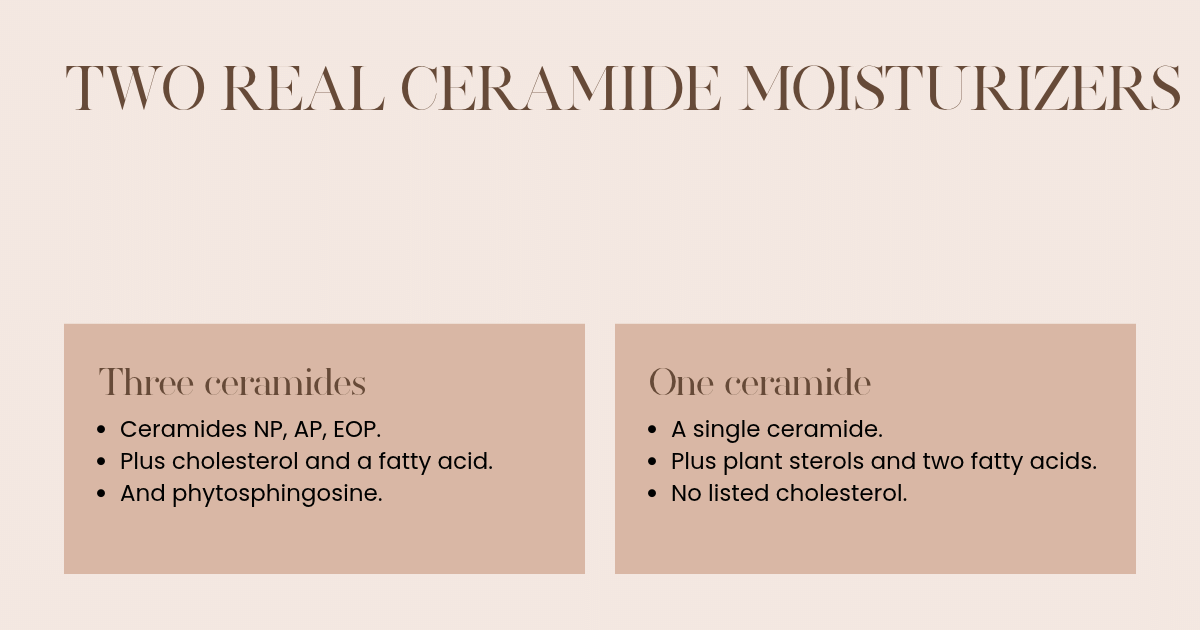
And that is the real takeaway. A ceramide is a perfectly good tiebreaker when you are choosing between creams. It is not, on its own, grounds for a higher price tag.
Ceramides or hyaluronic acid: which does your skin need?
This is the question that surfaces the second you start reading labels, because the two get shelved side by side and sold as rivals. They are not doing the same job. Hyaluronic acid is a humectant; it draws water up into the top layers of your skin. Ceramides are structural; they help the barrier keep that water from leaving. Treating it as an either-or is like asking whether a house needs water or walls. When skin feels tight and dehydrated, start on the water side, and the hyaluronic acid post walks through it. When skin feels dry, reactive, and slow to bounce back, the barrier side is where ceramides pull their weight. Most routines end up wanting a bit of both, layered so the water goes down first and the richer cream seals over it.
Three questions to ask before you buy a ceramide moisturizer
If you are in the store weighing it up, three questions handle most of the call.
- What is my skin actually asking for? Dryness, a tight feeling after cleansing, irritation, or am I just chasing the ingredient of the month? When the tightness lands right after washing, your cleanser is the likelier culprit. And ongoing stinging, cracking, or eczema flare-ups belong with a dermatologist, not with a label you are squinting at.
- Have I read past the front of the jar? Spot the ceramides if that is your reason for buying, then scan for the partner lipids and the water-grabbers and softeners that actually do the moisturizing, and keep an eye on fragrance if your skin reacts. A longer ceramide list is not a win.
- Do I need anything new at all? If the cream already on your shelf keeps your skin content and you are happy using it, there may be nothing to fix. Changing nothing is a fine result, and a free one.
If the real answer to that first question is ongoing stinging or cracking, skip the shelf and book a professional; the esthetician or dermatologist guide helps you pick which one. And for a shortlist of the calming ingredients worth keeping near your ceramides, the eczema ingredients post runs through them.
Go Deeper in the Video
In the video, I flip an actual jar over on camera and work down the label line by line, so you can watch where the ceramides land on a real list and what the partner lipids look like in the wild. It is the kind of thing that is easier to catch by watching than by reading.
Ceramide questions, answered
- Are more ceramides better?
Not by themselves. Naming three ceramides covers more of the family than naming one, but breadth is not the same as a well-built cream. What counts more is the company the ceramide keeps, cholesterol or plant sterols and fatty acids, and whether the cream is pleasant enough to use every day. - Where should the ceramide fall on the ingredient list?
Low, usually, and that is nothing to worry about. Quantity only drives the order down to roughly one percent; below that line, the sequence stops telling you much. Do not grade a ceramide cream on how near the top its ceramide sits. - Can a ceramide moisturizer fade my dark spots?
No. Supporting the barrier can reduce one source of the irritation that leads to new marks, though it is not a guarantee of fewer marks, and it does nothing for discoloration already there. That calls for a different routine. - Do I need a ceramide moisturizer if I already use hyaluronic acid?
They do different jobs, so it is not either-or. Hyaluronic acid draws water in; ceramides help the barrier hold it. If your skin feels dry and reactive rather than simply dehydrated, ceramides are the side worth adding.
The Bottom Line
Ceramides matter; they are a real part of how your barrier works, and a ceramide moisturizer can be a smart pick, especially if your skin runs dry or reactive after 40. A ceramide is a fair reason to pick one cream over another. It is not, on its own, a reason to spend more. Read the whole formula, look for the partner lipids and the ordinary moisturizing jobs, and judge the cream by whether your skin is comfortable in it.
The most useful move here is also the cheapest. Go flip over the cream already sitting on your shelf and read it the way we just did.
What To Do Next
- Watch the companion video for the on-camera label read.
- Browse my ShopMy edit for the fragrance-free moisturizers I keep in rotation.
- Find my current discount codes on the codes page.
Shop With Me
The products I keep in rotation plus my budget-friendly picks, all in one place: discount codes, my ShopMy edit, and my Amazon picks. This post may contain affiliate links; some products were gifted. I only feature what I use or genuinely recommend, and education always comes before product.
Some links are affiliate or press links. I only feature what I use or genuinely recommend, and education always comes before product.
Sources
- Feingold, Journal of Lipid Research (2007), barrier lipid composition
- Knox and O’Boyle, Chemistry and Physics of Lipids (2021), ceramide structure and naming
- Elias, Journal of Investigative Dermatology (1983), the two-compartment barrier model
- Rogers et al., Archives of Dermatological Research (1996), stratum corneum lipids by age and season
- Ghadially et al., Journal of Clinical Investigation (1995), barrier recovery and age
- Imokawa et al., Journal of Investigative Dermatology (1991), ceramides in atopic skin
- Kendall et al., Scientific Reports (2022), ceramides and menopause
- American Academy of Dermatology, dry skin remedies for darker skin
- Alexis et al., Journal of Drugs in Dermatology (2021), skin barrier variation in skin of color
- Man et al., Journal of Investigative Dermatology (1996), combined lipids and barrier repair
- US ingredient labeling rule, 21 CFR 701.3
- Spada et al. (2018), hydration and a barrier-mimicking cream
- Cochrane review, van Zuuren et al. (2017), moisturizers for eczema