Estimated reading time: 14 minutes
Tinted sunscreen for hyperpigmentation works because of what the tint is made of, not how it looks. Here is what iron oxides block, and how to tell whether the one you already own is doing anything at all.

You’ve been wearing sunscreen. Every morning, without skipping. You’ve got a serum you like and a routine you’re consistent with, and the dark spots are still moving slower than they should be.
The usual advice at this point is to reach for something stronger. A higher percentage, a new active, a different serum. But if you’re working on hyperpigmentation and progress has stalled, the more useful question isn’t what to add to your treatment step. It’s whether your sunscreen is covering everything you assumed it was.
For most of us, it isn’t. And the fix is smaller and cheaper than a new serum.
By the time you finish reading, you’ll know what visible light actually does to pigment in Black skin, why the tint in a tinted sunscreen is the functional part rather than the cosmetic one, why the label almost certainly won’t tell you how much of it is in there, and the two checks you can run on a bottle in about ten seconds. You’ll also know the difference between a tint that’s too sheer and one that simply matches you, which is the distinction that sends a lot of us looking for the wrong thing. Most of this costs you nothing, and you may find you already own what you need.
In This Post:
- Does Tinted Sunscreen Actually Help With Hyperpigmentation?
- What the Tint Is Actually Made Of
- Why Your Regular Sunscreen Doesn’t Cover This
- Why the Label Won’t Tell You How Much Iron Oxide Is Inside
- How to Tell if the Tint Is Working on Your Skin
- Choosing One: What to Actually Look For
- What a Tinted Sunscreen Will Not Do
- Go Deeper in the Video
- Tinted Sunscreen for Hyperpigmentation FAQ
- The Bottom Line
- What To Do Next
- Shop With Me
- Sources
Does Tinted Sunscreen Actually Help With Hyperpigmentation?
Yes, with one important qualification: it helps by protecting, not by fading.
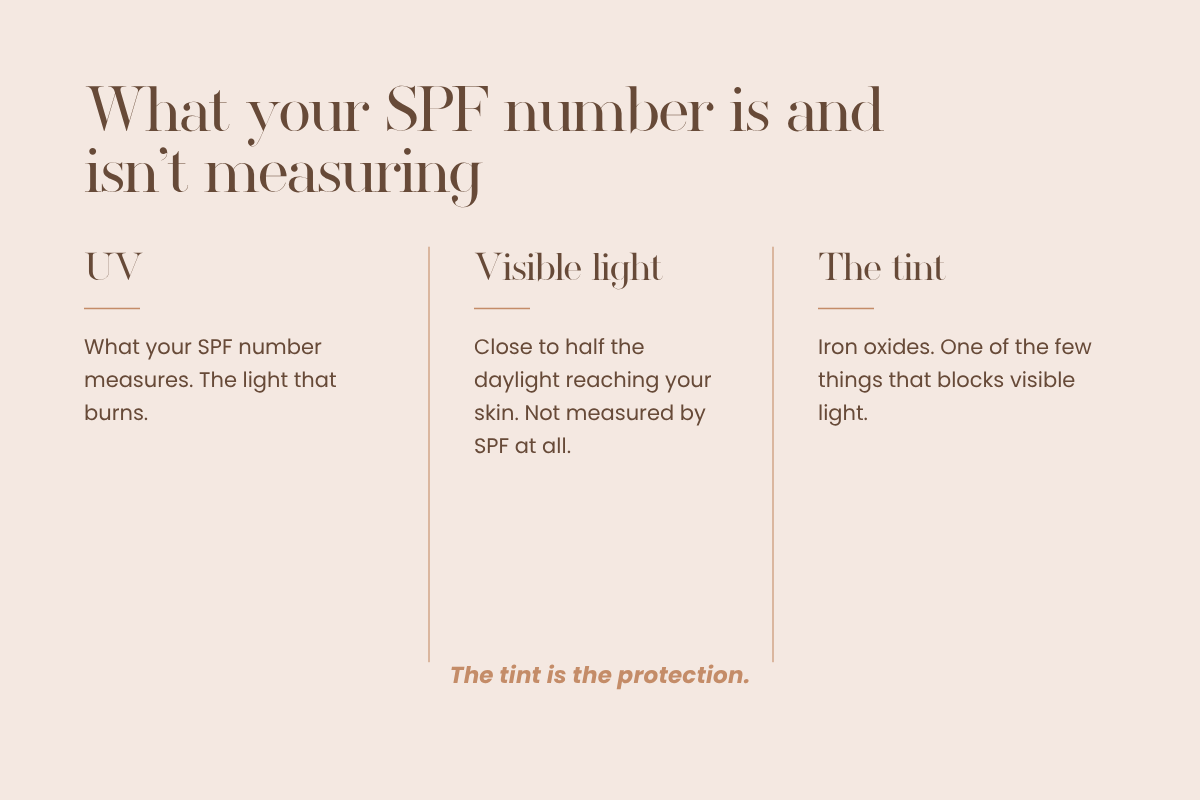
Your SPF number measures one thing, which is how well a product shields you from ultraviolet light. UV is the part that burns, and it absolutely matters. But UV is only a slice of what reaches your skin on an ordinary day. Visible light, the light you can actually see, makes up close to half of it, and it was left out of the SPF conversation for decades because nobody thought it did much to pigment.
That’s changed. Research now shows visible light, particularly the high-energy blue portion in roughly the 400 to 490 nanometre range, can trigger and worsen pigmentation, and that the effect is more pronounced and more persistent in richly pigmented skin [1] [2].
Here’s why that matters for your routine. If you’re actively working on a dark spot while getting daily unprotected exposure to visible light, you’re treating and re-triggering at the same time. The treatment isn’t failing. It’s working against something you didn’t know was there.
If you want the full picture of how those marks form in the first place, I’ve broken down what actually causes dark spots in Black skin separately. The short version worth carrying into this article is that our pigment cells respond readily to inflammation and to light, and the marks they leave take patience to resolve.
What the Tint Is Actually Made Of
The color in a tinted sunscreen almost always comes from iron oxides. On an ingredient list they appear as CI 77491, CI 77492, and CI 77499, usually alongside titanium dioxide.
Iron oxides are one of the very few cosmetic ingredients that meaningfully reduce visible light transmission [1] [5]. That’s the entire reason they’re in the bottle. The tint isn’t a finishing touch that the formulator added for appearance. It’s the functional component.
This is the part most people have backwards. The tint is the protection. Not the packaging around the protection, and not a cosmetic bonus sitting on top of a sunscreen. On a tinted formula, the pigment is doing a job that the UV filters cannot do on their own.
Dana’s Tip: Turn the bottle over and look for CI 77491, CI 77492, or CI 77499 before you look at anything else on the front. Those three codes are the tint. If they’re absent, whatever “tinted” means on that label, it isn’t iron oxides.
Why Your Regular Sunscreen Doesn’t Cover This
There’s a reasonable assumption that a good mineral sunscreen has this handled. Zinc oxide and titanium dioxide are physical blockers, so surely they block everything.
They don’t. In one study of people with Fitzpatrick type IV skin, which is the range that tans readily and rarely burns, iron-oxide containing formulations significantly protected against visible light-induced pigmentation, while a mineral SPF 50+ sunscreen did not [3].
So the meaningful split isn’t the one most of us were taught. It’s not chemical versus mineral. It’s tinted versus not. A non-tinted mineral sunscreen and a non-tinted chemical sunscreen are in roughly the same position on visible light, meaning they mostly let it through.
If white cast and filter chemistry are the thing standing between you and wearing sunscreen daily at all, that’s a separate and legitimate problem, and I’ve covered how to choose a sunscreen that disappears on deeper skin in detail.
Why the Label Won’t Tell You How Much Iron Oxide Is Inside
This is where it gets frustrating, and where being able to check for yourself becomes genuinely valuable.
There is no standardised rating for visible light protection the way SPF rates UV. Nothing on the front of the bottle is required to tell you how much iron oxide is in there, or whether the amount is meaningful.
A 2026 product analysis put numbers on how bad the gap is. Researchers examined 37 tinted sunscreens and contacted the manufacturers directly [2]. What they found:
- 97.3% did not list iron oxide as an active ingredient.
- Only 9.6% of responding brands would disclose the iron oxide percentage when asked directly. Among those that did, concentrations ranged from under 1.4% to 10.4%.
- Six brands claimed their product protects against visible light. Exactly one publicly detailed any testing supporting the claim.
That range matters. A product with under 1.4% iron oxide and a product with 10.4% are both sold as tinted sunscreen, and nothing on either label distinguishes them.
You’re not missing something obvious. The information mostly isn’t published.
How to Tell if the Tint Is Working on Your Skin
Since the label won’t answer this, your skin has to. And there’s a distinction here that trips people up, because two very different products can look identical on your face.
Sheer versus matched: they are not the same thing
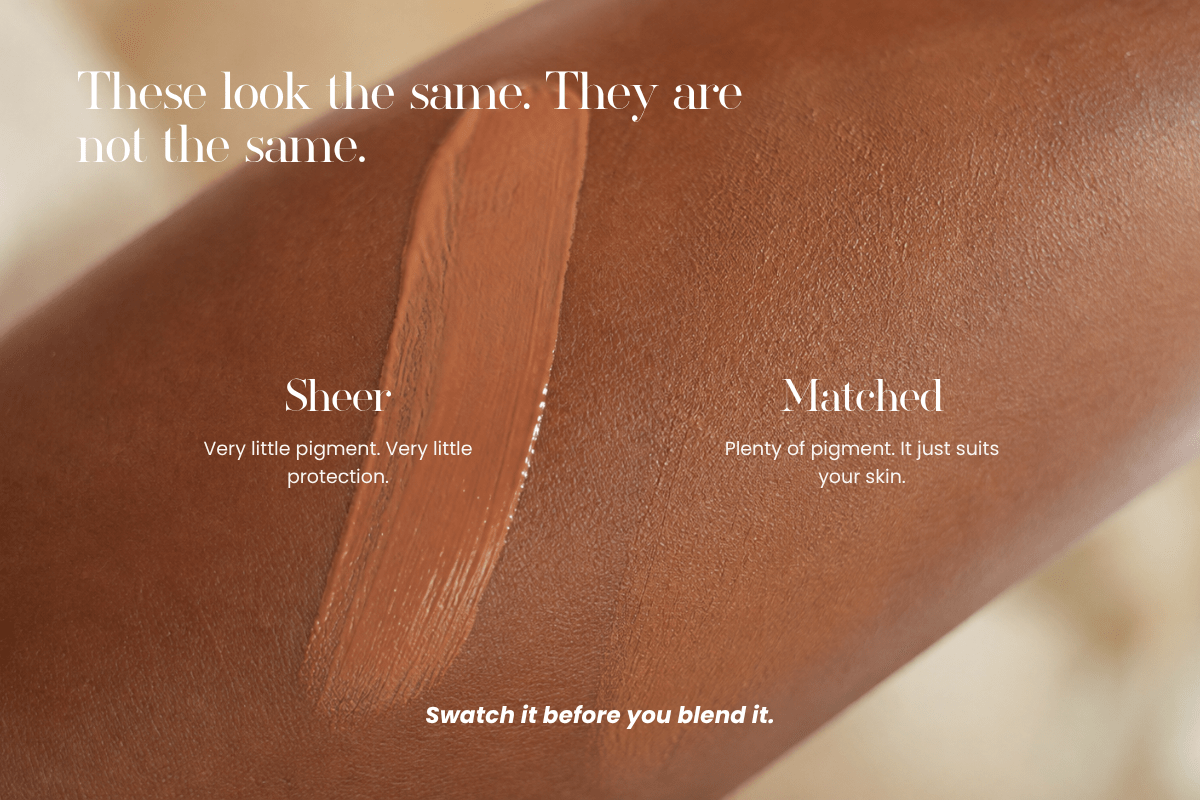
When you blend a tinted sunscreen in and it seems to vanish, there are two possible explanations:
- There’s very little pigment in it. Nothing much to see because there isn’t much there. That’s a real protection gap.
- There’s plenty of pigment and it matches your skin well. It disappears precisely because it’s doing its job on the right person.
Those outcomes look the same in a mirror and they are not remotely the same product. This is the part I’d want you to be careful with, because a woman who assumes the second case is the first will go looking for something more visibly tinted, and on deeper skin “more visible” very often means ashy or too light.
The test that actually separates them
Look at the product before you blend it. Swatch it on the back of your hand, or look at what comes out of the tube. Is there real color in it?
Then, after blending, ask whether your skin looks more even, not whether you can still spot the product sitting on top of it.
Pigment presence and pigment visibility are two different questions. You want the first. The second depends almost entirely on how well the shade matches you.
Dana’s Tip: Swatch it before you blend it. I’m in Merit Beauty’s 08 Chestnut, and there’s real pigment in it that still settles into my skin rather than sitting on top. That’s not a sheer formula failing. That’s a matched one working.
Choosing One: What to Actually Look For
You can run this standing in an aisle or on your own bathroom counter with something you already own.
- Broad spectrum on the label. This is your UV coverage and it isn’t optional. A tint is an addition to broad spectrum, never a replacement for it.
- Iron oxides on the ingredient list. CI 77491, CI 77492, CI 77499. The word “tinted” on the front is not evidence.
- Real color in the product itself, checked before you blend.
- A shade range that actually includes you. If a line stops at medium, the fourth check has already failed and the first three don’t matter.
- Something you’ll wear daily. A formula you avoid is protecting nobody.
That fourth point is worth sitting with. Shade range on tinted sunscreen is uneven, and plenty of products in this category are built in two or three shades that top out well before deep. The check that decides whether a tinted sunscreen is usable for you is often the one the brand answers on its shade page, not its ingredient list.
The tinted sunscreen I’m reaching for most often right now is Merit The Uniform Tinted Mineral Sunscreen SPF 45, in 08 Chestnut. It’s broad spectrum, iron oxides are on the list, and the range runs to 02, so it doesn’t stop at me. I’m still in the testing window with it, so I’m not calling it settled. I’ll tell you if it sticks.
There’s no discount code for it, and I’d rather say that plainly than imply otherwise.
Dana’s Tip: Your shade match will move with the seasons. Mine matches a tanned complexion right now and probably won’t in January. That’s normal, and it’s worth knowing before you decide a product stopped working.
What a Tinted Sunscreen Will Not Do
This is the honest part, and it’s the reason to trust everything above it.
A tinted sunscreen does not fade the marks you already have. It protects. It helps stop a mark from re-darkening while you work on it. Fading is a separate job with a separate routine, and I’ve walked through the full dark spot fade routine and how to layer it start to finish.
The evidence is stronger for melasma than for post-acne marks. A 2025 randomised study followed 42 women with melasma through a summer, comparing a visible-light-protective tinted sunscreen against an untinted one with matched UV protection [4]. After five months, the tinted group showed significantly better colour uniformity between the affected and unaffected skin. Overall melasma severity, though, improved in both groups with no significant difference between them.
Two things about that study you should know. Participants were phototype III and IV, so it doesn’t tell us directly about deeper skin. And it was funded by the company that makes the tinted product tested, with several authors employed there. That doesn’t make the finding worthless. It means you should hold it as one piece of evidence rather than proof.
For post-acne dark marks specifically, the mechanism and the prevention logic extend, but I haven’t found head-to-head evidence at the same standard. So the honest framing is that a tinted sunscreen can support a dark spot routine. Not that it’s proven to fade your marks.
One more piece of nuance worth having. Much of the strongest iron-oxide research was conducted on formulations in a foundation format [3]. So if you want more coverage than a sheer tint gives you, that isn’t a compromise on protection.
Ilia Super Serum Skin Tint SPF 40 is the other one I’m testing right now. It’s broad spectrum, zinc oxide is the active, the iron oxides are there, and it comes in 30 shades. The difference from Merit Beauty tinted mineral sunscreen is coverage. Ilia positions it as makeup, skincare, and SPF in one step, and it gives you light to medium coverage rather than a sheer wash. If a bare-skin day isn’t your thing, that’s the version that might actually stay in your routine.
I’m early with that one too, so treat it the same way. Something I’m testing, not something I’ve settled on. If you want to see the ones I’m testing, they’re in one place.
Go Deeper in the Video
In the companion video I walk through the visible light piece out loud, and I show two swatches on my own skin so you can watch what a real tint looks like going on and settling in. Seeing it move on skin does something a photograph cannot. I also talk through the makeup objection honestly, because I don’t wear complexion products either, and that conversation is easier out loud than in writing.
The sheer-versus-matched distinction above is written for the blog specifically. If that’s the part you came for, you already have it here.
Tinted Sunscreen for Hyperpigmentation FAQ
- Does tinted sunscreen help with dark spots?
It helps by protecting them, not by fading them. Iron oxides reduce how much visible light reaches your skin, and visible light can trigger and deepen pigmentation. That means a tint can stop a mark from re-darkening while you work on it. Actual fading comes from your treatment step. - How do I know if my tinted sunscreen has enough iron oxide?
Mostly, you can’t from the label. In a 2026 analysis of 37 tinted sunscreens, 97.3% didn’t list iron oxide as an active ingredient and fewer than 10% of responding brands would disclose the percentage [2]. Check that the CI codes appear on the ingredient list, then check whether there’s real color in the product before you blend it. - Is mineral sunscreen better than chemical for hyperpigmentation?
Not on its own. The distinction that matters for visible light is tinted versus untinted, not mineral versus chemical. A non-tinted mineral sunscreen offered no significant protection against visible-light-induced pigmentation in one study where an iron-oxide formulation did [3]. - Can I just use a tinted moisturizer or skin tint instead?
Often yes, if it’s broad spectrum and carries iron oxides. Much of the research supporting iron oxide protection used foundation-format products [3]. The question is whether you’ll wear it every single morning, including the mornings you weren’t planning to put anything on your face. - Will a tinted sunscreen look ashy on deep skin?
It shouldn’t, if the shade range genuinely extends to you. The problem is that plenty of tinted sunscreens are built in a handful of shades that stop well short of deep. Check the range before you check anything else. - Do I still need my regular sunscreen if I wear a tinted one?
A tinted sunscreen is a sunscreen, so it replaces rather than layers, as long as it’s broad spectrum and you’re applying enough. The tint is an addition to UV protection, not a substitute for it.
The Bottom Line
Sun protection was never only about the light that burns. Close to half of what reaches your face every day is visible light, and in Black skin that light has a hand in the very marks you’re working to fade. A tint is what addresses it, because iron oxides are among the few things that block it.
The good news is that this is one swap inside a purchase you already make, not a new expense or a longer routine. And you may not need to buy anything at all. If the tinted product already on your shelf is broad spectrum, has the CI codes on the list, and shows real color before you blend it, you’re covered.
The label can make the claim. Your skin decides if it’s true.
What To Do Next
- Watch the companion video for the full walk-through: https://youtu.be/rOx9Sc-f2Oc
- Working on marks you already have? Start with the dark spot fade routine.
- Browse SEE THE TINT COLLECTION, organized by how visible the tint is on deeper skin, if you want to compare options.
- Join the newsletter for one practical skincare lesson each week.
Shop With Me
The products I keep in rotation plus my budget-friendly picks, all in one place.
Sources
- He M, Chen X, Jin S, Zhang CF. Visible Light Protection: An Updated Review of Tinted Sunscreens. Photodermatology, Photoimmunology & Photomedicine. 2025. https://onlinelibrary.wiley.com/doi/10.1111/phpp.70033
- Doan V, Rustad AM, Akuamoah J, Sulejmani P, Tran JM, Krueger L. Iron Oxides in Tinted Sunscreen for Hyperpigmentation: A Product Analysis and Literature Review. Journal of Drugs in Dermatology. 2026;25(5):440. https://jddonline.com/articles/iron-oxides-in-tinted-sunscreen-hyperpigmentation-product-analysis-literature-review-S1545961626P9919X/
- Dumbuya, Grimes, Lynch, et al. Impact of Iron-Oxide Containing Formulations Against Visible Light-Induced Skin Pigmentation in Skin of Color Individuals. Journal of Drugs in Dermatology. 2020;19(7):712-717. https://jddonline.com/articles/impact-of-iron-oxide-containing-formulations-against-visible-light-induced-skin-pigmentation-in-skin-S1545961620P0712X/
- Polena H, Queille-Roussel C, Graizeau C, Duteil L, Sayag M, Passeron T. Comparison of Visible Light-Protective Tinted Sunscreen to Untinted Sunscreen to Protect Melasma Patients During Summer. Journal of Cosmetic Dermatology. 2025;24(10):e70450. https://pmc.ncbi.nlm.nih.gov/articles/PMC12475913/
- Lyons AB, Trullas C, Kohli I, Hamzavi IH, Lim HW. Photoprotection Beyond Ultraviolet Radiation: A Review of Tinted Sunscreens. Journal of the American Academy of Dermatology. 2021;84(5):1393-1397. https://www.jaad.org/article/S0190-9622(21)03006-1/fulltext