Estimated Reading Time: 14 minutes
Skincare after 40 should not stop at your jawline. This guide explains how to care for your neck, chest, and hands, including neck wrinkles, aging hands, sun protection, and when darkening on melanin-rich skin deserves a closer look.
If you are somewhere in your forties and your skin suddenly feels like it belongs to someone else, you are not imagining it, and you are not doing anything wrong. A lot of what gets filed under aging in this decade is really about hormones. Perimenopause skin changes, and the broader menopause skin changes that follow, tend to show up as drier skin, more reactivity, and a face that looks a little less firm than it did, driven by one thing in particular: estrogen starting to drop. The good news is your skin doesn’t need to be rebuilt. It needs the routine you already own, retuned for skin that keeps less water, builds less collagen, and recovers more slowly than it once did.
In This Post:
- Is It Your Age, or Is It Your Hormones?
- What Estrogen Does for Your Skin
- When Do Perimenopause Skin Changes Start?
- What Changes for Black Women Specifically
- Retuning Your Routine, One Adjustment per Step
- Do You Need “Menopause” Skincare?
- What Skincare Cannot Do, and When to See a Doctor
- Go Deeper in the Video
- Perimenopause and Menopause Skin Questions, Answered
- The Bottom Line
- What To Do Next
- Shop With Me
- Sources
Is It Your Age, or Is It Your Hormones?
This is usually the first question, and it is the right one to ask, because the answer changes how you respond. Ordinary aging is slow and steady. The shift around perimenopause is different: it can feel like your skin turned a corner over a season rather than over a decade. When your usual moisturizer stops holding you through the day, when a serum you have used for years starts to sting, or when your skin looks thinner on your neck and the backs of your hands, hormones are usually part of the story.
A quick word on where I stand, since it shapes how I teach this. At 44, my doctor and I don’t think I’ve entered perimenopause yet. The women closest to me are in it now, though, and it is what you ask me about more than almost anything, so I dug into the research to stay a step ahead for all of us. What follows comes from that reading and from your questions. If you want the companion piece on why skin gets more reactive with age, I cover that in the video on sensitive skin after 40.
What Estrogen Does for Your Skin
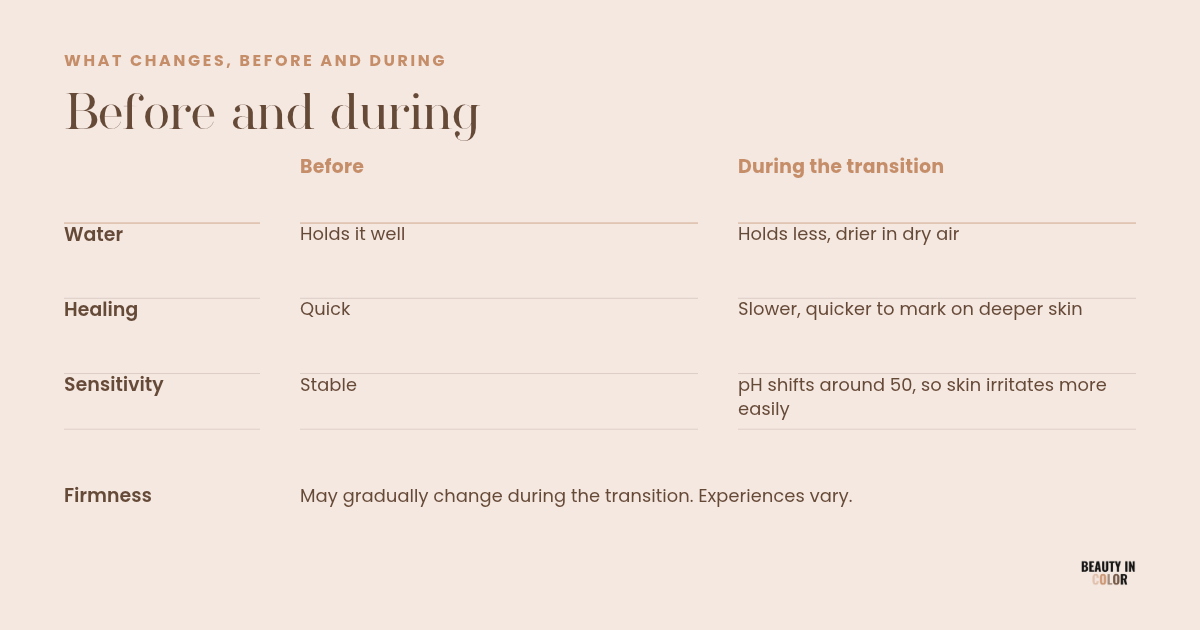
Estrogen quietly handles three jobs for your skin. It helps your skin hold on to water, it supports the collagen that keeps skin firm, and it speeds up repair after anything irritates you. As estrogen drops, none of those three jobs stops, but each one slows down and runs a little less efficiently. Your skin still works. It is simply getting less behind-the-scenes support than it had a few years ago.
Dermatologists describe all three shifts. Water comes first: skin retains less of it, so it reads drier, and dry air outside makes it more obvious. Thickness is next: as estrogen falls, skin grows thinner, and the change shows earliest wherever skin was already thin to begin with. Then there is collagen, which drops on a schedule worth knowing (American Academy of Dermatology).
That collagen schedule is the number that caught me off guard, so here it is as a quick visual.
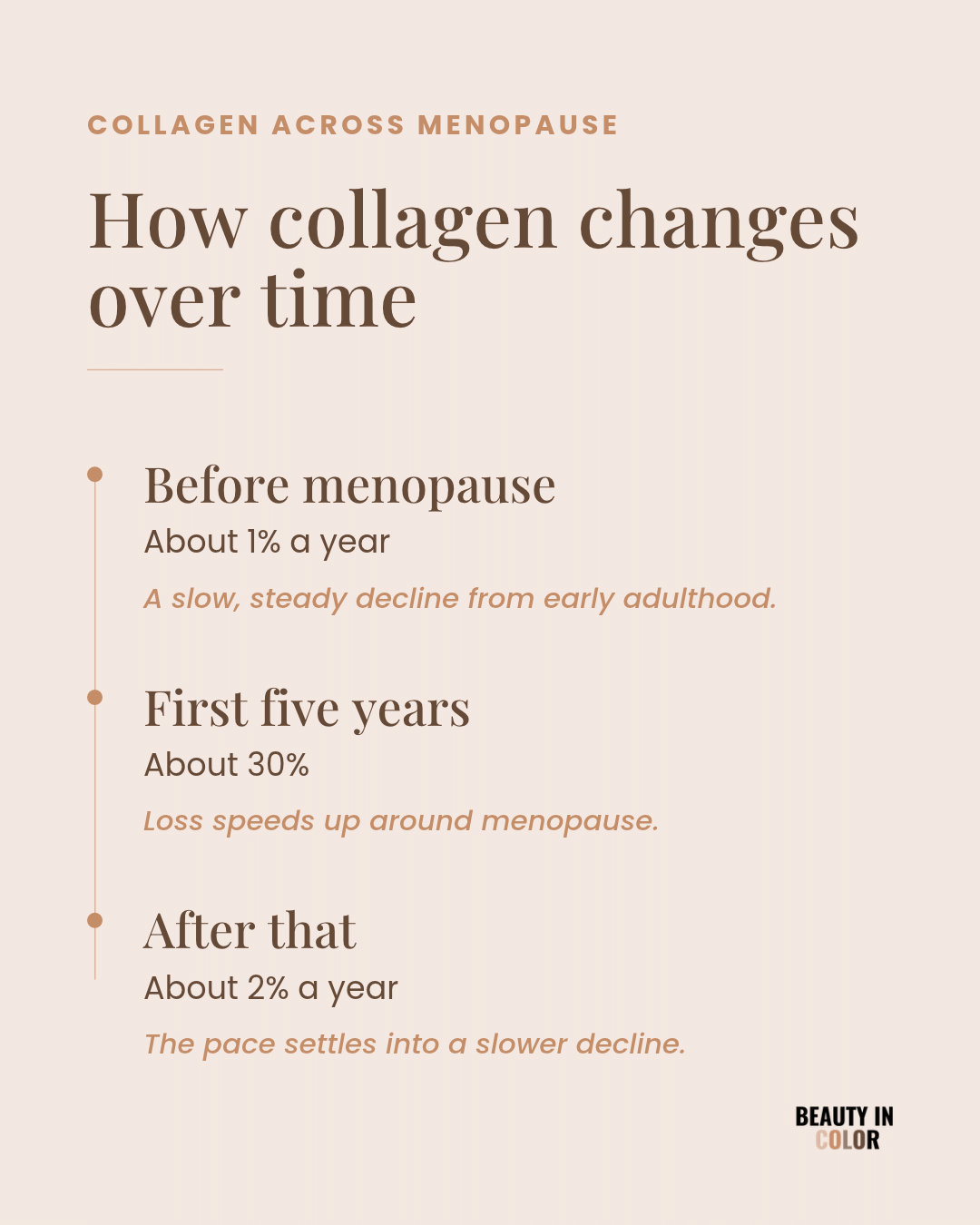
From our twenties on, collagen slips away gradually, on the order of one percent a year. Then menopause front-loads the loss: roughly thirty percent disappears across its opening five years, many times the earlier rate, before the pace levels off near two percent a year (Reilly and Lozano, 2021, whose authors work in the collagen-supplement field, so treat the exact figure as a loose estimate; American Academy of Dermatology).
Here is what all of that adds up to, side by side, so you can see what is actually changing.
When Do Perimenopause Skin Changes Start?
Menopause is one specific day: the point at which twelve straight months have passed without a period. In the United States that lands around age 52 on average. Perimenopause is the run-up to it, and it is where the skin shifts usually begin, often in the mid to late forties, sometimes as early as the thirties, and it runs roughly four years, anywhere from two to eight (Office on Women’s Health; Mayo Clinic).
Across those years, estrogen falls unevenly, rising and dipping on the way down, which is part of why a blood test usually cannot pin down where you are. And because the shifts accumulate so gradually, they are easy to miss until it feels like your skin changed overnight, when really it had been moving for a long while.
What Changes for Black Women Specifically
This is the research I went looking for hardest, and there is thinner evidence here than there should be, a gap the reviewers in this field name openly. What does exist is still worth having.
One trial tracked women for four years after menopause, measuring their skin each year. Of every group in it, Black women showed the fewest lines, from the first measurement to the last (Wolff and colleagues, 2011). Our melanin tends to hold wrinkles off longer, and that head start carries into this season too. Firmness was a different story. By year four, researchers also observed a difference in facial firmness compared with the white participants (Owen and colleagues, 2016). It is a single trial, measured only at the forehead and cheek, so I hold it loosely. It does not establish that Black women lose firmness earlier than other women, or that firmness changes necessarily arrive before fine lines. What I take from it is narrower, and it still matters: wrinkles are not the only signal worth watching, so I keep an eye on dryness and firmness too.
The second piece is about healing. Lower hormones mean skin knits back together more slowly, and that lands differently for us: when deeper skin is irritated, it tends to darken rather than redden, and the mark it leaves can sit for months once the irritation itself has passed. No study has measured those marks on either side of menopause, so I will not hand you a figure. What I can tell you is that skin which heals slowly and marks easily is skin to treat with a lighter hand, and that shapes every step that follows. The reviewers in this field say the same about how thin the evidence for deeper skin still is (Viscomi and colleagues, 2025).
The timeline runs a little differently for us as well. The biggest long-running study of this transition found that Black women tend to reach menopause somewhat sooner, carry hot flashes for roughly ten years against six and a half for white women, and use hormone therapy at about half the rate (Harlow and colleagues, 2022). None of that is skin data on its own. It is a case for a routine you can sustain for a decade over a product you drop inside a month.
Retuning Your Routine, One Adjustment per Step
Your four steps hold: cleanse, treat, moisturize, protect. What changes is one adjustment inside each one. Here is the whole picture first, then the detail.
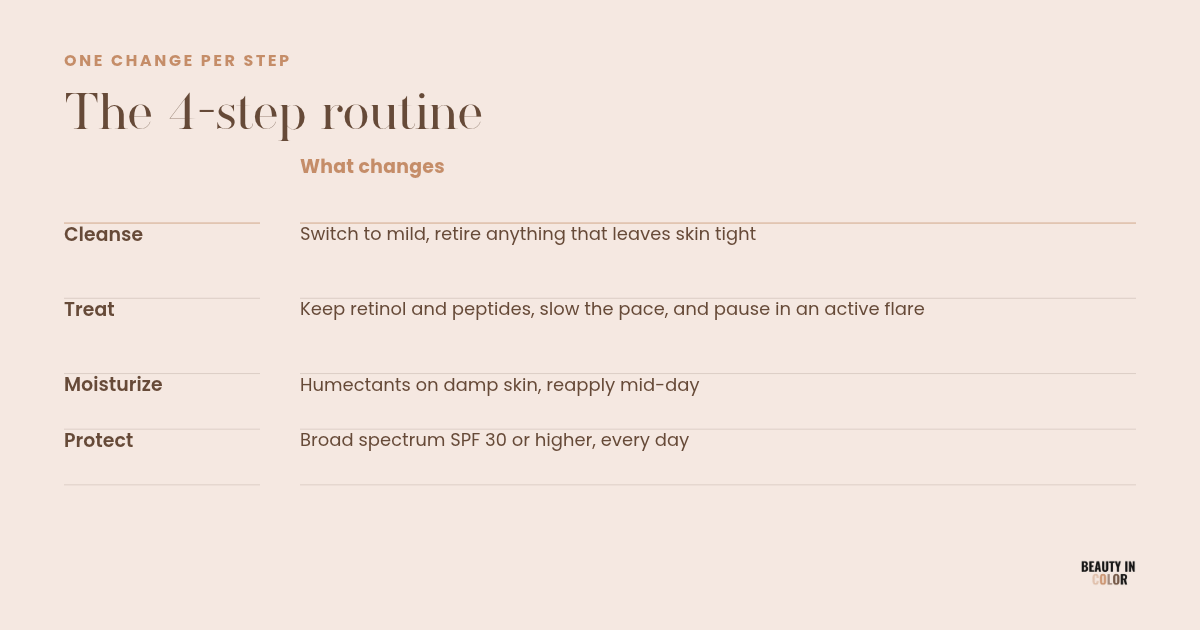
Cleanse: switch to mild, and drop anything that leaves your face tight
Skin holding less water can’t take a cleanser that strips it. Switch to a mild formula and drop anything that leaves your face tight once you have rinsed. If breakouts have come back, as they do for some women around this time, note that teen-aisle acne products run too aggressive for skin that is now thinner and drier, so take that one to a dermatologist if it does not calm down on its own.
Treat: keep your actives, slow the pace
Treating is the step that tends to make people nervous, and the reassuring part is that your actives stay. The two ingredients dermatologists lean on for collagen, retinol and peptides, aim at exactly what is declining, so there is no reason to retire them.
What shifts is the cadence. I keep retinol to one or two evenings a week and run a peptide serum the rest of the week, not because either outperforms the other but because that rhythm is what my skin can take. If yours is turning more reactive but still comfortable, ease the frequency down before you cut anything out.
There is a point, though, where easing off is not enough. If you are in an active eczema flare, genuinely irritated, or your barrier feels compromised, pause the retinol and any other stinging actives, keep things gentle and barrier-supportive for a while, and check with a dermatologist about persistent symptoms or when to restart. New to retinol? Here is how to start retinol. The one practice I would set aside is at-home resurfacing: harsh peels and vigorous scrubbing belong in a professional’s hands once skin is thinner, not on your own bathroom counter.
Dana’s Tip: Let your skin set how often you use retinol, not the calendar. If it is just a little reactive, ease back a night before you drop it. If it is actively flaring or your barrier feels compromised, stop and let your skin settle before you start again.
Moisturize: the step that now takes the most effort
The bulk of your effort moves here now. The goal comes in two simple parts: get water onto the skin, then help it stay put. Reach for humectants such as hyaluronic acid or glycerin, which draw water inward (more on how those work in the hyaluronic acid guide). Smooth your moisturizer onto still-damp skin right after you cleanse, and top it up later in the day whenever your skin feels tight. Menopause dry skin rewards water applied often far more than one heavier layer at breakfast. For years my own version has been plain: a hyaluronic serum onto damp skin, then a moisturizer to seal it in.
The serum I reach for year round is the NIOD Multi-Molecular Hyaluronic Complex, which I have used long term. Over it, through the cooler months, I seal with the Dieux Instant Angel, a firming moisturizer I am using now. Both are fragrance-free, which carries more weight at this age: somewhere around 50 the skin’s pH shifts and it takes offense more easily, and eczema can flare harder than it once did. What actually fills a good moisturizer, its lipids and ceramides, is a subject of its own, and it is the one I am covering next. If you are choosing a moisturizer in the first place, here is how I pick a moisturizer.
Dana’s Tip: When your skin feels tight by mid-afternoon, reapply your moisturizer on the spot, over makeup or bare skin, rather than saving it for your evening routine.
Protect: daily broad-spectrum sunscreen, SPF 30 and up
Sunscreen is daily, broad spectrum, SPF 30 or above, anywhere your clothing leaves exposed. It will not rebuild thickness, but it slows further thinning, and it helps fade the dark spots you have while keeping new ones from setting in, which counts for a great deal on skin that marks easily. Keep one fragrance-free formula you genuinely like within arm’s reach, so the step that matters most is also the easiest to actually do.
Do You Need “Menopause” Skincare?
There is an entire aisle labeled for menopause now, and the plain truth is that the word on the box does nothing on its own. The work is done by a gentle cleanser, by water-binding ingredients, by retinol or peptides, and by daily sunscreen, and you may already own most of that lineup. A menopause label does not make a formula better, and it does not make it worth switching to. Read the ingredient list, not the front panel, and spend only where a step is genuinely missing, not where the marketing is loudest.
What Skincare Cannot Do, and When to See a Doctor
A routine covers a great deal, but it would be a disservice to suggest it covers everything. The question I get first is about hormone therapy, and that is a whole-body decision you make with your doctor. It is rarely prescribed for the skin by itself, and in the four-year trial above it moved neither wrinkles nor firmness (Owen and colleagues, 2016; Bravo and colleagues, 2024). If you take it for other reasons, your skincare stays exactly as it is.
A few things deserve a professional’s eyes rather than a new product:
- A new dark spot. Have a dermatologist check it before you try to fade it, because now and then an early skin cancer can pass for an everyday dark mark, and treating it as one simply delays the diagnosis.
- Breakouts that will not calm down. Acne is common in this season, and the products aimed at teenagers tend to be too stripping for skin that is now thinner and drier.
- Any strong resurfacing. Peels and aggressive exfoliation on thinner skin start with a professional, not with your cart.
If you are not sure whether your concern is a skincare question or a see-someone question, here is how I think about esthetician versus dermatologist.
The last piece is not skincare at all. The women a decade or two ahead of me keep repeating the same advice about this stretch of life: stay on top of strength work, get enough protein to protect your muscle, sleep well, and keep stress from running the show. I am working on all of it, the stress part most of all. I cannot teach that part, but I would be skipping something real if I acted as though your skin stood apart from everything else happening in your body.
Go Deeper in the Video
The video walks through each step out loud, with the collagen numbers and the research for Black women on screen as I explain them, and it is where I talk through my own retinol-and-peptide week in more detail than fits here. If you take in a routine better by watching it than by reading it, start with the video and come back to this page as your reference.
Perimenopause and Menopause Skin Questions, Answered
- Does menopause age skin?
It changes skin more than it ages it in the usual sense. As estrogen falls, skin holds less water, thins, makes less collagen, and heals more slowly. Those shifts can look like faster aging, but much of it responds to a gentler, more hydrating routine and daily sunscreen, so it is better understood as skin working with less help than as skin simply getting older. - When do perimenopause skin changes start?
Usually in the mid to late forties, though some women notice changes in their thirties. Perimenopause lasts about four years on average, with a range of roughly two to eight, and the skin changes build gradually across it (Office on Women’s Health). - Why is my skin so dry during menopause?
Lower estrogen means skin holds less water, so menopause dry skin is one of the most common complaints. The fix is to add water often rather than once: a humectant serum on damp skin, a moisturizer over the top, and a second application mid-day whenever your skin feels tight. - Can hormone therapy improve my skin?
Hormone therapy is a whole-body decision you make with your doctor, not a facial treatment. It is rarely prescribed for the skin by itself, and across a four-year trial it moved neither wrinkles nor firmness (Bravo and colleagues, 2024). - Is skincare during menopause different for Black women?
The core steps are the same, but the emphasis shifts. In one four-year study, Black participants kept fewer wrinkles while researchers also observed a difference in firmness compared with white participants. That single study does not prove Black women lose firmness earlier or that it changes before wrinkles, but it is a good reason to watch dryness and firmness, not only lines. Skin that is slower to heal is also quicker to leave a dark mark, so being gentle and consistent matters even more.
The Bottom Line
Your skin is not failing you. It is simply running with less support than it had, and a few small changes hand some of that support back. The estrogen that kept water in, held collagen up, and sped repair is easing off, so you cleanse gentler, carry your actives at a slower pace, pour most of your effort into water, and protect daily. You almost certainly do not need an aisle of new products with menopause on the label.
If you take one thing from this, make it the easiest one: the moment your skin feels tight in the afternoon, reapply your moisturizer right then instead of waiting for the evening. That is the first adjustment, and it is one you can make today.
What To Do Next
- Watch the companion video for the full walk-through here.
- If your skin has mostly gotten more reactive, read why your skin turns more reactive with age next.
- Browse the Hydrate, Then Seal collection, organized so you can see which product does which job before you decide anything belongs in your routine.
- Get the weekly letter for Black women over 40, straight to your inbox: join the Beauty In Color newsletter.
Shop With Me
The products I keep in rotation plus my budget-friendly picks, all in one place.
- Discount codes page: beautyincolor.com/beauty-discount-codes.
- My ShopMy edit: shopmy.us/shop/beautyincolor.
- Amazon budget picks: amazon.com/shop/beautyincolor_official.
- This week’s collection: Hydrate, Then Seal. A few of these picks are also in The Sephora Holiday Savings Event Edit if you are shopping the late-October event.
Some links are affiliate or press links. I only feature what I use or genuinely recommend, and education always comes before product.
Sources
- Caring for your skin in menopause (American Academy of Dermatology): https://www.aad.org/public/everyday-care/skin-care-secrets/anti-aging/skin-care-during-menopause
- Menopause basics (Office on Women’s Health): https://womenshealth.gov/menopause/menopause-basics
- Perimenopause (Mayo Clinic): https://www.mayoclinic.org/diseases-conditions/perimenopause/symptoms-causes/syc-20354666
- Skin collagen through the life stages (Reilly and Lozano, 2021): https://www.oaepublish.com/articles/2347-9264.2020.153
- Skin wrinkles and firmness in early postmenopausal women by race (Wolff and colleagues, 2011, KEEPS): https://einstein.elsevierpure.com/en/publications/skin-wrinkles-and-rigidity-in-early-postmenopausal-women-vary-by–2/
- Hormones, skin wrinkles, and firmness, four-year follow-up (Owen and colleagues, 2016, KEEPS): https://www.fertstert.org/article/S0015-0282(16)61352-3/fulltext
- Managing menopausal skin changes, narrative review (Viscomi and colleagues, 2025): https://pmc.ncbi.nlm.nih.gov/articles/PMC12374573/
- Disparities in reproductive aging between Black and White women (Harlow and colleagues, 2022, SWAN): https://pmc.ncbi.nlm.nih.gov/articles/PMC8822825/
- Dermatological changes during menopause and HRT (Bravo and colleagues, 2024): https://www.mdpi.com/2079-9284/11/1/9