Estimated Reading Time: 9 minutes
Peptides for skin after 40 are printed on every serum and moisturizer, and the marketing around them is loud. Here is what the ingredient really does, where it sits next to retinol, and how to tell whether the one in your cabinet is worth keeping.
I keep both retinol and peptides in my own routine. My skin runs dry, sensitive, and quick to react, so I have spent a while figuring out where each one belongs, and I have gone back to the studies to make sure the way my skin feels matches what the evidence shows.
The short version is that peptides for skin after 40 can earn their place, once you know the narrow job they do. Think of them as a supporting player: gentle on the skin, fine for most nights, and designed to work with retinol rather than replace it.
In This Post:
- Peptides for skin after 40: what do they do?
- Do peptides really work, or is it mostly marketing?
- Peptides vs retinol: do you need both?
- How often should you use peptides?
- Should your peptide be a serum or a moisturizer?
- How to choose a peptide product
- Go Deeper in the Video
- Peptides for skin: frequently asked questions
- The Bottom Line
- What To Do Next
- Shop With Me
- Sources
Peptides for skin after 40: what do they do?
Start with the material your skin is made of. Collagen, the protein you already associate with firmness and bounce, is built from amino acids. Chain a few of those amino acids together and you have a peptide. So a peptide on an ingredient list is a small fragment of the very stuff your skin already produces.
In a formula, certain peptides behave like a quick note passed to your skin cells, a short prompt to keep doing their job. It is a nudge, not a full set of instructions, and different peptides carry different prompts. Some signal for more collagen support, some ferry minerals like copper that the skin draws on for repair, and some slow the enzymes that chip collagen away. A single well-made serum can carry more than one of them, which is part of the appeal.
Over a stretch of weeks, the payoff tends to show up as comfort and a bit more spring in the skin, which lines up with what pooled studies track: moisture, surface smoothness, and the appearance of fine lines. Reactions in those trials were rare, which fits the gentle reputation. The caveat worth stating plainly is that the evidence is thin. The most recent pooled review found only two well-run trials of topical peptides, and the wrinkle improvement they measured was small and not statistically meaningful. The sticking point is delivery: a peptide has to survive the trip through the skin, and whether it does depends on how the product is built.
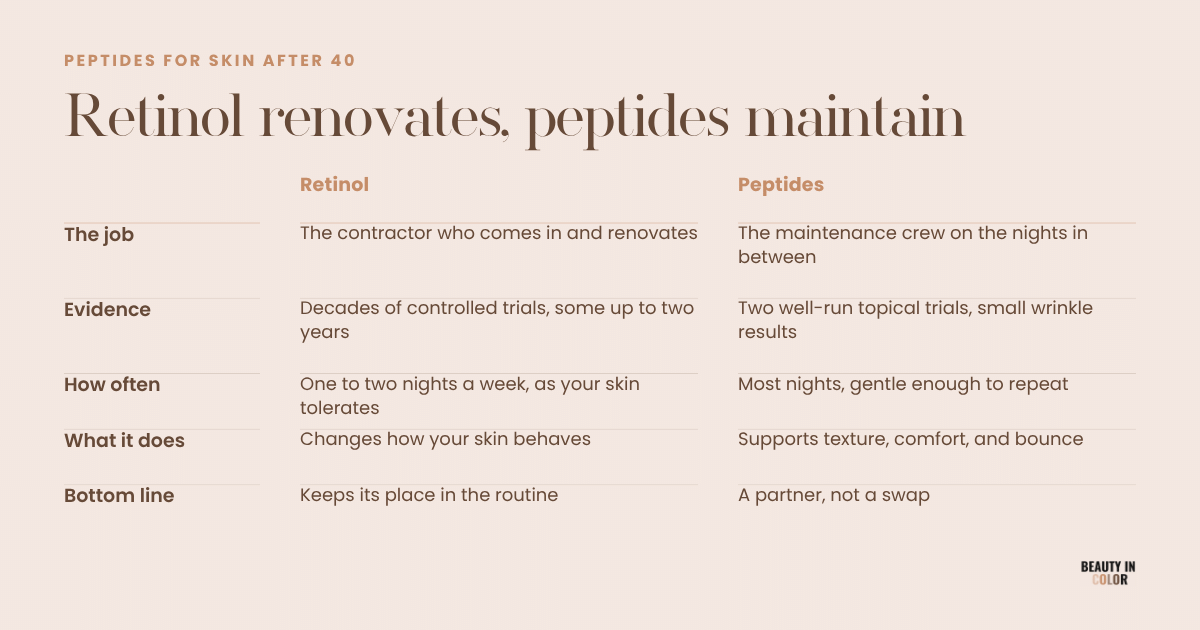
Here is the shorthand I keep in my head for how the two compare.
Do peptides really work, or is it mostly marketing?
It can be both at once. The ingredient and the mechanism are legitimate, and the claims on the box often run well past the data. The tell is the phrase Botox in a bottle, which you will spot on more than one peptide product. That is a sales line, not a study result. The peptide behind it is a fraction as potent as the injectable and gets into the skin poorly, so the comparison falls apart on contact.
Set your expectations around firmness, texture, and comfort, and expect to notice them as a feeling before you see anything in the mirror. In the trials, the window to a visible change ran somewhere between one and three months, so checking the next morning only sets you up to be disappointed.
Dana’s Tip: Rate a peptide product by how your skin feels after a couple of months, not by the promise on the front of the box. Seeing the word on a label only confirms the ingredient is in there, never that the formula around it was done well.
Peptides vs retinol: do you need both?
Picture retinol as the general contractor on a gut renovation. It changes the way skin behaves, and it carries decades of controlled trials, a few of them stretching to two years, which is a depth of evidence almost nothing else in this category comes close to. Peptides are more like the crew that keeps the place running smoothly between those big jobs, steady and mild enough to show up most nights. That is why I treat peptides as a partner to retinol, not a swap for it.
If retinol never agrees with your skin, peptides are a sensible place to spend your effort, as long as you are clear that you are choosing the gentler route with less proof behind it, not a backdoor to the same outcome. And if retinol is still on your list, whether you have not started or you stopped when your skin rebelled, that is its own topic, and I lay out a careful way in elsewhere.
Related: how to start retinol without wrecking your skin.
How often should you use peptides?
This is the part people do not expect. My peptide serum goes on roughly twice as often as my retinol, and not because it does more. Retinol sits at one or two nights a week in my routine, which is the ceiling my skin will take without flaring, and peptides fill the nights around it precisely because they do not provoke a reaction. What sets the rhythm is tolerance, not potency. The research leans the same way: peptides were applied daily in the trials, and twice daily in one, which only works because people handled them so easily.
For us, tolerance matters even more. When darker skin gets irritated, it usually leaves a mark instead of redness, and that mark can stay for months after the irritation itself is gone. So I keep retinol at the limit my skin can handle, and on the nights in between I use something that still does a job while keeping my skin calm.
More on why marks stay on Black skin: hyperpigmentation on Black skin.
Should your peptide be a serum or a moisturizer?
No study I have seen hands the win to one format over the other. What matters more is that the product stays on the skin long enough to work and is engineered to carry the peptide past the surface, since getting through is the whole challenge.
For a first step, a moisturizer with peptides is the least complicated choice, because it’s already in your routine and you add nothing new. Reach for a serum when you want a dedicated treatment on the nights retinol is resting; it slots in after cleansing and before moisturizer, in the same spot as any treatment. Two of the serums I keep are copper peptides, which carry a small dose of copper skin uses to repair, and copper raises its own questions about what to use alongside it, which I handle in the FAQ below.
How to choose a peptide product
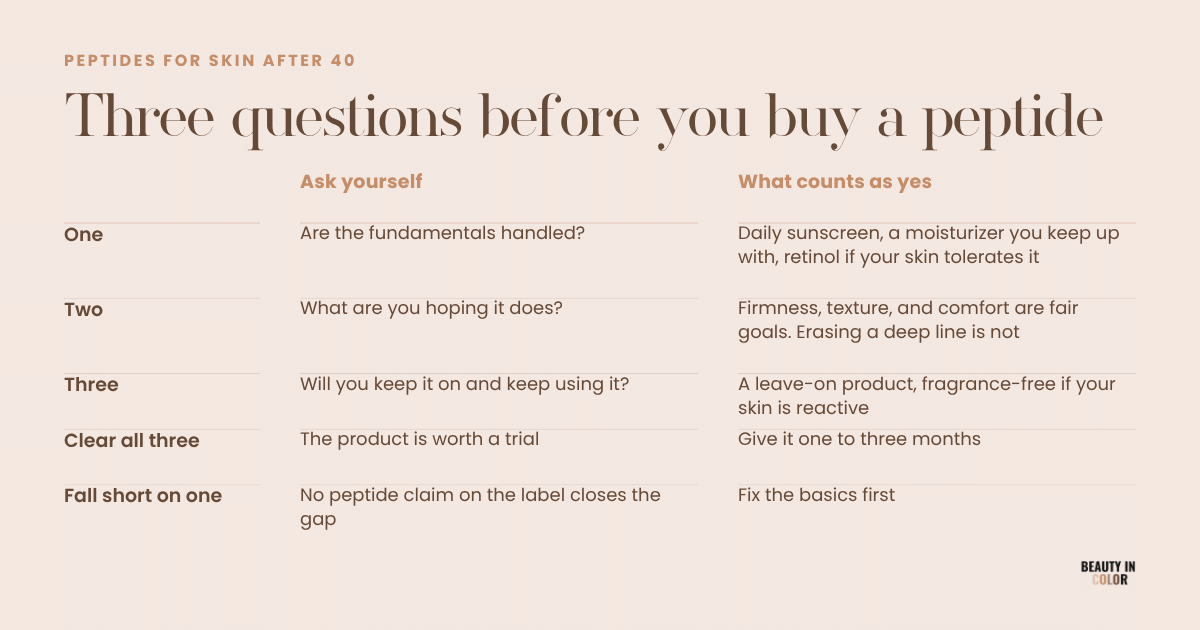
Run any candidate through three quick questions before you reach for your card.
- Are the fundamentals handled? Daily sunscreen, a moisturizer you stick with, and a retinol if your skin tolerates it. Peptides reinforce a routine; they do not rescue a missing one.
- What are you hoping it does? Firmness, smoother texture, and comfort are fair goals. Erasing a deep line is not.
- Will you keep it on and keep using it, and is it fragrance-free if your skin reacts the way mine does?
If it clears all three, it is worth a trial. Fall short on any of them, and no peptide claim on the label will close the gap.
Go Deeper in the Video
The companion video walks through all of it on camera: what peptides are, how they sit next to retinol, how often I use them, and whether yours should be a serum or a moisturizer. Watch it here.
If you are deciding between a serum and a moisturizer, the last section is the one to watch; I show both and explain how I pick.
Peptides for skin: frequently asked questions
A few questions that come up around peptides, kept short.
- Do copper peptides need special pairing?
Keep copper peptides uncomplicated. The usual worry is stacking them with direct acids, pure vitamin C, or retinol in the same routine, and the brand behind the serum I use says to run those in alternate routines rather than together. So copper peptides get their own nights, applied first after cleansing before anything else, and the acids, vitamin C, and retinol get theirs. If retinol is already in your week, that rhythm is built in: copper peptides on the nights retinol is off. - Can you use peptides with retinol on the same night?
You can, and plenty of people layer them without trouble. I alternate instead, retinol on its one or two nights and peptides on the rest, because alternating is what keeps my reactive skin settled. If you do want to layer, add one product at a time so you can read how your skin responds. - Are peptides safe for sensitive or eczema-prone skin?
Peptides are among the better-tolerated actives, which is a large part of why I rely on them. If your skin reacts easily, pick a fragrance-free leave-on, introduce it when your skin is calm, and give it time. If you are working through eczema specifically, get to a settled baseline before you add anything. My full approach for reactive and eczema-prone skin is here: the eczema skincare routine.
The Bottom Line
Peptides are a supporting ingredient, not a replacement for retinol. Retinol does the renovating on the one or two nights your skin can handle it; peptides keep things running on the nights in between, and that steadiness is where the value sits. Set your expectations around comfort, texture, and bounce, give it one to three months, and before you buy anything new, read the label on the moisturizer already on your shelf. There is a decent chance peptides have been in there all along.
What To Do Next
- Watch the companion video: How to Use Peptides in Your Skincare Routine After 40.
- Browse the peptide serums and moisturizers I use: The Peptide Edit.
- Join the newsletter for the weekly lesson in your inbox: Beauty In Your Inbox.
Shop With Me
The products I keep in rotation plus my budget-friendly picks, all in one place.
- The Peptide Edit: this week’s peptide serums and moisturizers: shopmy.us/shop/collections/7959762
- Discount codes: beautyincolor.com/beauty-discount-codes
- My ShopMy edit: shopmy.us/shop/beautyincolor
- Amazon budget picks: amazon.com/shop/beautyincolor_official
These are affiliate links, which means I may earn a small commission at no extra cost to you. I only link products I use or would recommend.
Sources
- Nukaly et al., topical peptides for skin aging, Frontiers in Medicine (2026)
- Cosmetic peptide classes and skin penetration, Biomolecules review (PMC)
- Anti-wrinkle peptides and the penetration limitation, Int. J. Cosmetic Science (2022)
- Tretinoin as the gold standard; alternatives better tolerated, Am. J. Clin. Dermatol. (2024)
- Tretinoin RCTs, follow-up to two years, meta-analysis (PMC)
- Retinol improves fine wrinkles, network meta-analysis, Scientific Reports (2025)
- Acetyl hexapeptide-8 versus botulinum toxin, potency and absorption, JDD (2025)
- Post-inflammatory hyperpigmentation in skin of color, JCAD
- PIH patient education, Skin of Color Society