Estimated Reading Time: 12 minutes
Skincare after 40 should not stop at your jawline. This guide explains how to care for your neck, chest, and hands, including neck wrinkles, aging hands, sun protection, and when darkening on melanin-rich skin deserves a closer look.
Your neck, chest, and hands deserve the same attention you give your face. The good news is that you probably do not need three new products to care for them.
You might be consistent with your face routine, then catch your neck in a photo or notice the backs of your hands against the steering wheel. These areas can show different combinations of dryness, lines, texture, and uneven tone. After 40, that contrast can become more noticeable. It does not mean you have neglected your skin.
The useful change is simple: extend the habits that make sense beyond your jawline, especially sunscreen and moisturizer, and adjust stronger treatments to what each area tolerates. For melanin-rich skin, where uneven pigmentation can be a prominent part of photoaging, it also matters to understand a dark patch before trying to fade it. This guide explains why these areas deserve attention, two patterns of neck darkening worth recognizing, and the routine I would build before buying anything new.
In This Post:
- Why your neck, chest, and hands may age differently
- Dark neck and dark knuckles: two patterns worth recognizing
- Do neck creams work, or are horizontal lines just part of aging?
- The habit that matters most: your jawline is not a border
- How to care for each area, morning and night
- Do you need a neck cream, body retinol, or fingerless gloves?
- See the full routine in the video
- Frequently Asked Questions About Neck, Chest, and Hands After 40
- The Bottom Line
- What To Do Next
- Shop With Me
- Sources
Why your neck, chest, and hands may age differently
The neck is often more prone to dryness and irritation than people expect, particularly when they apply the same strong active treatments that their face can tolerate. The chest gets regular sun exposure when it is uncovered. Hands face their own routine: washing, sanitizing, weather, and daylight exposure. Dryness, fine lines, and uneven color can be the combined result of age, sun exposure, skin sensitivity, and everyday habits, not one single cause.
Windows deserve a place in this conversation. Ordinary glass blocks most UVB, but it can transmit UVA, which contributes to photoaging and pigmentation. Laminated front windshields generally offer more UVA protection than many side windows, although the protection varies by glass and added film (Skin Cancer Foundation). If you drive frequently or work beside a bright window, the backs of your hands, neck, and exposed chest may receive UV exposure even when you think of yourself as indoors.
This matters for darker skin, too. Research on skin of color describes photoaging that may include dyschromia, dark patches, and laxity, in addition to wrinkles. More melanin offers some natural UV protection, but it does not make sunscreen optional, and the reasons sunscreen advice so often misses our skin are their own subject (why most sunscreen advice does not work for Black women). Use broad-spectrum SPF 30 or higher on exposed skin. And if visible light and tinted sunscreen are on your mind, that is the deeper subject of our separate V18 lesson, not a reason to assume the chest is uniquely vulnerable.
Dana’s Tip: Keep a sunscreen you like in your bag or near the door, rather than leaving it inside a hot car. The easiest one to reapply is the one you can reach, and the FDA advises protecting sunscreen containers from excessive heat and direct sun.
Dark neck and dark knuckles: two patterns worth recognizing
Darkening is not one diagnosis. Friction, inflammation, sun exposure, medicines, and medical conditions can all play a role. Two patterns are especially worth knowing, but they are clues, not a way to diagnose yourself from a mirror or a photo. If darkening is new, unexplained, spreading, or changing quickly, have a professional assess it before buying a lightening treatment.
Set your expectations around firmness, texture, and comfort, and expect to notice them as a feeling before you see anything in the mirror. In the trials, the window to a visible change ran somewhere between one and three months, so checking the next morning only sets you up to be disappointed.
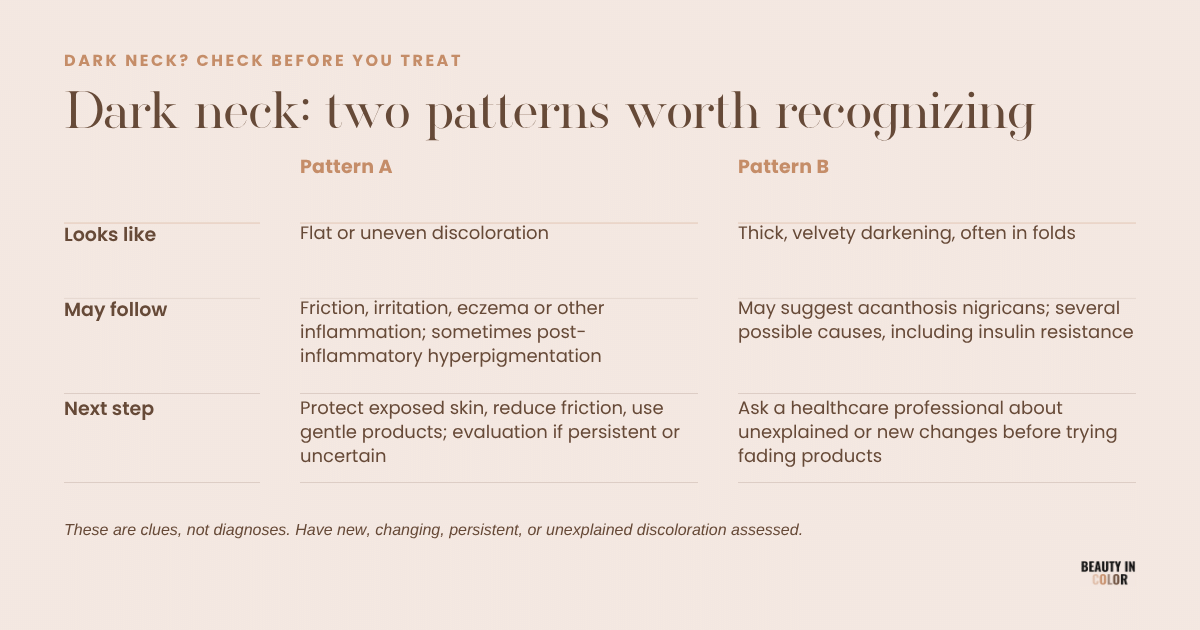
One pattern is flat or uneven discoloration after a known source of irritation, such as rubbing, eczema, or another inflammatory episode. That can be post-inflammatory hyperpigmentation (PIH). On melanin-rich skin, inflammation may leave a dark mark that lasts longer than the irritation itself. Gentle care, reducing repeated friction, appropriate sun protection, and patience are sensible first steps once the cause is understood. Not every flat dark patch is PIH, though, so persistent or uncertain changes deserve an evaluation.
A different pattern is skin that becomes darker, thicker, and velvety, often at the back or sides of the neck, underarms, or sometimes the knuckles. It may be acanthosis nigricans. This condition can be associated with insulin resistance, but it can also occur with other conditions or medication use (American Academy of Dermatology; Mayo Clinic). A clinician can assess the skin and decide whether testing is appropriate. Addressing an underlying cause may help, although the discoloration does not always disappear completely. That is why a new cream should not be the first and only response.
Before buying a product promising dramatic lightening, know this: the FDA says there are no FDA-approved over-the-counter skin-lightening drugs. The agency has found mercury or hydroquinone in some products sold without approval. Prescription hydroquinone is a separate, clinician-supervised category, not the same as buying an unapproved cream online. Avoid unlabeled products, missing ingredient lists, and promises of overnight results. You deserve to know what you are putting on your skin (FDA consumer warning).
Dana’s Tip: If darkening has a known cause and you are monitoring gradual improvement, take photos in consistent daylight about once a month. But do not use photos to self-diagnose thick, sudden, or unexplained changes. Those warrant medical advice.
Do neck creams work, or are horizontal lines just part of aging?
Horizontal lines can develop long before our forties. I have had lines on my own neck since I was young, long before anyone was blaming phones. They may become more visible with age, but that does not mean they are caused only by looking down or that every line needs correcting.
There is research suggesting that some topical products can improve the appearance of neck aging. In a 2023 industry-funded study, a neck cream formulated with retinol, a tripeptide, and glaucine improved measures including horizontal lines and crepiness after 12 to 16 weeks. Fifty women completed the main trial, and only five were Black. About 30% of participants across the research reported some irritation, with four stopping because of product-related adverse effects. This supports a cautious discussion of that particular combination formula. It does not prove that every neck cream works, or that applying any facial retinol to your neck will produce the same result (Sullivan et al., 2023). If you are new to retinoids, start with the slow, barrier-safe approach rather than copying your whole face routine straight onto your neck (how to start retinol without wrecking your barrier).
The habit that matters most: your jawline is not a border
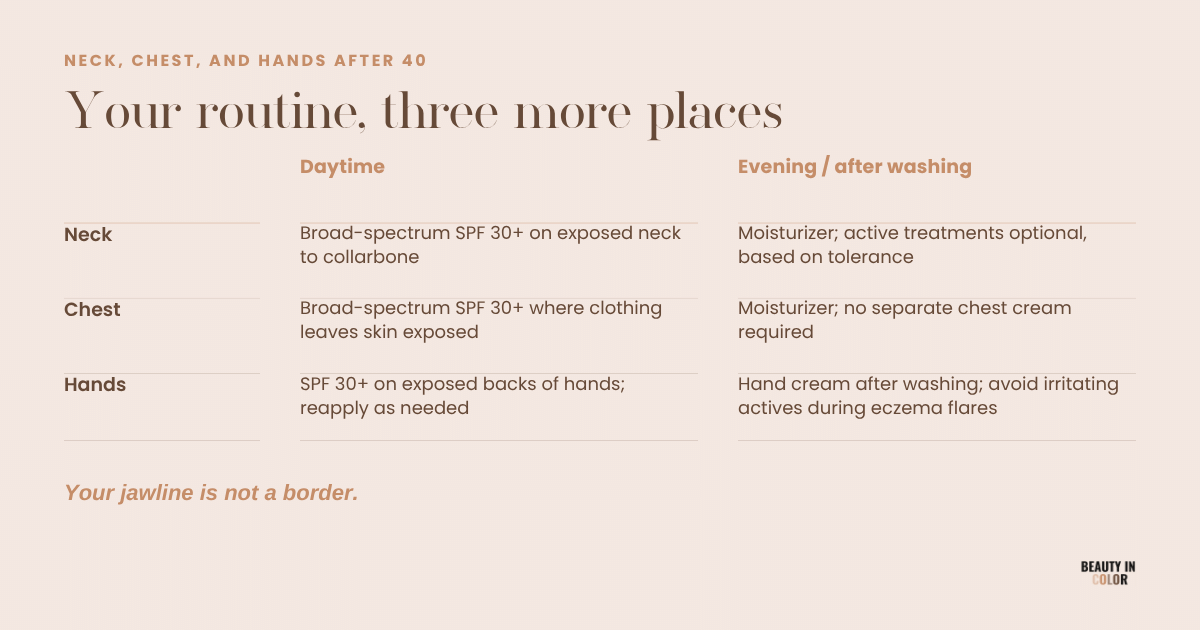
If you take one thing from this guide, take this: your jawline is not a border. Bring your moisturizer and appropriate sun protection down to your neck and exposed chest, and remember the backs of your hands. Those are the habits to make automatic. Strong actives, including retinoids and exfoliating acids, are a separate decision based on tolerability, not an instruction to copy every step from your face.
This is what I do myself. I routinely carry my face skincare down to my decollete, but I pay attention to how each area responds. You do not have to turn your neck and chest into a separate project. Consistency with a comfortable basic routine comes first; optional treatments can follow if there is a clear reason for them.
How to care for each area, morning and night
Neck
Morning: apply broad-spectrum SPF 30 or higher to the neck and any exposed upper chest, reaching the collarbone rather than stopping under your chin.
Evening: bring a well-tolerated moisturizer down the same area. A retinoid is optional. If you decide to use one, introduce it carefully, use a low-irritation approach, and stop if your skin becomes persistently irritated. Do not use retinoids during pregnancy, and consult your dermatologist if your skin is eczema-prone or reactive.
Chest
Morning: protect any chest skin left uncovered by clothing.
Evening: moisturize. You can use a simple product you already tolerate. Do not assume a stronger face treatment belongs on your chest just because it works on your cheeks. If pigment is the concern, the separate V18 lesson explains how visible light can contribute to discoloration in deeper skin tones; research does not establish that the chest is the single most vulnerable area.
Hands
After washing: apply a fragrance-free hand cream or ointment, especially if your skin tends to feel dry or develops eczema.
During the day: use broad-spectrum SPF 30 or higher on the backs of exposed hands, and reapply after washing or during sustained outdoor exposure.
For gel manicures: dermatologists recommend sunscreen before the appointment and dark, opaque fingerless gloves. A 2023 laboratory study found DNA damage in human cells exposed to certain UV nail lamps. It did not measure real-world cancer rates among people who receive gel manicures. The practical takeaway is protection, not panic (AAD; Zhivagui et al., 2023).
A retinoid on your hands is optional, not a requirement. Skip potentially irritating actives during hand-eczema flares.
Dana’s Tip: Make the backs of your hands part of the sunscreen step before you leave home. A small hand cream kept by the sink makes the after-washing habit easier to keep.
Do you need a neck cream, body retinol, or fingerless gloves?
Most of the time, a separate neck cream or body retinol is not a requirement. A dedicated formula may earn its place if your regular active product irritates your neck or if keeping a different product beside your body lotion helps you follow through. But a product label is not evidence that you need it. First ask what the product adds, how your skin tolerates it, and whether you will use it consistently.
If you regularly get gel manicures, I’d consider a pair of dark, opaque fingerless gloves designed to protect your skin while leaving your nails exposed. I wear gloves for my own appointments. I have a Prequel option and a budget Amazon alternative in my recommendations. You can also ask your nail professional how they handle UV exposure; gloves are one practical option, not a reason to be afraid of every manicure.
As for the extras, I have used Necessaire’s body line for years. I am currently trying to be more consistent with its neck serum and body retinol. I have not used those two consistently enough to give you an effectiveness verdict yet. DANA10 is the confirmed 10% code for eligible Necessaire body care. My most reliable habit is still carrying appropriate face products down to my chest, rather than counting on a new jar to make the difference.
See the full routine in the video
In the companion video, I walk through the neck, chest, and hand routine and explain why the look and texture of darkening can change what you should do next. The video also covers UVA through windows and sun protection for gel appointments. Watch it here: Neck, Chest, and Hands: The Aging Zones Your Skincare Routine Is Skipping After 40
Frequently Asked Questions About Neck, Chest, and Hands After 40
- Can I use my usual retinol on my neck?
Possibly, but facial tolerance does not guarantee neck tolerance. The neck can be more reactive. If you choose to try a retinoid there, introduce it conservatively with moisturizer, monitor irritation, and stop if it causes persistent burning or irritation. If you have eczema or another active skin condition, ask your dermatologist before experimenting. Retinoids are not recommended during pregnancy. - Can I tell the cause of dark neck skin from its appearance?
No. Flat discoloration after irritation may be PIH, and thick, velvety darkening may suggest acanthosis nigricans, but appearance alone is not a diagnosis. A new, persistent, thickened, or rapidly changing patch deserves a professional assessment, particularly if it appears in skin folds or on the knuckles. - Do I need sunscreen while indoors or in the car?
If you spend meaningful time beside a sunny window or drive with sun reaching exposed skin, UVA transmission through some glass makes photoprotection worthwhile. The amount varies by window type and film. You do not need to apply sunscreen to covered skin simply because you are indoors; focus on the skin exposed to daylight. - Is a dedicated neck cream worth buying?
Not automatically. Sunscreen and a comfortable moisturizer are a sensible foundation. A dedicated neck treatment may be helpful if it fits your tolerance or makes the habit easier, but results from one combination-product study cannot be promised for every cream.
The Bottom Line
Your neck, chest, and hands can show age and sun exposure differently from your face, but that does not automatically require a separate shelf of products. Start with the routine you can actually sustain: moisturize, protect exposed skin with sunscreen, and adjust any active treatment to the skin in front of you. If a darkening patch is unexplained, changing, or thick and velvety, get it assessed rather than trying to fade it on your own.
Your jawline is not a border. Your skincare does not have to be complicated to extend beyond it.
What To Do Next
- Watch the companion video for the full walkthrough and the decisions behind each step: Watch the video on YouTube
- Browse The Neck, Chest, and Hands Edit for the gloves and the body-care products mentioned here.
- For more skincare education for Black women over 40, join Beauty In Your Inbox.
Shop With Me
The products I keep in rotation plus my budget-friendly picks, all in one place.
Discount codes | Beauty In Color Approved | My ShopMy edit | Amazon picks
Affiliate disclosure: I may earn a small commission from qualifying purchases through links on this page, at no extra cost to you. I share products only where they fit the teaching.
Sources
- Sullivan et al. (2023), multi-ingredient retinol, peptide, and glaucine neck treatment, Journal of Cosmetic Dermatology
- Skin Cancer Foundation, UV exposure through window glass
- Photoprotection for Skin of Color (2022), PMC
- Mayo Clinic, acanthosis nigricans
- American Academy of Dermatology, acanthosis nigricans
- FDA, skin-lightening products containing mercury or hydroquinone
- Zhivagui et al. (2023), UV nail lamps and DNA damage, Nature Communications
- American Academy of Dermatology, safer gel manicures