Estimated Reading Time: 11 minutes
Figuring out what causes dark circles under the eyes is the step most people skip, and it is the one that decides whether any product has a chance. Before you replace another eye cream, it is worth knowing which of three things you are actually looking at.
Most of us notice our dark circles in the mirror and try to fix them on a shelf. The cream promises to lift, tighten, or fade, and when it does very little, the natural conclusion is that we chose the wrong one. More often the miss happened a step earlier. Dark circles are not one condition with one fix. They are a small family of causes that can show up alone or, more commonly, together, so a product bought before you know the cause is aimed at a problem it may not share.
The useful question, then, is not which eye cream to buy. It is what actually causes dark circles under your eyes, and which cause is leading on your skin. This guide covers the three mechanisms behind under-eye darkness, a thirty-second way to tell which one is yours, and what genuinely helps each, with the parts that matter most for melanin-rich skin in your 40s. The goal is to put your effort where it moves something, and stop spending it where it cannot.
In This Post:
- Why one eye cream rarely fixes dark circles
- The three causes of dark circles under eyes
- Why Reactive Skin Needs Two Routines, Not One
- How to tell which type of dark circle you have (a 30-second mirror check)
- Do dark circles get worse in your 40s?
- Why dark circles look different on Black skin
- What you can control
- What actually helps each type
- Three honest options for your under-eyes
- Go Deeper in the Video
- Dark circles under eyes: frequently asked questions
- The Bottom Line
- What To Do Next
- Shop With Me
- Sources
Why one eye cream rarely fixes dark circles
Eye creams are narrower than their marketing suggests. Each formula is built to influence a single cause, most often surface pigment, and it can only act on the thing it was designed for. When your circles come from more than one source, and for most people they do, a single cream is addressing one slice of a larger picture. That is the quiet reason the second and third jars disappoint as reliably as the first. The way forward is not a better version of the same category. It is matching the tool to the cause, which you can only do once you know the cause.
The three causes of dark circles under eyes
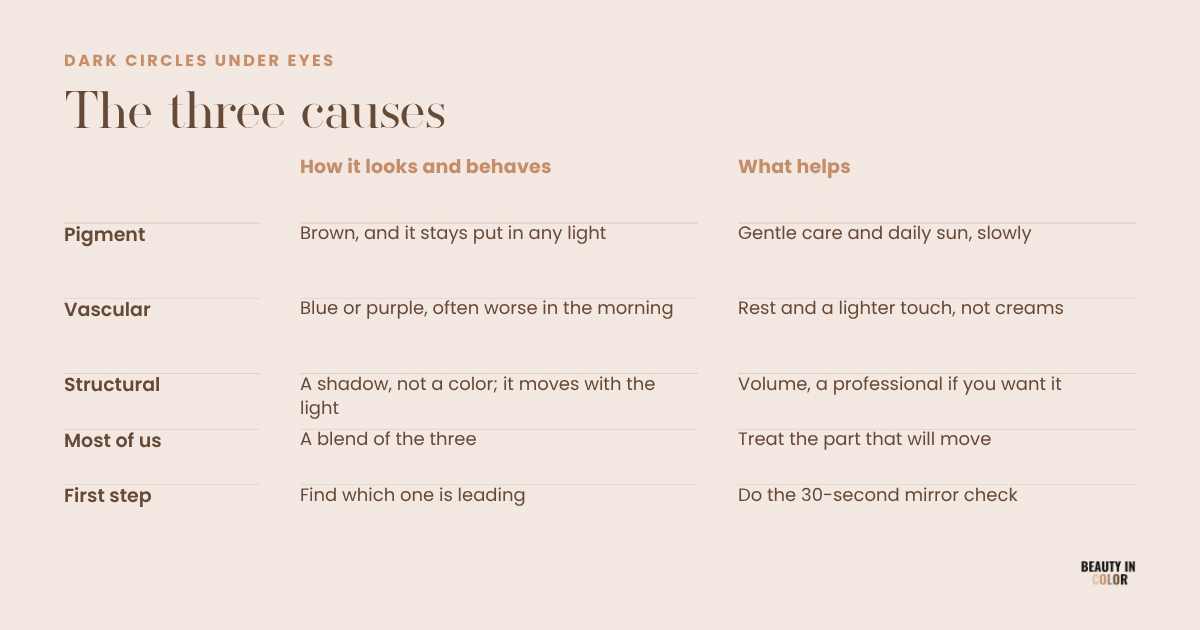
Dermatology sorts under-eye darkness into three mechanisms, plus the combination most people actually have (Sarkar et al., 2016). Told apart, they call for completely different responses, which is why naming yours comes before buying anything.
Pigment: brown that stays put
Pigment is extra melanin sitting in the skin itself. It reads brown, and it holds steady. Move your head or change the light, and it doesn’t really shift, because the color lives in the tissue rather than in a shadow or a vessel.
Vascular: blue that comes and goes
Vascular darkness is the network of small vessels beneath the skin showing through. It leans blue or purple, and it fluctuates. A short night, a cold, or the first hour after waking can each deepen it, and it often eases as the day goes on.
Structural: a shadow, not a color
Structural darkness is not pigment at all. As the area loses a little volume and the skin thins, a slight hollow forms where the lower lid meets the cheek, and that dip catches shadow. Your skin tone can be perfectly even, and the area still looks dark, purely because of how light falls across it.
Very few under-eyes are one clean type. Most are a blend: a little pigment over a little hollowing, sometimes with vessels adding a cool cast underneath. That layering is exactly why one product rarely clears the whole thing, and why the first job is working out which cause is doing the most.
If pigment turns out to be your lead, the way it behaves on deeper skin is worth understanding on its own; our guide to hyperpigmentation on Black skin covers that mechanism in the context of dark spots.
Why Reactive Skin Needs Two Routines, Not One
The shift that makes reactive skin manageable is this: you are not building one routine, you are building two. A baseline routine for your normal, calm days, and a stripped-back flare routine for when your skin is inflamed or reacting.
Most people run a single routine and, without meaning to, run it backwards. They coast on good days, then the moment a flare hits they add something. A new treatment, an extra active, whatever promises fast relief. Reactive skin needs the opposite response. The skill is not hunting for a perfect product. It is knowing which routine the day calls for and picking it deliberately.

How to tell which type of dark circle you have (a 30-second mirror check)
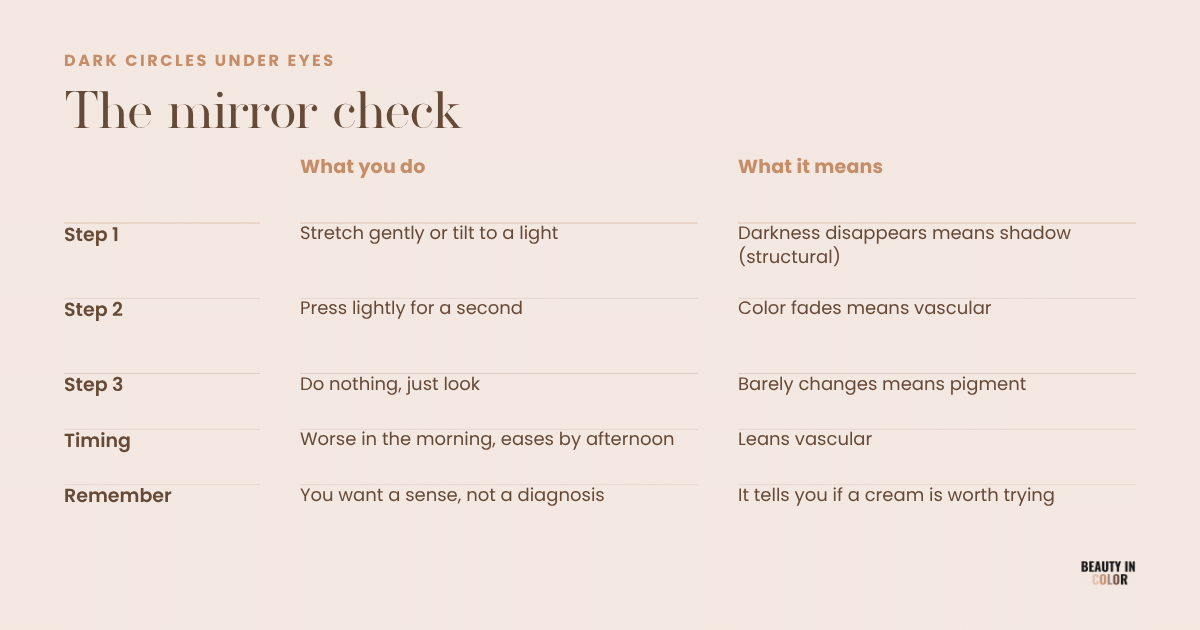
You do not need a diagnosis to make a smart decision. You need a rough sense of which cause is leading, because that sense is what tells you whether a cream is even worth trying. A professional can confirm it, but this quick check in good light will point you the right way.
- Rest a fingertip below one eye and stretch the skin gently sideways, or tilt your chin up toward a window. If the darkness mostly vanishes, you are likely looking at structural shadow. Move the angle and the darkness moves with it.
- Press lightly for a second and let go. If the color pales briefly under the pressure, there is a vascular piece in the mix.
- If nothing you do changes it much, pigment is probably in the lead. And if it looks worse first thing in the morning and softens through the day, that points back toward vascular.
Dana’s Tip: Do this by daylight at a window rather than under a hard bathroom bulb, and keep your touch light. You are reading the skin, not tugging at the most fragile area on your face while you do it.
Do dark circles get worse in your 40s?
For many people, yes, and two ordinary changes are usually behind it. The area loses a little of its cushioning over time, and the skin covering it grows thinner, so both the shadow and the vessels beneath read more clearly than they used to. The timing varies; some notice it in their 30s, others well into their 40s or later. A good deal of it comes down to your own face and your family rather than a number (the aesthetic literature describes these volume and thinning changes; see Aesthetic Surgery Journal, 2024). This is squarely a healthy-aging conversation, not a flaw to correct, and understanding the mechanism is what keeps you from over-treating an area that mostly needs support.
Why dark circles look different on Black skin
One piece of this is specific to melanin-rich skin. The pigment type, periorbital hyperpigmentation, is common in deeper skin tones and tends to run in families (Roberts, 2014; Daroach and Kumaran, 2018). Our skin also has a habit of answering irritation by making more pigment instead of turning red, so anything that inflames the eye area, from a genuine reaction to simple rubbing, can register as darkening in ashy or grayish tones, and that pigment can linger for months. That’s why advice written for lighter skin often points us the wrong way. When irritation itself is what feeds the darkness, going gentler stops being the cautious choice and becomes the effective one.
What you can control
A few everyday habits quietly deepen the pigment type, and each is yours to adjust.
- Sun. The under-eye area is easy to miss with sunscreen, and ultraviolet exposure is one of the strongest drivers of pigment. Covering it matters. If sun protection on deeper skin has been its own struggle, our guides to sunscreen for Black women and choosing an SPF that disappears on deeper skin are a good place to start.
- Friction. Rubbing tired or itchy eyes, and dragging at the skin while taking off makeup, feeds darkness over time. A gentle hand at cleanup goes further than it sounds.
- Overdoing actives. Strong ingredients applied right up to the lash line can irritate skin that is already delicate, and that irritation is precisely what deepens the pigment you are trying to lighten.
What actually helps each type
Here is what moves each cause, and where a product is beside the point.
When pigment leads, slow and steady care can help it fade over time: daily sun protection on the area, and patient, non-irritating “brightening” rather than the strongest thing on the shelf. If that is your situation, the natural next step is a proper fade routine layered so it does not provoke a reaction, which we walk through in our dark spot routine for Black skin.
When the darkness is mostly structural, no cream removes a shadow, because the shadow is a matter of volume rather than color. Well-hydrated, smooth skin can soften how light hits the area, but the hollow itself is a conversation with a qualified professional if and when you decide you want one; our note on when to see an esthetician versus a dermatologist can help you decide who to ask. It is not a checkout-page decision.
When it is mostly vascular, creams are not really the lever either. Rest, a lighter touch, and time tend to do more than any single product.
And for deeper skin especially, there is a reason not to throw everything at it at once: aggressive in-office treatment can respond with more darkness rather than less, so pushing harder can cost you ground. Going slower here is not the timid option. It protects the result you are after.

Three honest options for your under-eyes
Once you know what you are working with, you have three legitimate paths, and none of them is a failure.
Treat the cause. For pigment, that is gentle care and sun protection. For structural or vascular darkness, it is the professional conversation, on your own timeline.
Manage the appearance. Concealer, plus keeping the area hydrated and smooth so it sits well, applied and removed with a light hand so you are not creating the very irritation described above.
Protect it and leave it alone. Keep it out of the sun, resist the urge to over-treat, and let it be.
For the record, mine is mostly structural, so I live somewhere between the last two right now: hydrated and plump, concealer when I feel like it, and the door open to more later if I change my mind. You get to make the same call once you know your type.
Go Deeper in the Video
The companion video walks the under-eye self-check on camera, so you can watch how the skin behaves when you stretch it or shift the light, which is easier to copy than to read. It also thinks through the eye-cream decision out loud, including where I have landed for my own skin. Watch it here.
Dark circles under eyes: frequently asked questions
- Can dark circles go away on their own?
The vascular type can ease with rest and less rubbing. Pigment fades slowly with gentle, consistent care and sun protection rather than disappearing overnight. Structural shadow does not resolve on its own, because it comes from volume rather than skin health. - Are dark circles genetic?
Often, at least in part. Periorbital hyperpigmentation runs in families and is common in melanin-rich skin, and the shape of the under-eye area is inherited too. Genetics set your starting point; sun exposure and daily habits decide how far it travels from there. - Do eye creams work for dark circles?
Only when the cream matches the cause, and mostly for the pigment type, gradually. For structural or vascular circles, no cream erases them. A cream that seemed to fail usually was not a bad product. It was pointed at the wrong cause. - Does lack of sleep cause dark circles?
Poor sleep and congestion can make the vascular type look worse, and puffiness can deepen a shadow for a while. But sleep is rarely the whole story, and treating it as the only cause is what sends people back to the shelf for the wrong fix.
The Bottom Line
Dark circles are less about finding the right product and more about reading the right cause. Pigment responds slowly to gentle care and sun protection; structural shadow is a volume question for a professional, if you want it; vascular darkness answers more to rest than to creams. Most under-eyes are a blend, so the honest move is to treat the part that will move and make peace with the part that will not. Start with the mirror check, then spend only where it counts.
What To Do Next
- Run the thirty-second mirror check and note which cause seems to lead. Watch the companion video to see the check in motion.
- Browse the Skin Concerns guides for the next step on your type.
- And if you would like one clear email a week, join the newsletter.
Shop With Me
The products I keep in rotation plus my budget-friendly picks, all in one place.
- The eye-care edit, this week’s under-eye collection: shopmy.us/shop/collections/7633828
- Discount codes: beautyincolor.com/beauty-discount-codes
- My ShopMy edit: shopmy.us/shop/beautyincolor
- Amazon budget picks: amazon.com/shop/beautyincolor_official
Sources
- Sarkar R, et al. Periorbital Hyperpigmentation: A Comprehensive Review. J Clin Aesthet Dermatol. 2016.
- Roberts WE. Periorbital Hyperpigmentation: Review of Etiology, Medical Evaluation, and Aesthetic Treatment. J Drugs Dermatol. 2014.
- Daroach M, Kumaran MS. Periorbital Hyperpigmentation, An Overview. Pigment International. 2018.
- Lower Eyelid Dark Circles (Tear Trough and Lid-Cheek Junction): A Stepwise Assessment Framework. Aesthet Surg J. 2024.