Estimated reading time: 10 minutes
Most advice about hyperpigmentation on Black skin skips the one thing that would make it useful: an explanation of what the mark actually is. So you end up with a cabinet of “brightening” products and a spot that has not moved since spring. The mark is not permanent, and it is not a sign that you did anything wrong. It is pigment your skin deposited while it was healing, and fading it is less about buying the right bottle than about understanding what you are looking at first.
By the end you will be able to look at a dark mark and read three things off it, what caused it, how deep it sits, and which ingredients have a real chance of reaching it, and you will know the one step that decides whether any of the rest works.
In This Post:
- Why Black skin marks more easily
- Why some dark spots barely move
- Is it PIH, melasma, or a red mark?
- The three jobs that fade a dark spot
- Azelaic acid, the one I reach for
- The step that decides everything: sunscreen and visible light
- How long it takes, and when to bring in a professional
- Go Deeper in the Video
- Dark Spots FAQ
- The Bottom Line
- What To Do Next
- Shop With Me
Why Black skin marks more easily
A dark spot begins with inflammation. A breakout, a bug bite, a scratch, a product that stung: anything that irritates the skin can prompt it to lay down extra pigment as it repairs, and that pigment stays after the original irritation is gone. The clinical name is post-inflammatory hyperpigmentation, or PIH, and it is the most common kind of dark mark in melanin-rich skin.
What makes it more of a problem for us is not fragility, it is reactivity. In deeper skin the pigment-producing cells respond to injury quickly and abundantly, so a minor insult that clears in a week on lighter skin can leave a brown mark that lingers for months. That same reactivity is why keeping skin calm matters so much, and why reactive skin after 40 is worth understanding as its own subject. The pattern is well documented: reviews of PIH in skin of color describe it as more common, more distressing, and longer lasting in deeper skin, with surface marks often taking six to twelve months to resolve and deeper ones lasting years (JCAD, PIH in skin of color).
This is why sequence matters more than any single product. Before naming an ingredient, you need to know how the mark formed and where it sits, because those two facts decide what can reach it.
Why some dark spots barely move
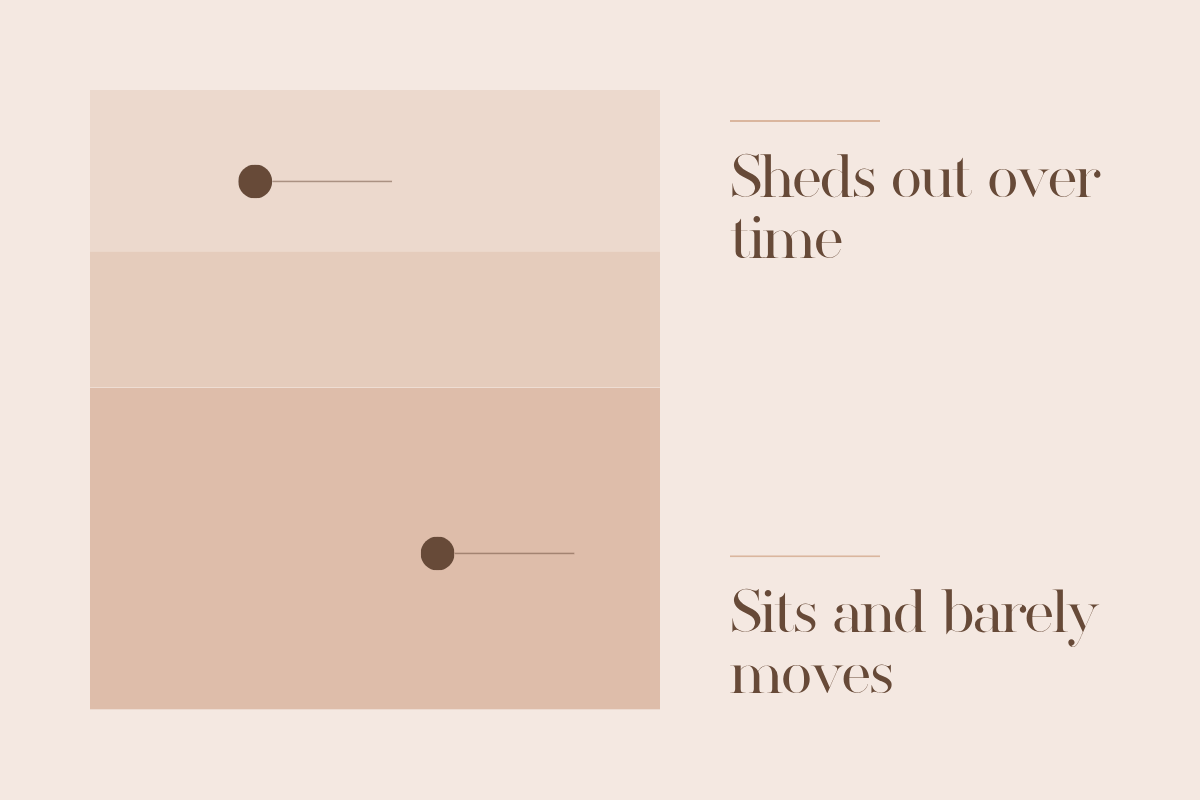
The difference between a spot that fades and one that seems permanent is usually depth. Skin renews itself by shedding and rebuilding its surface layer, so pigment sitting near the top is gradually carried out over time. Pigment that has settled into the layer beneath the shedding has nothing escorting it out. It stays put, often reads more gray than brown, and responds slowly if at all.
That distinction should shape both your expectations and your budget. Topical products reach surface pigment reasonably well, and deep pigment poorly, so some of your result was determined before you bought anything, by how far down the pigment went. That is not a reason to quit. It is a reason to protect the skin while it heals, treat consistently, and recognize the point where a mark has gone deep enough that a professional, not another serum, is the honest next step.
Dana’s Tip: Photograph the mark once a month, same spot and same light, and judge only against those photos. You will not see change day to day, but you will see it clearly across two images taken eight weeks apart.
Is it PIH, melasma, or a red mark?
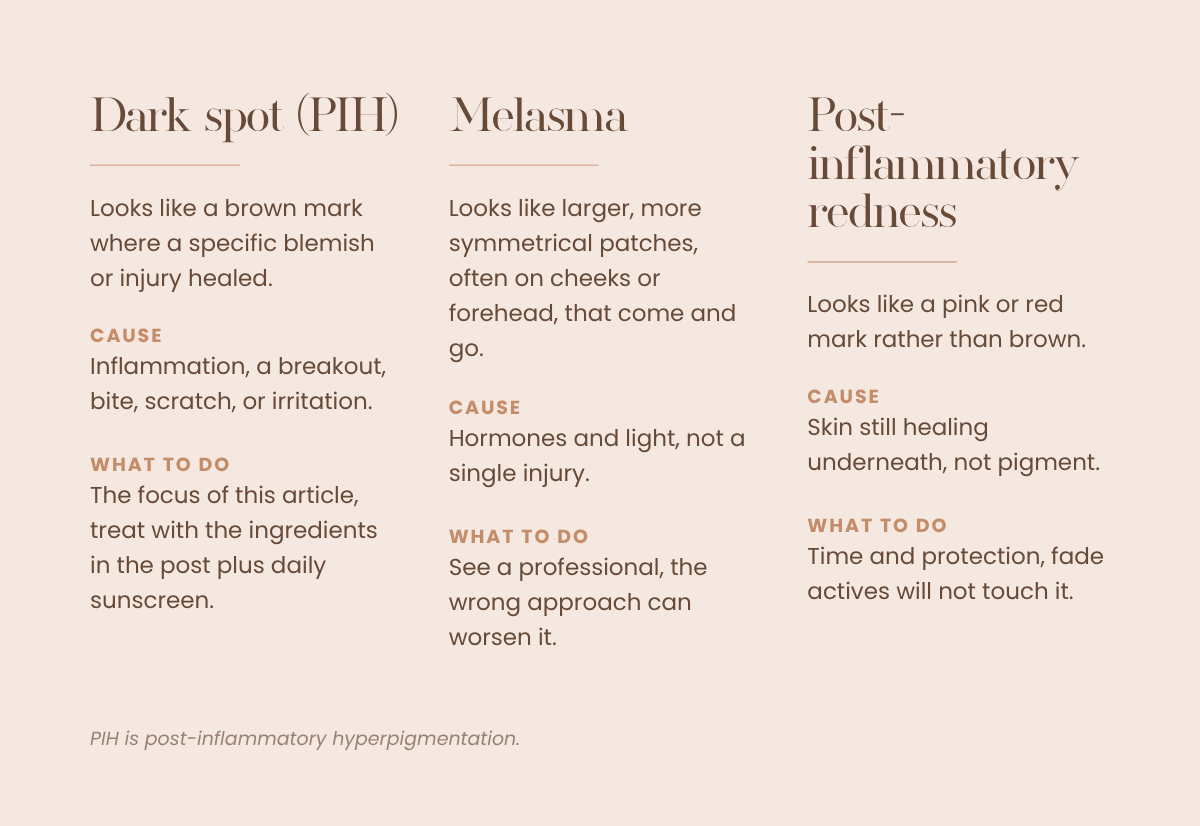
Not every dark mark is the same kind of mark, and treating the wrong one costs months. Three get confused constantly. Identify yours before spending anything.
The short version: a brown mark, left behind by something specific, is what the rest of this article is written for.
The three jobs that fade a dark spot
Once you know you are treating a brown mark, the ingredient aisle becomes readable, because every ingredient that genuinely fades one is doing one of three jobs. It either slows how much pigment the skin makes, blocks that pigment from surfacing, or turns the skin over faster so pigmented cells clear. A good routine covers more than one job at once, but it does not need all of them. Two or three compatible ingredients, used long enough to matter, will outperform a shelf of half-finished bottles.
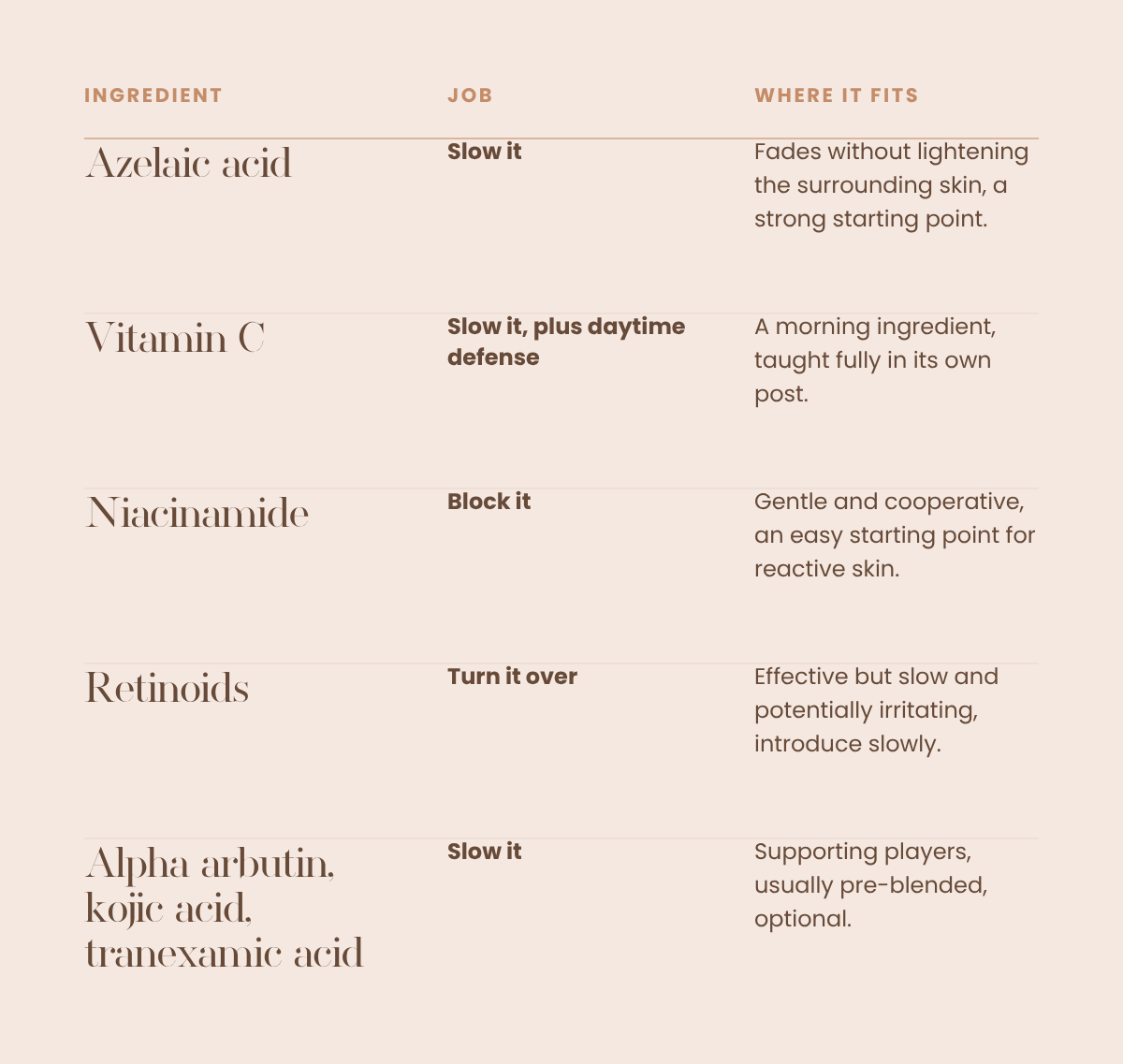
Niacinamide earns its place with real mechanism, not marketing. A foundational study in the British Journal of Dermatology found it inhibited the transfer of pigment toward the surface and, in clinical use, significantly reduced hyperpigmentation and increased skin lightness against a control after four weeks (British Journal of Dermatology, Hakozaki et al.). It works best paired with a pigment-slowing ingredient, not alone.
Dana’s Tip: Turn the bottle over before you buy. “Brightening” is a marketing word and is not regulated. The ingredient list is the only part of the package obligated to tell the truth, so if none of the actives above are in it, the front of the bottle is all you are paying for.
Azelaic acid, the one I reach for
Of the “slow it” ingredients, azelaic acid is the one I keep on my own shelf, because of how selective it is. It acts on the overactive pigment cells and largely leaves normal skin alone, which is exactly the property that matters in deeper skin: it can fade the mark without lightening the tone around it. That sidesteps a real risk, which is trading a dark spot for a pale one with a harsher lightener. The evidence is encouraging without being extravagant. In a sixteen-week study, azelaic acid gel used twice daily left more than half of participants with no measurable PIH remaining (Journal of Drugs in Dermatology, azelaic acid for PIH). It supports fading rather than guaranteeing it, on the same slow timeline everything here runs on.
If you want a specific starting point, Paula’s Choice 10% Azelaic Acid Booster is my example of the “slow it” job done well, and the one I use on my own face. It sits in the Dark Spots collection linked at the end. No discount code on this one.
The step that decides everything: sunscreen and visible light
Every ingredient and dollar above depends on one step that most people treat as optional. Sunscreen. Light re-darkens a mark faster than any active fades it, so treating a spot without protecting it works against itself. Protection alone is measurable: in one review, daily SPF with no added active produced significant lightening of hyperpigmented marks over eight weeks, with higher SPF outperforming lower (JCAD, PIH in skin of color).
There is a piece of this specific to deeper skin. The rays that burn are UV, but UV is only part of sunlight. Visible light, the part you can see, also drives pigment in melanin-rich skin, and conventional sunscreen mostly lets it through. What blocks it is iron oxide, the pigment that gives a tinted sunscreen its color. In a controlled study on skin of color, an iron-oxide formulation protected against visible-light-induced pigmentation better than both untreated skin and a mineral SPF 50 without iron oxides (Journal of Drugs in Dermatology, iron oxides and visible light). So for fading, tinted is not a cosmetic preference. It is the version that shields against the specific light darkening your marks. The fuller method for choosing one that disappears on deeper skin lives in the sunscreen selection post.
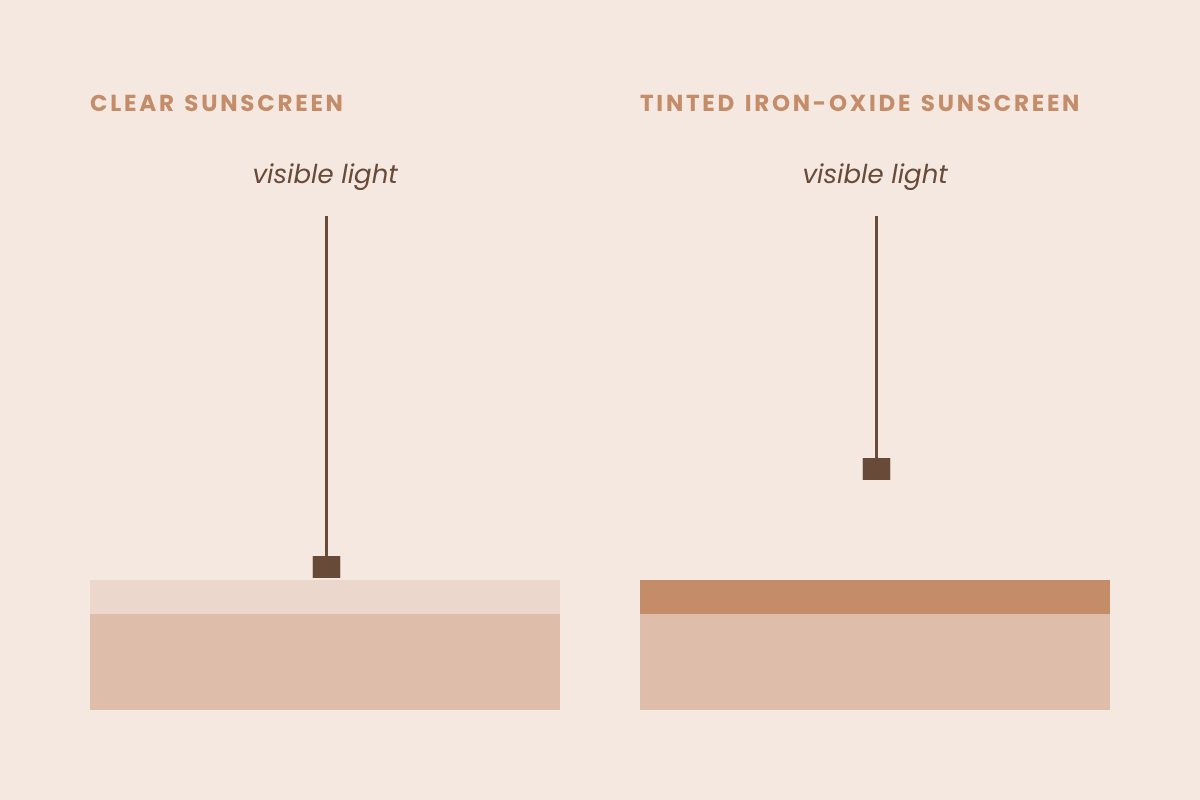
The tinted mineral option I am testing for this exact job is Merit The Uniform Tinted Mineral SPF 45. It carries confirmed iron oxides plus zinc and comes in deep shades, which is what makes it relevant here. In fairness, I am still testing it, so I am watching how it wears rather than presenting it as settled. It is in the collection if you want to follow along. No code.
How long it takes, and when to bring in a professional
The honest timeline is months, not days or weeks. What produces the change is unremarkable: two or three well-chosen ingredients, used consistently, under sunscreen every morning, for longer than feels fair. Three mistakes strand people short of the finish line, and all three are avoidable.
- Fading while inflamed. Treating a mark while the surrounding skin is still breaking out or reacting. Calm has to come before fade, which is why starting from a settled barrier matters.
- Trusting a clear sunscreen. It guards against burning but not against the visible light re-darkening the spot.
- Quitting at three weeks. That is judging a months-long process by a single moment.
Some marks are not a home-care problem. Consider a professional when:
- the mark reads gray or blue and has not moved in months, suggesting deep pigment
- the patches are symmetrical and fluctuate, which points to melasma rather than PIH
- a mark is changing in a way that concerns you, in which case see a dermatologist rather than treating it yourself
In-office options and prescription-strength treatments exist and can be effective, but they carry more risk on our skin and belong in a professional’s hands, not a self-experiment.
Go Deeper in the Video
This article is the map. The video is where I walk it at conversation pace and show the parts a page cannot. On camera, I spend more time telling the mark types apart by eye, sequencing two actives without stacking irritation, and closing out this chapter of the series in a way that does not fit a scannable post. If reading this made something click, the video is where it settles.
Watch the full lesson here:
Dark Spots FAQ
- How long do dark spots take to fade on Black skin? Months rather than weeks. Surface marks tend to fade first, over a few months of consistent treatment plus daily sunscreen, while deeper marks take longer and the deepest may need a professional. Judging progress at three weeks is judging it too early.
- Is it dark spots or melasma? Dark spots (PIH) are usually discrete marks left after a specific event such as a breakout or bite. Melasma tends to be larger, more symmetrical patches across the cheeks or forehead that fluctuate with hormones and light, and it warrants a professional because the wrong approach can worsen it.
- Does niacinamide fade dark spots? It can help. Niacinamide interrupts the transfer of pigment toward the surface and is gentle enough for reactive skin, and it works best paired with a pigment-slowing ingredient and daily sunscreen rather than used alone.
- Why does “brightening” skincare not work on my dark spots? Because “brightening” is a marketing term, not a regulated one. A product only works if it contains actives that slow, block, or turn over pigment, so read the ingredient list rather than the front label.
- Can I fade a dark spot without sunscreen? Realistically, no. Visible light re-darkens marks faster than actives can fade them, and in melanin-rich skin visible light matters alongside UV, so a tinted sunscreen with iron oxides is what makes the rest of the routine count.
The Bottom Line
A dark spot is neither a mystery nor a personal failure. It is pigment left behind after inflammation, resting at a depth you can now roughly read. Once that is clear, the plan is simple even when it is slow: identify what you are actually looking at, choose two or three ingredients that work different jobs, protect the area with a tinted sunscreen every morning, and give it months rather than weeks.
The reason “brightening” products disappoint is not that fading is impossible. It is that they hand you a promise and skip the method. The method is what you have now.
Read the mark first, protect it daily, and let time do the rest.
What To Do Next
- Watch the full YouTube lesson for the visual walk-through: youtu.be/yW3lOX7yw9g
- Get the next lesson, including the dark-spots video, by joining the newsletter: beautyincolor.com/newsletter
- Browse my Dark Spots collection
Shop With Me
The products I keep in rotation plus my budget-friendly picks, all in one place.
- Discount codes: beautyincolor.com/beauty-discount-codes
- My ShopMy edit: shopmy.us/shop/beautyincolor
- Amazon budget picks: amazon.com/shop/beautyincolor_official
- Dark Spot collection: https://shopmy.us/shop/collections/4436392