Estimated reading time: 13 minutes
How to prevent acne scars on Black skin starts with a correction: the flat brown mark a pimple leaves behind usually isn’t a scar at all. Knowing the difference changes what you should do the moment you feel a breakout coming.
You feel it before you see it. That deep, sore spot along the jawline that hasn’t surfaced yet, and already you’re doing the math on how long the mark is going to sit there afterward.
That math is usually right. The pimple itself is a short story. The brown spot it leaves can outlast it by months, and for a lot of us it’s the mark, not the breakout, that we’re actually upset about. So when we search for how to prevent acne scars, we’re rarely asking about scars in the clinical sense. We’re asking how to stop the discoloration.
Here’s the part that changes the whole approach: the marks most of us are trying to prevent respond to protection, not aggression. The instinct is to attack an active breakout with the strongest thing in the cabinet. In melanin-rich skin, that instinct often creates the mark in the first place.
This article covers what actually works in the window when a breakout is forming, why deeper skin tones mark more readily, how to make a spot treatment decision without buying something you’ll use twice, and where the line sits between a routine problem and a dermatology appointment. You can apply it all tonight without buying anything.
In This Post:
- What to do in the first 48 hours of a breakout
- Is it an acne scar or a dark mark? Here’s how to tell
- Why post-acne marks show up darker and last longer on Black skin
- Do pimple patches actually work?
- How to choose a spot treatment that won’t leave a mark behind
- Five mistakes that turn a one-week pimple into a six-month mark
- When to stop treating it yourself and see a dermatologist
- Go Deeper in the Video
- Acne Scars and Dark Marks FAQ
- The Bottom Line
- What To Do Next
- Shop With Me
- Sources
What to do in the first 48 hours of a breakout
The first two days set the outcome. Not because there’s a magic window, but because this is when most of the damage that leads to a lasting mark gets done, and almost all of it is self-inflicted.
Four moves, in order of how much they matter.
- Don’t touch it. Not to squeeze, not to test whether it’s ready, not to press it flat before a meeting. Squeezing pushes inflammation further into the skin, and deeper inflammation means more pigment. It can also break the surface, which is the actual route to a textural scar. The American Academy of Dermatology is unambiguous on this point [1].
- Put the rest of your routine on hold. A breakout is the worst possible moment to introduce a new active. Frustration makes us start things. Keep your usual gentle cleanser, your hydrating layer, and your moisturizer, and change nothing else until the spot has closed. If your skin runs dry or reactive, that hydrating layer is doing more useful work here than anything harsh would.
- Wear sunscreen every single morning while it heals. A forming mark is pigment in progress, and UV exposure can deepen it beyond where it would have landed on its own. This is the step people skip and then wonder why the spot is still there in November. If you use actives at night, it matters more, not less.
- Let it close on its own terms. A spot that stays protected and comfortable tends to resolve better than one that’s been picked at and dried out.
Dana’s Tip: If you know you’re a toucher, deal with the access, not the willpower. Put something physically between your fingers and the spot during the day. I’ve never once out-disciplined a bathroom mirror, and I stopped trying.
Notice what isn’t on this list. Nothing here costs money, and nothing here is a product.
Is it an acne scar or a dark mark? Here’s how to tell
Most of what gets called an acne scar isn’t one. The distinction isn’t pedantic, because the two need completely different treatments and have completely different outlooks.
A scar is a change in texture. It’s pitted, or it’s raised. You can feel it with your fingertips with your eyes closed, and it usually needs a professional to address it.
A mark is a change in color. The surface is level with the skin around it. It’s just darker. That’s post-inflammatory hyperpigmentation, and the AAD notes that this kind of flat spot typically fades over time [2].
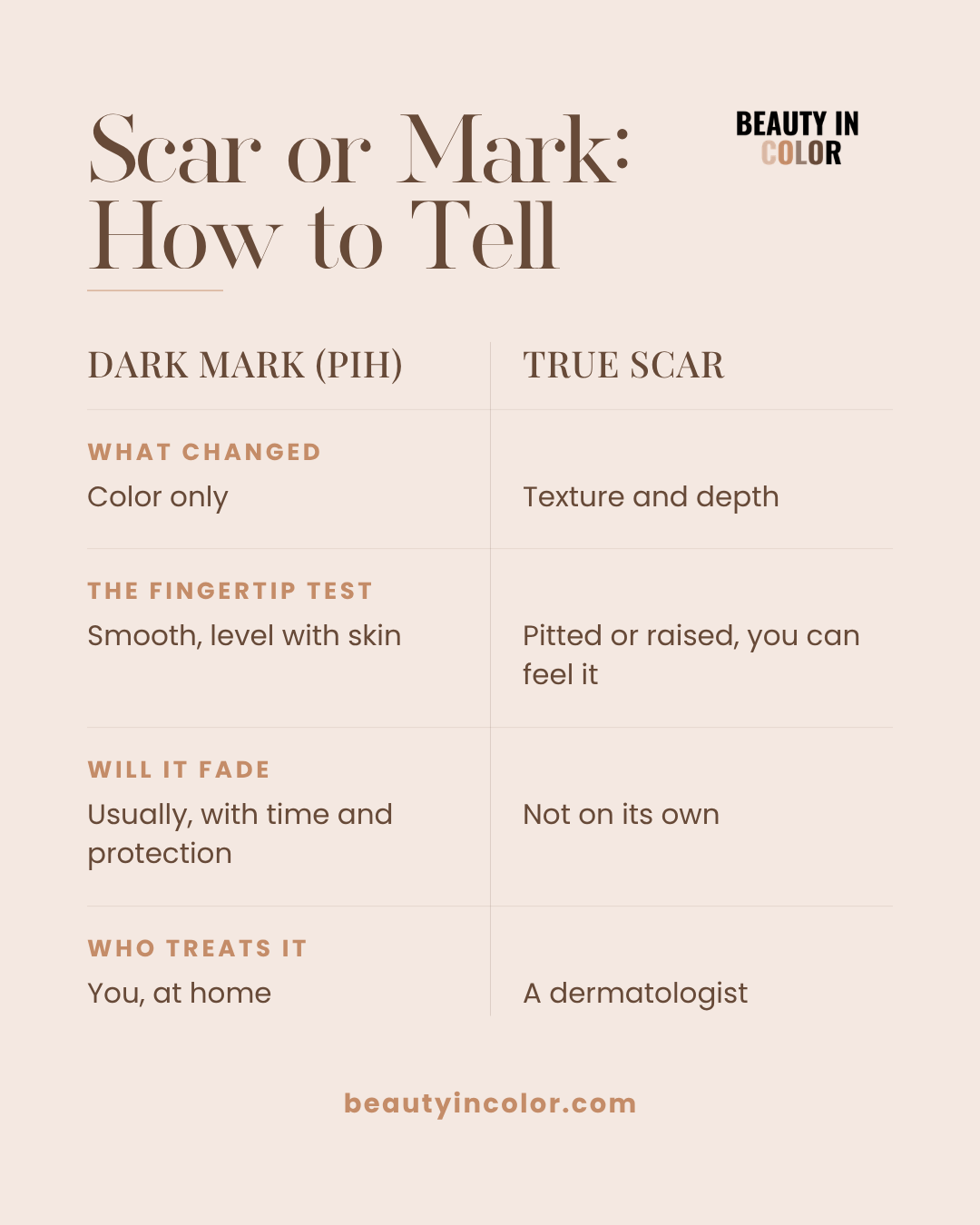
Run the fingertip test in good light with your eyes closed. If you can’t feel it, you’re dealing with color, and color can move.
That’s genuinely good news, and it’s worth sitting with, because the panic that drives harsh treatment usually comes from believing the damage is permanent.
Why post-acne marks show up darker and last longer on Black skin
Inflammation triggers pigment production. That’s true of every skin tone. What differs is the response.
In melanin-rich skin, the pigment-producing cells react quickly and generously to inflammation. Research on post-inflammatory hyperpigmentation in skin of color describes it as both more frequent and more persistent in darker skin tones, and as one of the leading reasons Black patients seek dermatologic care [3][4].
The practical consequence is the part worth carrying with you: the pimple is not your only source of inflammation. Your fingers are one. A stripping cleanser is one. A treatment that leaves the spot raw is one. Every additional bit of irritation is more pigment and a deeper mark.
I go into the full mechanism, including why some marks look grey or violet rather than brown, in the dark spots in Black skin article. For today, the short version is enough: irritation in our skin doesn’t resolve quietly.
Do pimple patches actually work?
This is probably the most-searched question in this entire category, and the honest answer has two halves.
As a barrier against your own hands, they work extremely well. That is their most reliable function. A patch you can’t easily peel off is a patch that keeps you from picking, and not picking is the single highest-leverage thing you can do for a forming mark.
As a treatment, expect less. A hydrocolloid patch absorbs fluid from a surfaced spot. It is not going to resolve a deep, unsurfaced cyst, and no patch is going to prevent pigment on its own.
Worth knowing before you buy: many patches marketed as plain hydrocolloid are medicated. The INKEY List Hydrocolloid Invisible Pimple Patches that I keep on hand are 99% hydrocolloid with 0.4% salicylic acid, 0.4% succinic acid, and 0.2% ectoin. That’s a reasonable formulation and I use them, but the salicylic acid means they’re doing something to the skin underneath, which matters if you’re already using an exfoliant elsewhere in your routine. It counts as an active. Don’t layer another one on the same spot on the same night.
I use these because they’re clear enough to wear through a workday without answering questions about my face. That’s a practical requirement, not a performance claim.
Dana’s Tip: Apply a patch to clean, dry skin with nothing underneath it. Serum or moisturizer under the patch keeps it from sealing, it slides off within the hour, and then you’re back to touching the spot.
How to choose a spot treatment that won’t leave a mark behind
Start with the job. The job is to calm an inflamed spot so it can close. The job is not to punish it.
Almost all spot treatment marketing sells the opposite. Blast it. Zap it. Dry it out overnight. For melanin-rich skin, drying a spot out aggressively trades a pimple you’d have had for a week for a mark you’ll have for months. That’s a bad trade and it’s the most common one people make.
Gentler categories are the better lane here. Sulfur can calm a spot without stripping it. Azelaic acid works on the breakout and on pigment at once, which is a useful pairing for exactly this problem. I use both, at different moments, and my skin is sensitive and eczema-prone, so nothing harsh gets near it.
But read the formula, not the category. A sulfur treatment built on isopropyl alcohol and camphor is a drying treatment regardless of what the ingredient sounds like. Check what the first few inactive ingredients are before you decide something qualifies as gentle.
Here’s the whole decision, and it’s shorter than the aisle suggests:
- Choose one treatment your skin already tolerates. Something you’ve used before without a reaction.
- Apply it only to the spot. Not the surrounding area, not the whole zone.
- Keep your sunscreen going every morning. Non-negotiable.
- Change nothing else until the spot has closed.
One. Not three stacked on the same pimple.
And a note from the years I spent in finance, because this is a money problem as much as a skin problem: the spot treatment you buy in a moment of frustration is usually the worst-value item in your cabinet. You use it twice, your skin settles down on its own, and it sits in a drawer until it expires. A breakout is also the worst possible time to evaluate a new product, because you can’t tell what helped and what irritated you. Buy when your skin is calm, not when you’re upset with it.
Five mistakes that turn a one-week pimple into a six-month mark
1. Exfoliating an active breakout to speed it up. The logic is understandable and it’s backwards. You’re adding irritation to a site that’s already inflamed. Exfoliation is a dose, not a step, and an active breakout is the moment to reduce that dose. I walk through how to exfoliate without triggering dark spots in its own video.
2. Stacking treatments on one spot. An acid, plus a treatment, plus a mask, plus a patch, all in one night. That isn’t four times the help. It’s four opportunities to irritate the exact place you’re trying to protect.
3. Pushing through irritation. This one deserves specifics, because “listen to your skin” isn’t actionable.
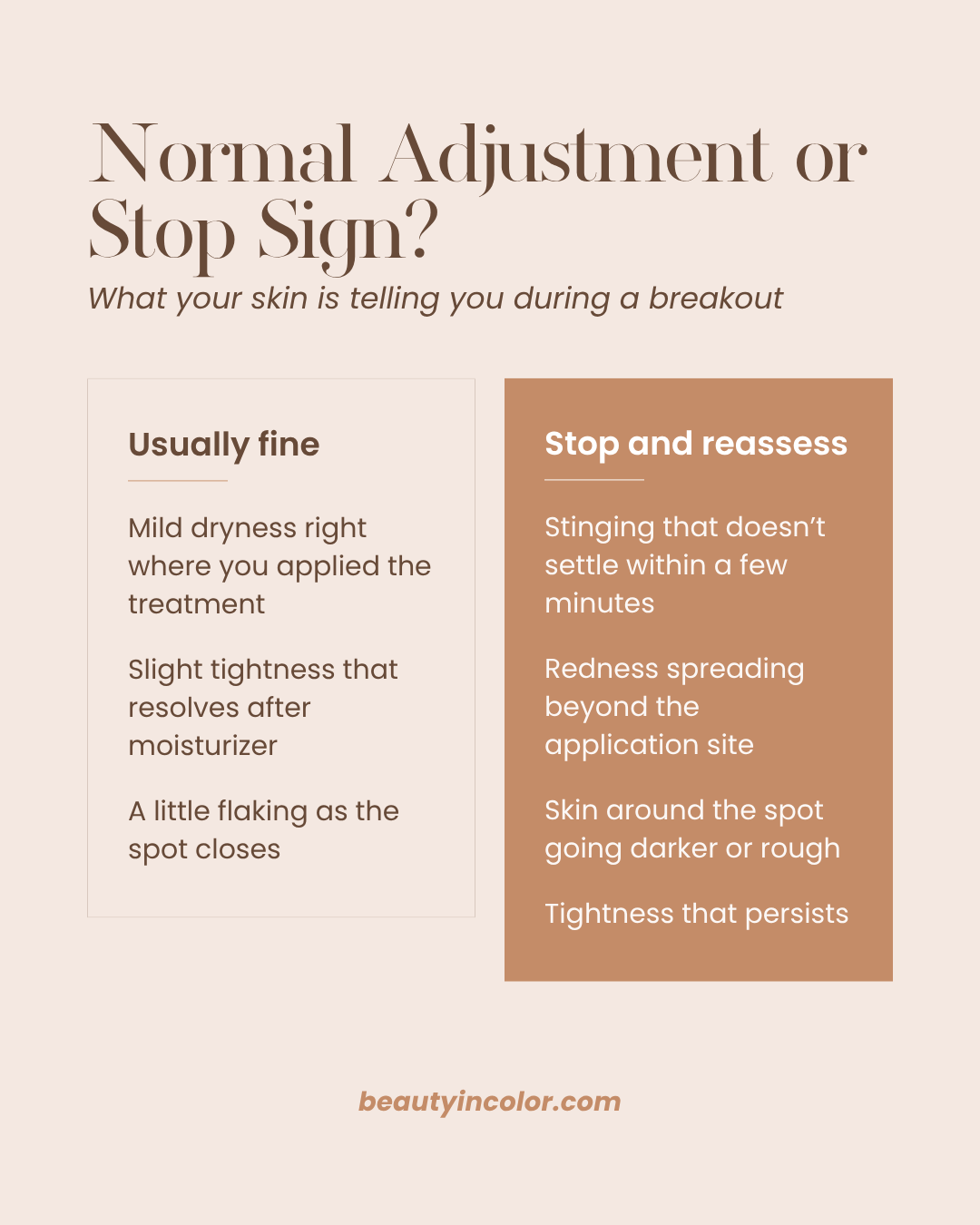
If you’re in the right-hand column, stop the treatment, return to gentle cleansing and hydration, and let things settle. Backing off isn’t lost progress. It’s protecting the progress you have.
4. Skipping sunscreen because the spot is small. The mark is forming while you’re not looking. A week of unprotected mornings can be the difference between a spot that fades quietly and one that sets in. If you want help choosing one that disappears on deeper skin, that’s covered here.
5. Starting a fade routine on an unclosed spot. Pigment correction is a separate job, and it belongs after the skin has healed, not during. When you’re ready for it, the dark spot fade routine is the sequence I’d follow.
When to stop treating it yourself and see a dermatologist
There’s a line where this stops being a routine conversation, and it’s worth naming plainly.
Book an appointment if:
- Your breakouts are deep, painful, or cystic
- They keep returning regardless of what you change
- A spot is changing in size, shape, or color
- A mark is raised, itchy, bleeding, or you simply can’t account for it
The reason to go sooner rather than later with persistent inflammatory acne is specific to us: the longer inflammation runs, the more marks it leaves behind. Waiting it out has a pigment cost.
And to be direct about the limits of this format: nothing on the internet, including me, can identify a mark on your face by looking at it. I’m a skincare educator, not a dermatologist. Getting help isn’t failing at skincare. It’s using the correct tool.
Dana’s Tip: If you’re going to see a dermatologist, photograph the spot in consistent daylight over a couple of weeks before the appointment. Change over time is diagnostic information, and it’s the thing you can’t reconstruct from memory in a fifteen-minute visit.
Go Deeper in the Video
The companion video walks through the first-48-hours protocol in real time and shows what “leave it alone” actually looks like in practice, which is harder to convey in writing than it sounds. I also talk through my own history as a reformed picker and the rule that finally worked, which is less a technique than an admission.
Acne Scars and Dark Marks FAQ
- Are dark spots acne scars?
Usually not. A scar involves a change in texture, meaning the skin is pitted or raised. A flat brown or grey spot left after a pimple is post-inflammatory hyperpigmentation, which is a change in color and typically fades over time. Use the fingertip test: if you can’t feel it, it’s a mark. - How do you get rid of a pimple without scarring?
Leave it closed. Don’t squeeze, don’t extract at home, and don’t dry it out with a harsh treatment. Keep the area clean and comfortable, use sunscreen daily while it heals, and if you want a treatment, use one gentle product your skin already tolerates rather than several at once. - Do pimple patches work?
For keeping your hands off a spot, they work very well, and that’s their most valuable function. For absorbing fluid from a surfaced whitehead, they help. They will not resolve a deep cystic breakout and they don’t prevent pigment on their own. Check whether yours contains actives such as salicylic acid, because many do. - How do you prevent dark spots from pimples?
Minimize inflammation at every stage. Don’t pick, don’t over-treat, wear sunscreen every morning while the spot heals, and keep the rest of your routine unchanged until it closes. Most post-acne marks are driven by how the breakout was handled rather than by the breakout itself. - Can I use vitamin C or a fade product on an active breakout?
Wait until the spot has closed. Pigment correction on broken or inflamed skin adds irritation, and irritation is what deepens the mark. Fading is the next job, not this one. - How long do post-acne marks take to fade?
It varies considerably by depth, by how much inflammation occurred, and by how consistently the area is protected from UV. Older and deeper marks take longer. I’d rather not attach a number to it, because the number people repeat online sets an expectation that makes women abandon a routine that was working.
The Bottom Line
Most post-acne marks are not scars, and that distinction should change how you respond to a breakout. A mark is color, color can fade, and the fastest route to a lighter outcome is protecting the spot rather than attacking it.
The method is unglamorous and it’s free. Hands off. Nothing new in the routine. Sunscreen every morning while it heals. One gentle treatment at most, and only if your skin already knows it. The products come after the protection, not instead of it.
Your skin knows how to heal a breakout. Most of the time, the mark is the interruption, not the pimple.
What To Do Next
- Watch the companion video for the full walkthrough
- If you already have marks you’re working on, start with the dark spot fade routine
- Lock in the sunscreen habit with how to choose one that disappears on deeper skin
- Join Beauty In Your Inbox for the weekly deeper cut
Shop With Me
The products I keep in rotation plus my budget-friendly picks, all in one place.
- Discount codes → https://beautyincolor.com/beauty-discount-codes?utm_source=blog&utm_medium=referral&utm_campaign=v17-breakout
- Beauty In Color Approved → https://beautyincolor.com/beauty-in-color-approved?utm_source=blog&utm_medium=referral&utm_campaign=v17-breakout
- ShopMy, the full edit → https://shopmy.us/shop/beautyincolor
- Amazon budget picks → https://www.amazon.com/shop/beautyincolor_official
Sources
- American Academy of Dermatology. Acne: Diagnosis and treatment
- American Academy of Dermatology. Acne scars: Signs and symptoms
- Davis EC, Callender VD. Postinflammatory hyperpigmentation: a review of the epidemiology, clinical features, and treatment options in skin of color. Journal of Clinical and Aesthetic Dermatology. 2010;3(7):20-31.
- Lawrence E, Al Aboud KM. Postinflammatory Hyperpigmentation. StatPearls. NCBI Bookshelf.