Estimated reading time: 8 minutes
If you keep starting over on your skincare routine, the problem probably was not your routine. It was starting over.
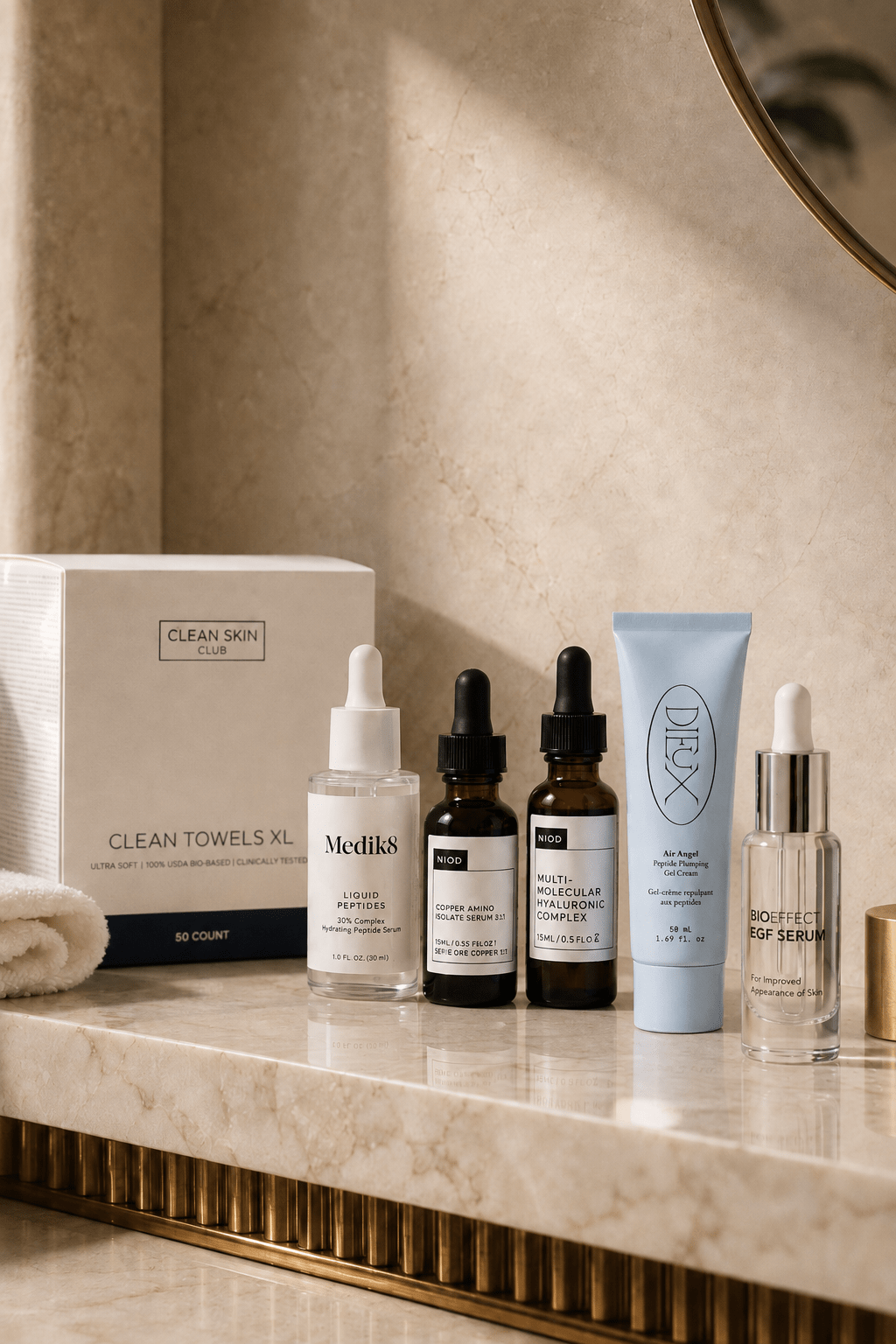
If your skin has not changed the way you hoped, the problem is probably not your products. It is more likely that you keep starting over. A new serum, a fresh two weeks of effort, then life gets busy, and the whole thing quietly falls apart, until the next product promises to be the one. That cycle is the real reason so many routines never pay off.
By the time you finish reading, you will know how long a routine actually needs to work, why the 21-day rule is a myth, and three simple ways to stay consistent long enough to see a difference. None of it requires buying anything new.
In This Post:
- Why does the perfect routine keep failing me?
- How long does skincare take to work?
- Is the 21-day rule real?
- How do I actually stay consistent?
- Why does consistency matter more for melanin-rich skin?
- The most common consistency mistakes
- Go Deeper in the Video
- Consistent Skincare Routine FAQ
- The Bottom Line
- What To Do Next
- Shop With Me
- Sources
Why does the perfect routine keep failing me?
The perfect routine is a moving target, and that is partly by design. There is always a newer active, a better serum, a step you are apparently missing. The steady message is that you are a little behind, which keeps you shopping and, just as often, keeps you quitting. Every time you abandon a routine at week two and start a different one a month later, you reset the clock. Your skin never gets far enough into anything to show you what it can do.
The fix is not a better routine. It is doing the one you already have. If you have not built one yet, that is a separate step, and we walk through it in how to build a skincare routine after 40. This post is about what happens after you have one, and how to keep it.
How long does skincare take to work?
Most skincare needs weeks of steady use before it shows, not days. Your skin renews itself on a cycle, and that cycle slows as you age. In your twenties, it runs roughly a month; by your forties, it can stretch closer to six to eight weeks. Anything you use has to work across more than one of those cycles before the results surface. Many actives can take somewhere in the range of eight to twelve weeks of consistent use to make a visible difference.
Here is a realistic timeline to keep your expectations honest.
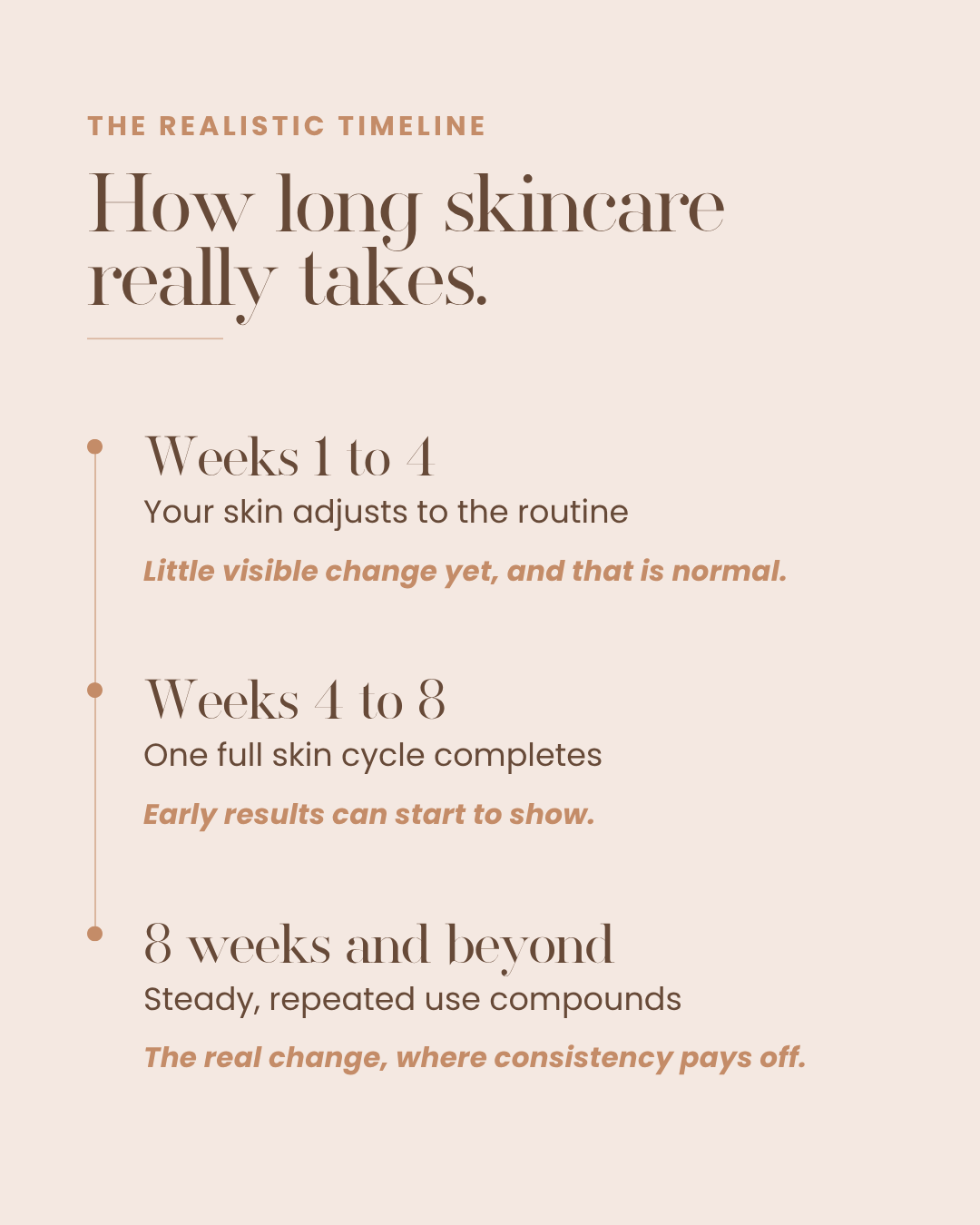
That is the quiet reason consistency wins. The routine that changes your skin is the one you will still be doing two months from now, not the one you ran perfectly for a single week.
Dana’s Tip: Take a plain, well-lit photo the day you commit to a routine, then leave your skin alone for eight weeks before you judge it. Day to day, you will not see change. Next to a photo from two months ago, you might.
Is the 21-day rule real?
The idea that it takes 21 days to form a habit is a myth. It traces back to a plastic surgeon’s book from the 1960s, not to habit research. When researchers at University College London measured how habits actually form, the average was closer to two months, and it varied widely from person to person, with a median around 66 days (Lally et al., 2010).
That does not make 21 days useless. It just is not the finish line. Think of it as the trial. Three weeks is long enough to find out whether a routine fits your life and your skin, and short enough that you will actually commit to it. Start with 21 days, then know that the staying power and the results come after.
How do I actually stay consistent?
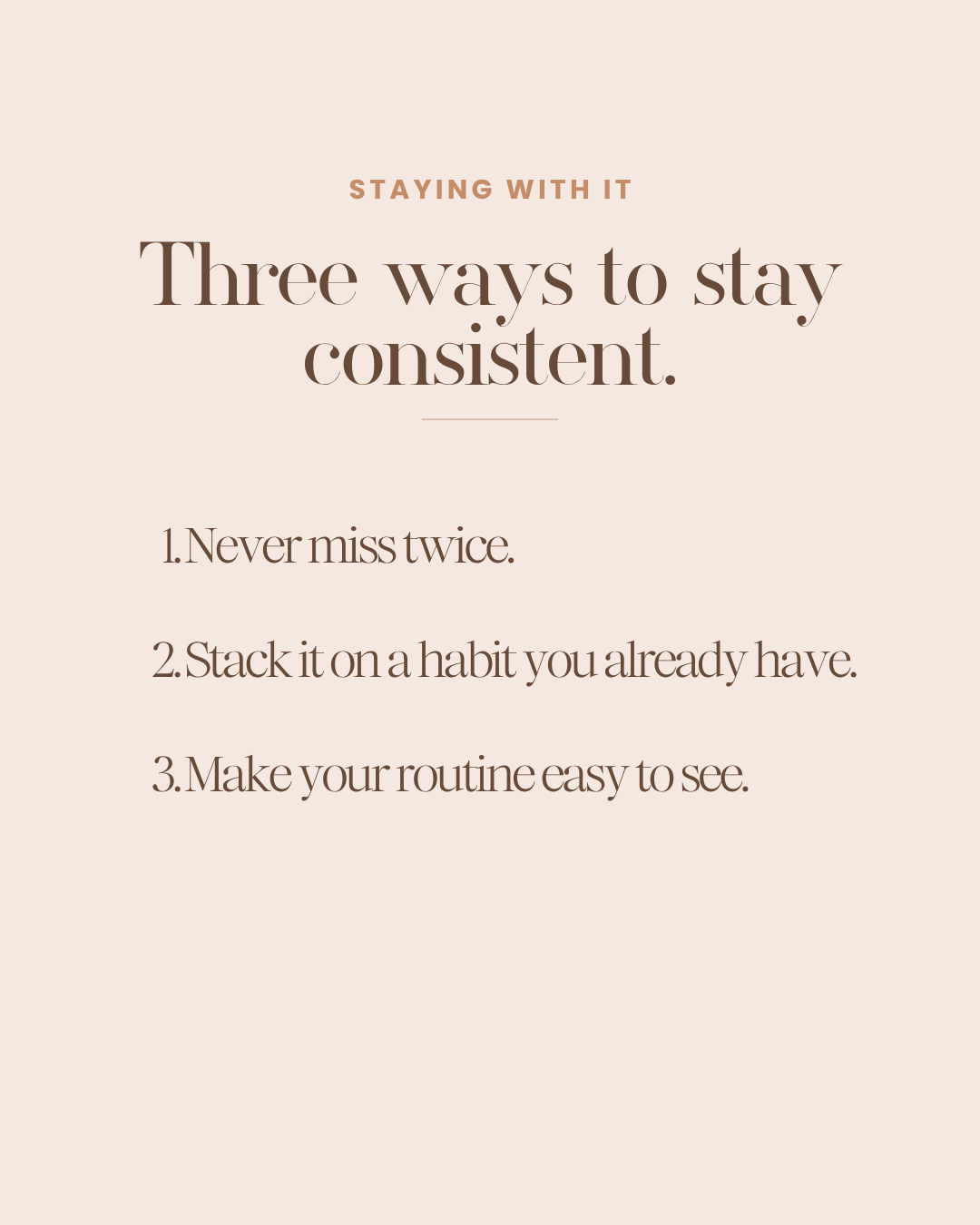
Willpower is not the mechanism, so do not rely on it. Three small changes do more.
1. Never miss twice
You are going to miss a night. You will be tired, you will travel, you will fall asleep in your makeup. One miss does not break anything, and the research supports that a single lapse does not derail a forming habit. What breaks a routine is the spiral after it, the all-or-nothing guilt that turns one skipped evening into a skipped month. Miss once, fine. Just do not miss twice in a row.
Dana’s Tip: Before a busy stretch, decide your one non-negotiable in advance, usually cleanse and moisturize. On the hardest nights, the short version still counts as not missing.
2. Stack it on a habit you already have
You already brush your teeth and take your makeup off every night. Attach your routine to the thing you never skip, so it rides along with something already automatic. You are not adding a new thing to remember. You are hooking it onto an old one.
3. Make your routine easy to see
If your products live in a drawer, behind a door, or in another room, you have added reasons to skip them at 11pm. Put them where you can see and reach them. Lowering the friction does more than motivation does.
Why does consistency matter more for melanin-rich skin?
When our skin gets irritated, it can mark. A breakout, a bug bite, a product that stung, and a brown spot can linger long after the thing that caused it is gone. That is post-inflammatory hyperpigmentation, or PIH, and in darker skin tones it tends to be more stubborn and slower to fade. We cover why that happens in dark spots in Black skin. The piece that matters here is simple: because those marks re-trigger easily and take patience to fade, the stop-start cycle works against you.
A steady, patient routine is what gives pigmentation the long, quiet stretch it needs. There is one more layer for reactive, barrier-prone skin: every time you switch products, your skin has to tolerate a brand-new set of ingredients, and each new product is another variable it may react to. Steady and simple is not the boring choice. For many of us, it is the protective one.
The most common consistency mistakes
Four mistakes keep people restarting, and each one looks like effort.
- Trying to buy your way out. A new product cannot fix a habit gap. No bottle does the showing up for you.
- Chasing the perfect routine instead of running a good-enough one. Good-enough and done beats perfect and abandoned.
- Switching products too soon. If you swap at week two, you quit before the first round of results could even show up.
- The all-or-nothing quit. One missed night is nothing. Quitting because of it is the actual problem.
Go Deeper in the Video
In the video, I talk through the savings-account way of thinking about your skin out loud, and I show what a right-sized routine actually looks like on a normal, tired weeknight. If the hard part for you is picturing how to do less but keep it going, the video is where that clicks.
Consistent Skincare Routine FAQ
- How long before I see results from a new routine?
Give it about two months of steady use. Skin renews on a cycle that slows with age, so most changes need more than one cycle to surface. - Is it bad to skip a day?
No. One missed night does not undo your progress. The rule that helps is never miss twice in a row. - Do I need a longer routine to see change?
Not necessarily. The best routine is the one you will actually keep, whether that is four steps or eight. Find the right size for you and stay with it. - My skin is eczema-prone. Should I keep it minimal?
Many people with reactive skin do better with fewer, gentler steps, but that is a personal call, not a universal rule. If your skin flares easily, patience and consistency tend to matter even more.
The Bottom Line
The answer was never another product. It is showing up. A right-sized routine, the same few steps, done consistently for at least two months, is what changes your skin. You will not see it day to day. You will see it over time, the way you notice savings grow.
Pick the routine you can keep on your most tired night, and protect it with the never-miss-twice rule. That single habit will do more for your skin than any upgrade.
What To Do Next
- Watch the companion video for the full lesson: Why Consistency Beats the Perfect Skincare Routine.
- Browse my skincare edit, organized by where each product fits, when you are ready to fill a gap.
- Join the newsletter for one practical skincare lesson each week.
Shop With Me
The products I keep in rotation plus my budget-friendly picks, all in one place.
- Discount codes: beautyincolor.com/beauty-discount-codes
- ShopMy edit: shopmy.us/shop/beautyincolor
- Amazon budget picks: amazon.com/shop/beautyincolor_official
Sources
- Lally, P., van Jaarsveld, C. H. M., Potts, H. W. W., and Wardle, J. (2010). How are habits formed: Modeling habit formation in the real world. European Journal of Social Psychology, 40(6), 998 to 1009. https://onlinelibrary.wiley.com/doi/10.1002/ejsp.674
- Davis, E. C., and Callender, V. D. (2010). Postinflammatory hyperpigmentation: a review of the epidemiology, clinical features, and treatment options in skin of color. Journal of Clinical and Aesthetic Dermatology, 3(7), 20 to 31. https://pmc.ncbi.nlm.nih.gov/articles/PMC2921758/
- Grove, G. L., and Kligman, A. M. (1983). Age-associated changes in human epidermal cell renewal. Journal of Gerontology, 38(2), 137 to 142. https://pubmed.ncbi.nlm.nih.gov/6827031/